
Industry Category Guides: How to Compare Equipment Segments Before You Shortlist Suppliers
Choosing among heavy industrial systems is rarely a simple feature match. In packaging and furniture production, equipment segments define process flow, quality stability, labor structure, and future expansion paths.
That is why strong industry category guides matter before any supplier shortlist is built. They help separate machines that look comparable on paper from systems designed for very different operating realities.
Within the PWFS view of global paper and wood manufacturing, this comparison task has become more urgent. E-commerce packaging demand is rising, visual packaging standards are tightening, and custom furniture production is moving toward faster digital execution.
A useful comparison starts with production logic, not brand names. Corrugated board lines, offset presses, die-cutting and folder-gluer systems, CNC routers, and edge banders each solve different bottlenecks, even when they serve adjacent factories.
Start with the process, not the machine label
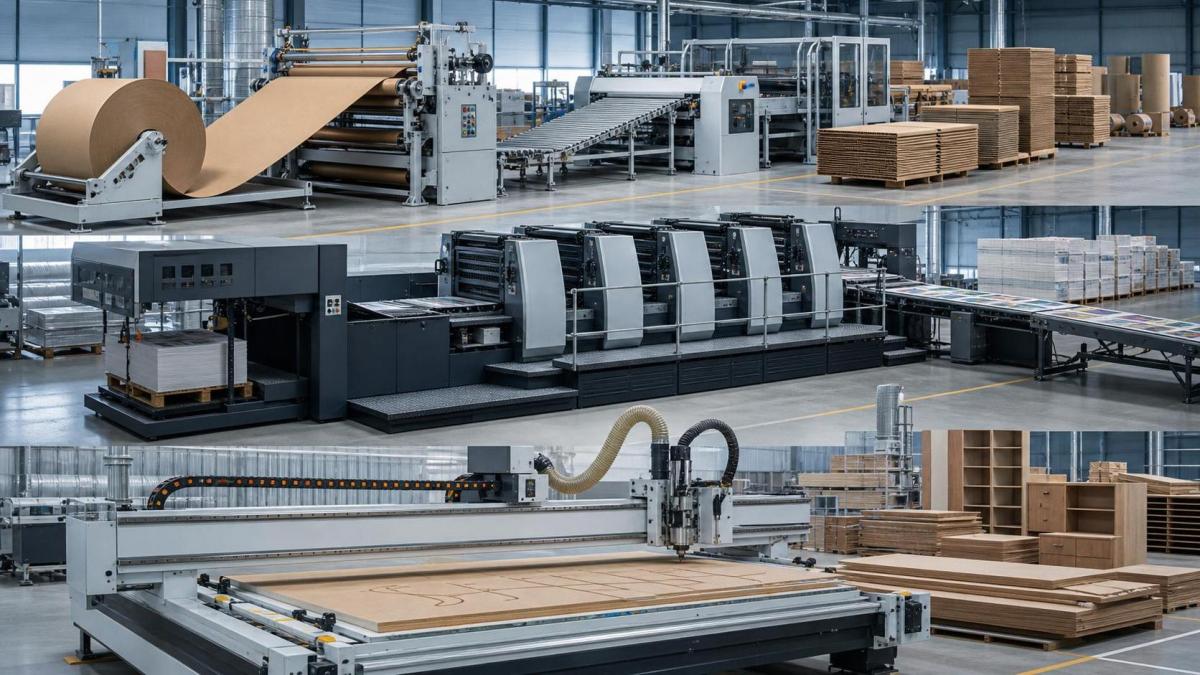
Many industry category guides fail because they compare equipment as isolated assets. In practice, every segment sits inside a chain of material transformation, timing, tolerances, and downstream dependency.
Corrugated board lines convert paper rolls into structural packaging material. Offset presses transform surfaces into sales-driven visuals. Die-cutters and folder-gluers convert printed sheets into finished cartons. CNC woodworking routers convert design files into physical components.
Edge banders complete a different but equally critical step. They protect panel quality, visual consistency, and environmental performance at the exposed edge, where furniture value can rise or fall quickly.
This means comparison should begin with one question: where does value actually emerge in the line? If a process creates structural strength, visual precision, geometric conversion, or flexible customization, the equipment should be judged against that core role.
Why segment comparison now carries more weight
The industrial environment has changed. Buyers are no longer choosing only for current output. They are choosing for volatility, compliance pressure, labor scarcity, and shorter delivery windows.
In corrugated packaging, throughput alone is not enough. Board consistency, flute quality, steam control, and energy efficiency now affect both shipping protection and cost recovery.
In printing, premium packaging has pushed tighter expectations around register accuracy, color repeatability, and substrate adaptability. A fast press with unstable color behavior can create expensive waste faster than a slower, better-controlled system.
Furniture production has its own shift. Whole-house customization depends on software connectivity, nesting efficiency, chip removal behavior, and seamless transfer from design to machining to finishing.
This is where industry category guides become practical tools rather than editorial content. They frame how to compare segments under real operating pressure, not under showroom conditions.
What to compare across the main equipment segments
Cross-segment comparison works best when the same decision lenses are used. The exact metrics change, but the structure of evaluation can stay consistent.
The advantage of this structure is clarity. It keeps supplier comparison tied to process outcomes rather than feature lists that look impressive but say little about operational fit.
Automation fit often matters more than peak speed
A recurring mistake in industry category guides is overvaluing top speed. Peak capacity only matters if upstream inputs, downstream handling, and control systems can sustain it.
A corrugator may advertise aggressive line speed, but paper moisture variation, glue behavior, and stacker coordination can still limit usable output. The same logic applies to printing and carton converting.
In woodworking, router speed can look attractive until tool wear, dust extraction, nesting logic, or barcode-based job transfer interrupts flow. Effective automation is usually a balance of motion, data, and recovery time.
PWFS places strong emphasis on this broader view. Its intelligence perspective connects machine physics with digital manufacturing systems, including MES, traceability, and flexible production control.
That matters because the best segment choice is often the one that reduces friction across shifts, materials, and order types. A machine that integrates cleanly can outperform a technically stronger machine that stays isolated.
Useful signs of automation readiness
- Stable data exchange with design, planning, or prepress systems
- Recipe management for repeat jobs and faster setup
- Clear fault diagnosis and remote support capability
- Material tracking for compliance, waste control, and yield analysis
- Operator interfaces that shorten training rather than deepen dependence
Quality standards are segment-specific, but the logic is similar
Quality should not be treated as a generic promise. Each category has its own definition of what “good” looks like, and those definitions affect supplier screening early.
For offset presses, micron-level register behavior, ink-water balance, and consistency across long runs matter. In printed packaging, attractive samples are less meaningful than repeatable production under commercial speed.
For die-cutters, quality includes cutting cleanliness, pressure balance, blank separation, and folding precision. In pharmaceuticals, cosmetics, or tobacco packaging, geometry errors can quickly become downstream packing problems.
For woodworking, surface damage, hole position accuracy, edge integrity, and adhesive performance matter together. A clean cut is not enough if later assembly or indoor environmental standards are compromised.
PWFS also highlights compliance signals that should influence segment comparison. FSC traceability, food-grade ink migration requirements, and eco-focused sealing methods are no longer side issues in many export-facing operations.
How to build a smarter shortlist of suppliers
Good industry category guides do not stop at explaining segments. They create a shortlist method that screens suppliers by relevance before deeper technical meetings begin.
A practical shortlist usually starts with four filters: product mix, required tolerance, automation depth, and acceptable payback horizon. These filters quickly remove suppliers that are technically capable but commercially mismatched.
Then compare supplier evidence, not claims. Look for running references in similar applications, uptime discipline, changeover performance, software support quality, and parts availability in the target region.
It also helps to request examples of problem handling. A supplier that can explain how it manages warp, register drift, chip evacuation, adhesive instability, or reject spikes often reveals more than a polished brochure.
Questions worth carrying into the next review round
- Which process variable most often limits stable output in this segment?
- How does the system behave when material quality changes?
- What portion of quoted speed is usable in normal production?
- Which data interfaces are standard, and which are custom work?
- What quality indicators are measured continuously, not only during setup?
Where to go after the first comparison
Once the main segments are understood, the next step is to turn industry category guides into a decision framework. That means ranking process risks, not just machine attractions.
A strong review path connects output goals, quality thresholds, digital integration needs, and compliance requirements. It should also reflect whether the operation depends on long runs, mixed SKUs, premium packaging, or mass customization.
In the PWFS context, the most useful comparisons bridge machine mechanics with strategic manufacturing logic. That includes yield rates, flexible automation, traceability, and the ability to scale without rebuilding the entire production philosophy.
From there, shortlisting becomes more disciplined. Segment by segment, supplier by supplier, the goal is simple: choose equipment categories that fit the production model first, then identify the suppliers most likely to execute that fit well.
Related News
Get weekly intelligence in your inbox.
No noise. No sponsored content. Pure intelligence.
