
Which Corrugated Board Grades Protect Heavy Products Without Overpackaging?
Which Corrugated Board Grades Protect Heavy Products Without Overpackaging?
When a heavy product arrives damaged, the first reaction is often to specify a heavier box. That is understandable—and frequently wrong. Adding paper weight can improve performance, but it can also raise material cost, slow converting, make folding less reliable, and still fail to address the real weak point: a poor load path, inadequate internal restraint, humid storage, or a box footprint that is simply too large for the product.
For project managers responsible for packaging changes, the question is not “what is the strongest corrugated board?” It is: which corrugated board grades provide enough compression, puncture resistance, cushioning, and handling durability for this product’s actual distribution route? The answer normally sits at the intersection of product mass, dimensions, centre of gravity, stacking height, warehouse conditions, transport mode, and box construction.
A compact metal component, a boxed furniture fitting, a small appliance, and a CNC-machined wood panel may weigh the same, yet they create very different packaging demands. One may threaten to puncture a sidewall; another may crush corners during pallet stacking; another may move inside the box and repeatedly load the same panel. Selecting corrugated board grades therefore requires looking beyond nominal “single-wall” or “double-wall” labels.
Start With the Failure Mode, Not the Board Description
Heavy-product packaging usually fails in a limited number of ways. The useful early question is: what does failure look like at the receiving end?
- Panel bulging or box collapse: usually points to insufficient compression strength, excessive stacking load, poor box proportions, or weakened board exposed to humidity.
- Corner crushing: may result from impact, weak vertical edges, inadequate closure design, or pallet overhang.
- Punctures and tears: are common with dense parts, sharp-edged metal assemblies, castings, hardware packs, or products that shift in transit.
- Bottom-panel failure: is often a design and sealing issue as much as a board issue. Tape pattern, flap overlap, glue performance, and product orientation all matter.
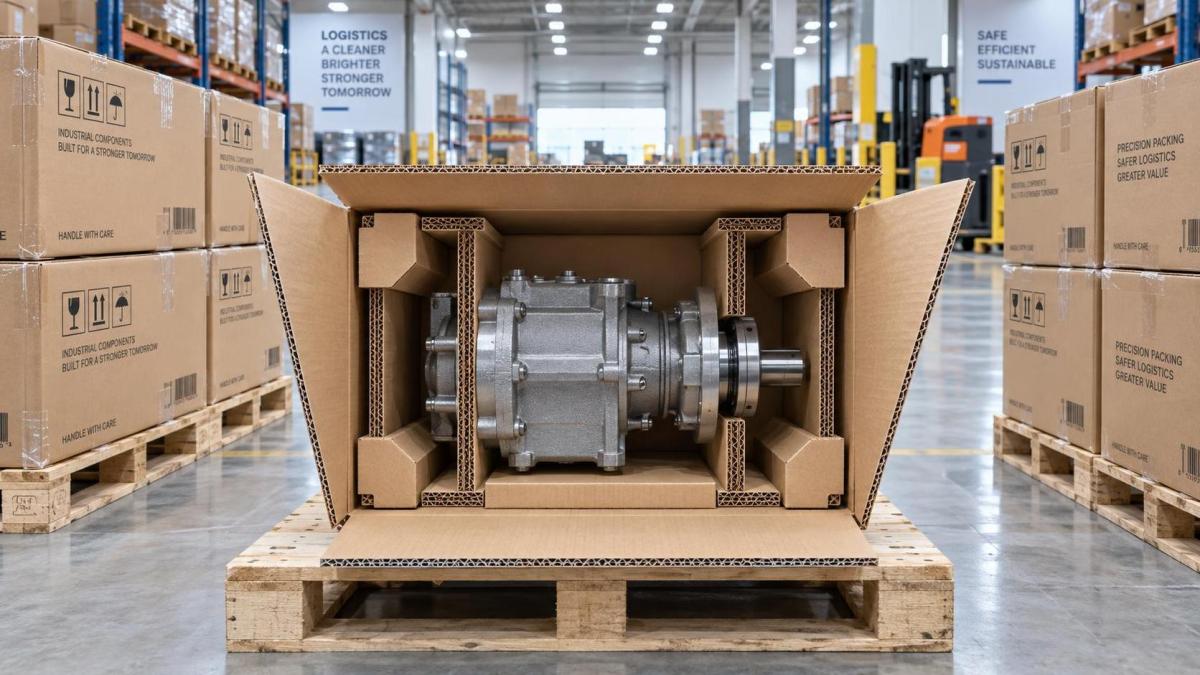
- Damage despite an intact carton: generally means the board grade is not the principal problem; internal blocking, cushioning, or immobilization needs attention.
This distinction prevents a familiar mistake: moving from a standard single-wall board directly to a heavy double-wall grade when the actual issue is an unrestrained product. A heavier carton cannot stop a gearbox, stone sample, or furniture hardware bundle from building momentum inside the pack. It only makes the outer shell more expensive while the impact continues.
What “Grade” Really Means in Heavy-Duty Corrugated Packaging
The term corrugated board grades is used broadly in procurement conversations. It can refer to wall construction, flute profile, liner quality, paper basis weight, compression-related performance measures, or regional board specifications. These are related, but they are not interchangeable.
A corrugated sheet is built from liners and one or more fluted mediums. The liners provide much of the surface durability and contribute to bending and compression behaviour. The fluted medium creates separation between liners, giving the structure stiffness and cushioning. In practical terms, a board specification should tell the team more than “B flute” or “double wall.” It should identify the construction and the performance requirement relevant to the pack.
In many markets, teams discuss edge crush performance, burst strength, or paper composition. Each measure offers a different lens. Edge crush performance is particularly relevant to stacking because it relates to the vertical strength of the corrugated structure. Burst resistance can be useful where rough handling and surface rupture are concerns, but it should not be treated as a direct substitute for stacking performance. A board can resist a burst test yet still be a poor choice for a tall warehouse stack.
The correct test method and acceptance level depend on the local supply chain, customer requirement, and applicable packaging specification. A project team should avoid copying a number from a legacy carton unless the product weight, dimensions, storage conditions, and pallet configuration are genuinely comparable.
Single Wall, Double Wall, or Triple Wall: Where Each Has a Place
Single-wall corrugated board remains suitable for many heavy products, especially where the product is compact, well supported internally, and not exposed to long-duration stacking. It is often the sensible choice for dense spare parts packed in smaller footprints, provided the bottom closure and internal fit are properly engineered. A compact carton can perform surprisingly well because its panels are shorter and less prone to buckling.
Double-wall board is usually the first serious upgrade when package dimensions increase, unit loads become more demanding, or supply chains include multi-stage handling. Combining flute profiles can balance cushioning, stiffness, print surface quality, and crush resistance. It is common in larger industrial cartons, furniture components, heavier appliance parts, and multi-pack shipments where the carton itself must carry significant stacking loads.
Triple-wall board belongs in a narrower category: very heavy items, large-format industrial packs, export units with demanding logistics, or situations where corrugated is replacing a lighter wooden crate design. It can be highly capable, but it is not a universal “safe” answer. It changes die-cutting behaviour, folding force, storage volume, pallet weights, and often the economics of converting. If the product only needs local reinforcement at the base or corners, full triple-wall construction may be overpackaging.
Flute Selection Is a Structural Decision
Flutes are not merely a thickness choice. Larger flutes generally provide more cushioning and separation between liners, while finer flutes can offer a flatter surface and better resistance to certain handling stresses. In heavy-duty packaging, combined flute structures are often used because one flute alone may not deliver the desired balance.
For example, a heavy product that must survive conveyor handling and repeated warehouse touches may need a robust outer surface as well as vertical stacking strength. A carton carrying printed instructions, branding, barcodes, or traceability labels may also need a printable face that remains readable after converting and transport. This is where board selection begins to connect with the wider packaging line: printing, die-cutting, creasing, folding, and gluing all influence final pack reliability.
At PWFS, the connection between board making and converting is particularly relevant. A corrugator can produce a board that looks strong on paper, yet downstream performance may suffer if moisture control, warp, score quality, die-cut accuracy, or adhesive application is inconsistent. A packaging specification should therefore be reviewed with both the board supplier and the converting operation, rather than being treated as a purchasing-line item alone.
The Box Design Can Save More Material Than a Grade Upgrade
There are several ways to improve heavy-product protection before increasing board weight. Reducing unused headspace is one of the most effective. Large empty areas invite panel deflection and product movement. A closer-fitting carton, especially around the base, may allow a lower-grade board to perform better than an oversized carton made from heavier material.
Product orientation matters too. Where possible, place the strongest or broadest product face toward the base, and avoid concentrating load onto a small unsupported area. For irregular parts, use pads, partitions, folded corrugated inserts, or purpose-designed blocking to spread point loads. If a sharp edge contacts the wall during transport, a small protective pad can be more valuable than upgrading every square metre of the carton.
Closure design deserves the same attention. Heavy packs may require an appropriate tape configuration, reinforced sealing, or a glued construction designed for the actual load direction. It is not unusual to see a board blamed for a bottom failure when the carton was sealed for a light consumer product rather than a dense industrial item. The closure is part of the structural system.
Humidity Is the Quiet Variable That Invalidates Good Specifications
Corrugated fibreboard is sensitive to moisture. A grade that performs acceptably in a dry test environment may lose practical stiffness after exposure to humid warehouses, sea freight conditions, rain during unloading, or long dwell times near open loading bays. This does not automatically mean corrugated is unsuitable. It means the environmental route must be part of the specification.
For export projects, ask where the pallet will wait, whether containers may experience condensation, how long the shipment is likely to remain stacked, and whether the outer pack is expected to be reused. Water-resistant treatments, stronger liners, protective wraps, pallet covers, or a revised logistics process may be appropriate depending on the risk. These choices should be validated against recyclability requirements and destination-market expectations rather than added by default.
A Practical Specification Path for Project Teams
The most reliable way to select corrugated board grades is to build the brief around the complete unit load. Record the product weight and dimensions, but also capture centre of gravity, sharp edges, allowable movement, pack quantity, pallet pattern, stack height, handling method, storage duration, and route conditions. Include whether the shipment moves through parcel networks, forklift handling, automated conveyors, mixed pallets, or overseas containers. Each route creates a different damage profile.
Then compare two or three realistic constructions rather than approving one board immediately. One option may use stronger liners in a single-wall structure with better internal fit. Another may use double wall but remove unnecessary void fill. A third may add base pads and corner protection while keeping the main carton lighter. The decision should account for material cost, converting complexity, pack-out speed, dimensional efficiency, and damage exposure together.
Testing should mirror the risks that matter. Compression assessment is relevant for stacked loads; drop and impact evaluation matter for manual or parcel handling; vibration assessment may matter for long road movement. The exact test program, conditioning requirements, and acceptance criteria should be agreed with the relevant supplier, customer, and applicable standard or contractual requirement. Laboratory results are useful, but a pilot shipment often reveals issues that a controlled test does not—especially around loading discipline, pallet restraint, and warehouse practices.
Avoid the “Heaviest Board Wins” Procurement Habit
Overpackaging is not only an unnecessary materials issue. It can create operational problems: heavier blanks are harder to run efficiently, excessive stiffness can complicate folding, larger wall thickness can affect pallet cube, and an oversized carton can encourage poor manual handling. In a high-volume operation, those secondary effects deserve attention.
The strongest specification is not necessarily the best specification. The better choice is the lightest board-and-design combination that remains stable across the real distribution environment, with enough margin for normal variation in board, converting, and handling. That margin should be deliberate—not an assumption hidden inside a vague request for “heavy-duty corrugated.”
Before releasing a new carton, ask one final practical question: if the product is stacked, dampened by the route, turned by a handler, and held at its weakest closure, where does the load go? If the project team can answer that clearly, it is usually much closer to the right corrugated solution than a team choosing by board thickness alone.
Related News
Get weekly intelligence in your inbox.
No noise. No sponsored content. Pure intelligence.
