
Custom Furniture Production: Which CNC and Edge Banding Setup Fits Your Product Mix?
When product mix changes, the best custom furniture setup changes too
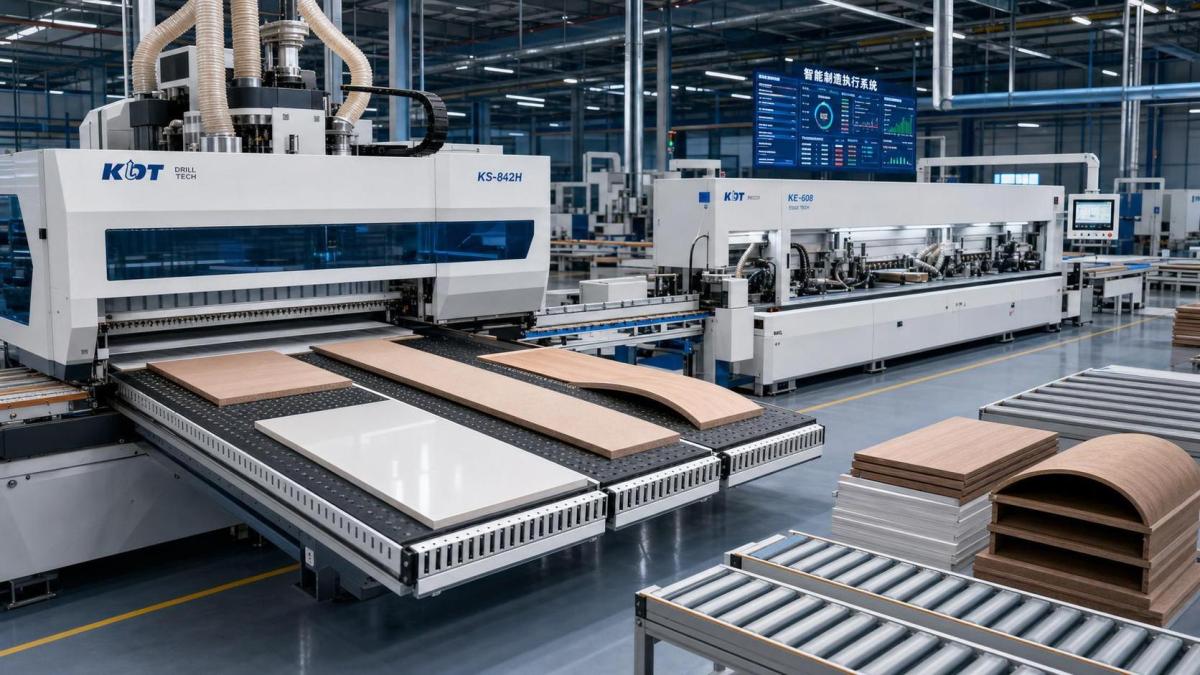
In custom furniture production, machine choice is rarely about headline speed alone.
The real question is how CNC routing and edge banding behave under a mixed order book.
A workshop cutting wardrobes, vanities, desks, and retail fixtures faces very different constraints every week.
Panel material changes, hole patterns shift, finishes vary, and delivery promises tighten without warning.
That is why the right custom furniture line is a matching exercise, not a catalog exercise.
PWFS often frames this through the same industrial logic used across paper and wood converting systems.
Micron-level printing registration and high-speed corrugated flow both depend on stable process control.
Custom furniture follows the same rule: precision, digital continuity, and repeatability drive margins.
A CNC and edge banding setup should therefore fit the production rhythm behind the products, not just the products themselves.
Different jobs create different decision points on the shop floor
Two factories may both say they produce custom furniture, yet their equipment priorities can be opposite.
One may run repeat cabinet programs all day with limited décor variation.
Another may switch between melamine, plywood, lacquered panels, and compact boards within one shift.
The first values flow and low touch time.
The second needs tolerance stability during constant changeovers.
In practice, four variables usually decide the custom furniture configuration.
- Product geometry: straight panels behave differently from curved, angled, or nested parts.
- Material behavior: MDF, particleboard, plywood, acrylic-faced board, and moisture-resistant panels cut and seal differently.
- Order structure: one-off designs require another logic than repeat batches or semi-standard programs.
- Downstream expectations: visible edge quality, moisture resistance, and installation accuracy all affect machine choice.
Ignoring one of these variables is where many custom furniture investments start drifting off target.
For cabinet-heavy custom furniture, flow often matters more than maximum complexity
When the product mix leans toward kitchens, wardrobes, and storage walls, most parts are rectangular.
Drilling density is high, but geometry is predictable.
Here, a nested-based CNC with automatic labeling, loading, and optimized drilling often delivers the best balance.
The key is not only spindle power.
It is the reliability of tool change, vacuum hold, panel identification, and CAD-to-machine data transfer.
For edge banding, this product mix usually benefits from a fast straight-edge machine with pre-milling.
If the boards arrive with slight dimensional variation, pre-milling protects final edge appearance.
That matters on white cabinets, matte finishes, and slim dark edge tapes where defects show immediately.
A common mistake is choosing a very advanced five-axis CNC for mostly standard cabinet work.
In many cases, the real bottleneck sits at labeling, sorting, or edge banding throughput instead.
Mixed residential projects usually need flexibility in more places than expected
Whole-house custom furniture rarely behaves like a simple cabinet line.
One order may combine closet internals, bathroom units, open shelving, wall panels, and decorative niches.
The machining challenge spreads beyond cutting speed.
Part orientation, grain direction, special connectors, and visible-edge logic all become more important.
This is where a more flexible CNC architecture starts making sense.
A machining center with aggregate capability, horizontal drilling support, and strong software nesting control can reduce manual exceptions.
On the edge banding side, PUR becomes more attractive when moisture exposure, premium finishes, or narrow radii enter the mix.
Laser edge banding may also fit high-appearance custom furniture, but only when panel quality and tape consistency are tightly controlled.
In this scenario, line stability depends as much on digital discipline as on machine hardware.
PWFS repeatedly highlights this across converting industries: automation works best when data quality is clean from the front end.
A quick comparison of common product-mix situations
The table matters because custom furniture profitability often disappears in the mismatch between actual work and chosen automation logic.
Retail fixtures and specialty pieces change the machining conversation
Some custom furniture operations also produce branded interiors, reception counters, or short-run display furniture.
These jobs look similar to residential pieces at first glance, but production behavior is different.
There are more contours, more mixed substrates, and more visible detailing under compressed delivery windows.
A CNC with better contouring control, stronger dust extraction, and stable hold-down on smaller parts becomes more valuable here.
Edge banding also becomes less standardized.
Thin PVC on one job and thick ABS on the next can change pressure, feed, and trimming behavior.
More common than expected is the need to protect decorative laminates from heat marks or glue squeeze-out.
In other words, this custom furniture segment rewards quick adjustability more than nominal output speed.
The edge banding choice should follow finish risk, not only adhesive preference
Many discussions reduce edge banding to EVA versus PUR versus laser.
That is too narrow for custom furniture planning.
The better question is what kind of finish risk the product mix can tolerate.
EVA still works well for stable, cost-sensitive, indoor applications with predictable materials.
PUR suits custom furniture that faces humidity, higher wash-down exposure, or premium appearance requirements.
Laser or zero-joint approaches fit premium lines, but only if the entire process chain is controlled.
That includes panel squareness, tape quality, climate stability, and consistent feed behavior.
If upstream cutting varies, the edge bander will only reveal the problem faster.
This is similar to high-precision printing logic in PWFS coverage.
A premium visual result comes from system discipline, not one premium module alone.
Where custom furniture investments are often misjudged
The most common misread is focusing on peak machine specification while ignoring order volatility.
A second misread is treating all panel furniture as one production category.
Visible bathroom cabinetry, utility storage, and retail display panels do not carry the same finish risk.
Another overlooked factor is rework routing.
If one wrong label forces parts back through nesting, drilling, edging, and sorting, capacity drops quickly.
- Do not size the CNC only by spindle horsepower; check data flow, clamps, vacuum zoning, and tool strategy.
- Do not choose edge banding only by glue type; confirm cleaning workload, warm-up behavior, and tape compatibility.
- Do not assume future product mix will stay narrow; many custom furniture shops broaden faster than planned.
- Do not separate quality from throughput; unstable machining always returns later as edging or installation trouble.
A practical way to match CNC and edge banding before expansion
A useful approach is to map the next twelve months by part behavior, not by sales category.
Group parts by drilling density, contour complexity, visible-edge share, board material, and rework sensitivity.
That usually reveals whether the custom furniture mix is really flow-driven, finish-driven, or changeover-driven.
Then compare three layers together: machine capability, software continuity, and operator intervention points.
If those layers do not align, technical upgrades will not translate into cleaner delivery performance.
For many custom furniture operations, the strongest setup is not the most elaborate one.
It is the line that keeps cut quality, edge appearance, and data traceability stable across changing orders.
That is also where PWFS intelligence is most useful: connecting machine physics, production logic, and long-term flexibility.
The next step is straightforward.
List the real product mix, identify the finish risks, and test whether the planned CNC and edge banding combination supports both today’s orders and tomorrow’s variation.
Related News
Get weekly intelligence in your inbox.
No noise. No sponsored content. Pure intelligence.
