
Edge Banding Materials Market: Demand Shifts for PVC, ABS, Veneer, and PUR
Edge Banding Materials Market: Demand Shifts for PVC, ABS, Veneer, and PUR
The edge banding materials market is changing because the edge of a panel is no longer treated as a minor finishing detail. For furniture manufacturers, cabinet shops, and whole-house customization businesses, it affects visual consistency, durability, machining speed, emissions documentation, and the perceived value of the finished interior. For distributors and furniture-system partners, this shift changes what should be stocked deeply, what should be supplied on demand, and which technical questions need to be answered before a roll reaches a customer.
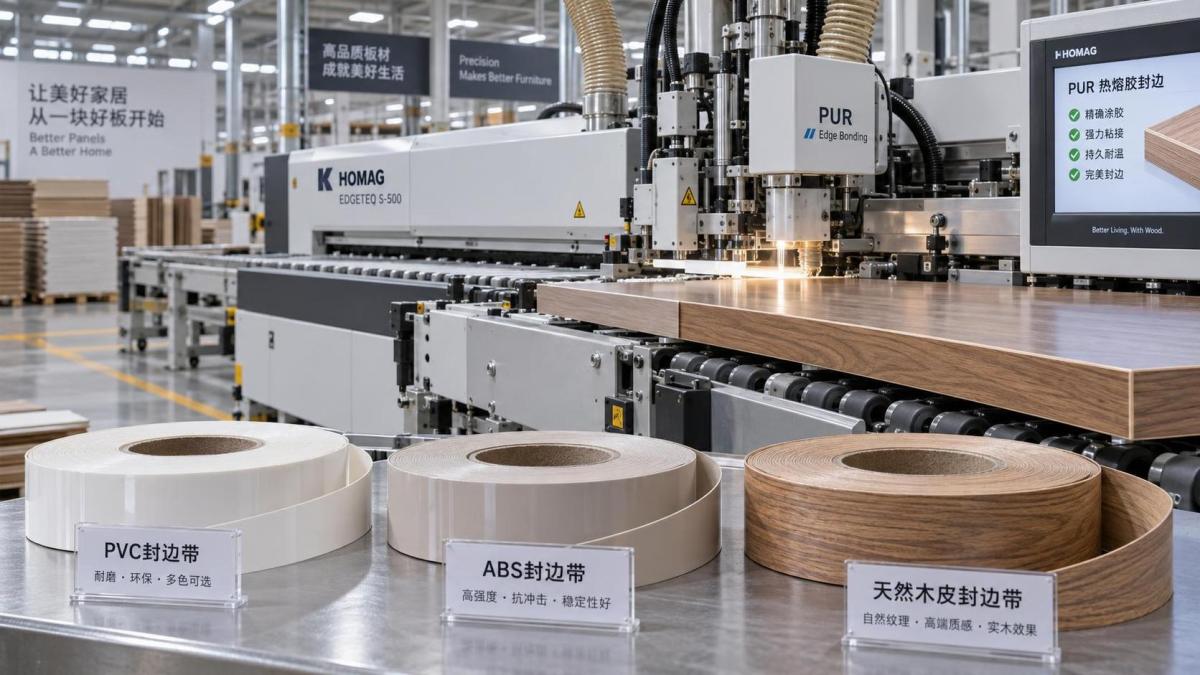
PVC remains widely used because it is familiar, economical, and versatile across a broad range of decorative papers, melamine boards, and standard cabinet applications. ABS is gaining attention where buyers seek an alternative with different material positioning and, in some projects, a more favorable environmental narrative. Veneer edging continues to matter where real wood character is central to the design language. Meanwhile, PUR-compatible edging systems are influencing material decisions not because PUR is an edge-band substrate, but because adhesive performance increasingly determines whether a selected edge solution can survive moisture, heat, cleaning routines, and demanding use conditions.
The practical question is not which material is universally superior. It is whether the band, board, adhesive, machine setup, and end-use environment form a reliable system.
Why demand is becoming more segmented
The old purchasing logic was straightforward: match the board décor, select a common width and thickness, then compete on roll price. That logic still applies to high-volume standard furniture, but it is less adequate for customized interiors. A kitchen door, retail fixture, office workstation, wardrobe carcass, and bathroom cabinet may use similar panel substrates while requiring very different edge performance.
Shorter production runs are another force behind the change. CNC-driven panel processing has made it easier to produce highly varied cabinet components from digital design files. Yet this flexibility creates pressure downstream: distributors must support more décors, textures, thicknesses, and edge profiles without allowing their inventory to become an unmanageable collection of slow-moving rolls. The edge banding materials market is therefore moving toward a split model—high-turn standard items held locally, supported by a more controlled program for special finishes and project-specific requirements.
This is especially visible in whole-house customization. A customer may expect a matte wardrobe front, a synchronized woodgrain kitchen panel, and a moisture-exposed vanity to look coherent within one interior scheme. The visible edge must match not only color, but also gloss, texture, radius, and tactile character. A technically acceptable mismatch can still be rejected by the end user when light catches the panel edge differently from the face.
PVC still anchors volume demand, but not every application
PVC edge banding remains a core category in many distribution portfolios. It is available in a wide decorative range, can be supplied in multiple thicknesses, and generally works well with common edge banding equipment when the band and adhesive are properly matched. It remains particularly relevant for cost-sensitive cabinet production, ready-to-assemble furniture, commercial fixtures, and general panel processing where visual and mechanical requirements are well understood.
Its continuing strength is operational as much as material-based. Customers know how to trim it, scrape it, polish it, and match it to familiar board programs. A distributor that can consistently supply matching colours, stable dimensions, and clear machine-processing guidance often delivers more value than one simply offering the lowest-priced alternative.
However, PVC should not be sold as a universal answer. Projects with specific material restrictions, internal environmental policies, export-market expectations, or demanding surface requirements may call for other options. Requirements vary by location and project, so distributors should avoid broad compliance claims without reviewing the relevant customer specification, material declaration, and applicable local rules.
ABS demand is tied to specification discipline, not fashion alone
ABS edge banding is often positioned as a premium or alternative thermoplastic option. In real distribution work, its value depends on whether the customer has a reason to specify it: a project brief, a corporate material preference, a particular market expectation, or a need to align with an established supplier program. It should be evaluated on processing behavior, finish quality, available décor range, mechanical demands, and the documentation requested by the project.
One common mistake is to reduce the PVC-versus-ABS discussion to a single environmental claim. Material selection is more complex than that. The panel core, decorative surface, adhesive, packaging, waste handling, indoor-air requirements, and local disposal infrastructure all influence the wider assessment. Edge banding also covers only a small portion of the final furniture item by mass, although its visual effect is substantial.
For distributors, the commercial opportunity is not necessarily to replace every PVC line with ABS. It is to build a credible ABS range around the décors and applications where customers can actually use it. That may mean starting with solid colours, popular neutral wood tones, and a manageable set of thicknesses rather than attempting a complete duplicate catalogue on day one.
Veneer edging keeps real-wood projects distinct
Veneer edge banding serves a different market logic. It is not simply an expensive substitute for plastic edging. It is used when designers, joinery workshops, and premium furniture makers want the edge to continue the visual identity of a real wood face. In these settings, grain direction, colour variation, finishing method, and the relationship between face veneer and edge veneer can matter more than catalogue uniformity.
This category requires more careful expectation management. Natural variation is inherent to wood, and a distributor should define what “matching” means before supplying a project. Is the objective a consistent species appearance, a close colour family, a continuous grain impression, or a book-matched visual effect? These are not interchangeable expectations. Samples should be reviewed under the intended finish and lighting conditions whenever the project is visually sensitive.
Veneer also creates a closer connection between edging and finishing operations. Sanding, staining, sealing, and topcoat processes can change the apparent match. A band that looks correct before finishing may appear noticeably different afterward. This makes batch control, sample approval, and traceability more important than in many standard thermoplastic programs. If customers request responsible-sourcing evidence for wood-based products, the precise documentation needed should be confirmed with the veneer supplier and the project’s procurement requirements.
PUR changes the conversation from appearance to bond reliability
PUR hot-melt adhesive has become a major reference point in edge banding discussions, particularly for kitchen, bathroom, laboratory-adjacent, commercial, and high-humidity furniture applications. Its appeal lies in the bond performance that manufacturers seek after curing, especially where conventional adhesive systems may be challenged by moisture, heat, or aggressive cleaning exposure. But PUR is not a simple upgrade that can be introduced without preparation.
PUR processing requires attention to adhesive handling, machine compatibility, cleaning procedures, storage, and operator discipline. Moisture-reactive chemistry is valuable in the bond line, but it also means that open adhesive, poorly maintained equipment, or incorrect cleaning practice can create costly problems. A distributor selling PUR-compatible edge banding should be ready to discuss more than roll dimensions. The customer may need confirmation of the edge bander’s glue unit, application method, trimming quality, panel condition, and production environment.
It is also worth separating two claims that are often blurred in the market. Sealing exposed panel edges can help protect a board from direct moisture ingress and improve the finished appearance. It does not, by itself, establish the emissions profile of the entire furniture item. Indoor-air and formaldehyde-related requirements depend on the panel, coatings, adhesive system, construction, and applicable test or regulatory framework.
What distributors should qualify before adding a line
The most expensive inventory is not always the premium roll. It is the apparently standard roll that cannot be matched, processed, or replenished when a customer needs it. Before expanding an edge banding portfolio, distributors should qualify the operating reality behind demand.
- Which panel brands, décors, and surface textures dominate the local customer base?
- Are customers running EVA, PUR, laser, hot-air, or other edge-sealing configurations?
- What thicknesses are used for carcass parts, doors, visible shelving, and impact-prone commercial furniture?
- Do customers need colour matching only, or a coordinated gloss and texture match?
- Which items need dependable local replenishment, and which can be supplied against project forecasts?
- What documents are routinely requested for material composition, sourcing, or indoor-use specifications?
These questions reduce a frequent source of friction: a factory receives an edge band that looks right on the roll but behaves poorly on the machine or diverges from the board after trimming. Edge quality is affected by substrate density, panel edge cleanliness, feed speed, adhesive temperature and quantity, pressure roller condition, trimming tools, and ambient conditions. The material supplier cannot control every variable, but a distributor that understands the full process can identify where a complaint is likely to originate.
Inventory strategy is becoming a technical service
A sensible portfolio often has three layers. The first is a high-rotation stock range: common white, black, grey, popular wood décors, and the widths and thicknesses used every day. The second consists of coordinated collections tied to major board programs, where accurate matching and replenishment are more important than broad speculative inventory. The third is project material—special veneer, unusual metallic or super-matte surfaces, deep embossing, or nonstandard dimensions—managed with clear lead-time and minimum-order communication.
This is where market intelligence matters. PWFS follows the connected manufacturing chain from digital panel design and CNC nesting through edge processing and finished interior delivery. The same production logic that drives high-speed corrugated, printing, and converting lines also appears in furniture systems: variation is manageable only when material, machine, workflow, and quality control are connected. For edge banding partners, the useful insight is simple: stocking decisions should reflect actual machining and order patterns, not only colour-card breadth.
The edge banding materials market will likely continue to reward suppliers that can balance dependable commodity supply with technically informed specialization. PVC will remain important where economy and broad compatibility lead the decision. ABS will grow where project requirements and product positioning justify it. Veneer will retain its place in authentic wood-led interiors. PUR-compatible solutions will remain central where bond durability is the real risk.
Before committing to a new range, test the actual panel, adhesive, machine configuration, décor sample, and end-use condition together. A matched roll is useful. A verified edge system is what protects the distributor’s reputation when the furniture reaches the site.
Related News
Get weekly intelligence in your inbox.
No noise. No sponsored content. Pure intelligence.
