
Woodworking CNC Machines for Sale: What to Compare Before Requesting a Quote
When reviewing woodworking CNC machines for sale, the biggest mistake is treating the quote as the decision.
In practice, the quote is only the starting point.
What matters more is whether the machine fits your board size, product mix, software flow, labor model, and output targets.
That is why experienced teams compare machining accuracy, nesting efficiency, automation depth, maintenance logic, and support response before asking for final pricing.
This matters even more in factories moving toward whole-house customization, shorter lead times, and tighter digital coordination.
Within the broader PWFS view of paper and wood manufacturing, CNC routers are not isolated assets.
They are part of a connected production system where design data, cutting precision, edge finishing, compliance, and automation must work together.
What should you really compare when looking at woodworking CNC machines for sale?
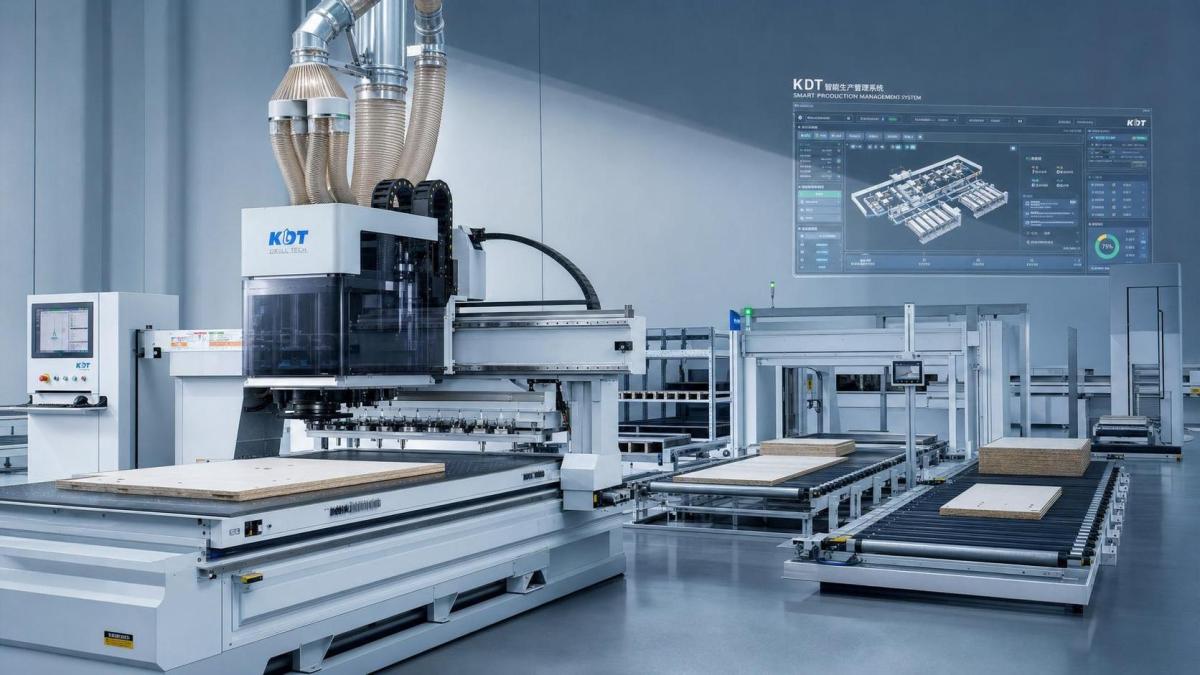
The short answer is this: compare the machine against your production reality, not the brochure headline.
Many woodworking CNC machines for sale look similar on paper.
Yet daily performance changes dramatically once material variety, shift patterns, and order complexity enter the picture.
A useful comparison usually starts with five checkpoints.
- Working envelope and table structure for your standard panel sizes.
- Spindle power, tool library, and drilling configuration for your actual materials.
- Repeatability, cutting quality, and dust or chip evacuation stability.
- CAD/CAM, nesting, MES, and barcode workflow compatibility.
- Installation, training, spare parts, and remote diagnostic support.
Need to note that one strong specification never offsets weak system integration.
A fast spindle is less valuable if the software handoff creates errors.
Likewise, a low purchase price can become expensive if downtime stretches or tool consumption rises.
Does higher machining accuracy always mean the better investment?
Not always, and this is where many comparisons become distorted.
For premium furniture, custom cabinetry, and complex joinery, accuracy has direct commercial value.
It affects hole positioning, edge alignment, assembly speed, and final visual quality.
But accuracy should be judged at production speed, not only in a static test.
A machine that performs well on a sample board may drift during long shifts, dense nesting, or multi-tool cycles.
More common questions to ask include these:
- How stable is repeatability after continuous operation?
- How does the machine handle laminated board, MDF, plywood, and particleboard?
- What happens to edge quality when feed speed increases?
- How often is calibration needed under normal factory conditions?
PWFS often frames this through manufacturing physics rather than marketing claims.
Tool vibration, chip evacuation, gantry rigidity, and motion control tuning all shape usable accuracy.
So, when comparing woodworking CNC machines for sale, ask for cutting samples from materials and patterns close to your own mix.
Which machine features matter most for customized furniture production?
If the production model includes small batches, frequent design changes, or whole-house customization, flexibility becomes central.
This is where CNC woodworking routers earn their role as smart carving tools in modern panel furniture lines.
They are valuable because they connect front-end design data with fast, repeatable cutting and drilling.
However, not every machine supports that transition equally well.
In actual use, the better choice is usually the one that removes bottlenecks between design, cutting, edge banding, and packing.
That system view is consistent with how PWFS looks across woodworking and packaging lines alike.
Precision alone is not enough if flow remains fragmented.
Why do some woodworking CNC machines for sale look affordable but cost more later?
This usually comes down to hidden ownership costs.
An attractive initial quote can mask weaker components, limited service reach, outdated control systems, or higher scrap risk.
The result is not always visible in month one.
It appears later through unstable output, rework, training dependence, and long downtime waiting for parts.
A more practical cost review should include:
- Tool wear rate on your common materials.
- Vacuum pump, dust collection, and power consumption.
- Planned maintenance intervals and spare part availability.
- Software licensing, updates, and training requirements.
- Downtime exposure if one core module fails.
This is also why quote comparisons should be normalized.
If one supplier includes commissioning, nesting software, and spare tools, while another does not, the numbers are not truly comparable.
A cheap line item can become an expensive project.
How can you tell if software and automation are strong enough?
Ask less about features in theory and more about workflow under pressure.
For example, can the machine receive revised files quickly?
Can labels, barcodes, and drilling data stay synchronized through job changes?
Can operators recover a stopped batch without creating mismatched parts?
The better woodworking CNC machines for sale usually prove their value through control reliability and workflow continuity.
This is especially relevant in digital factories where routers, edge banders, and sorting stations need clean data exchange.
A few confirmation points help clarify the difference:
- File formats supported without manual conversion.
- Remote diagnostics and software troubleshooting speed.
- Operator interface simplicity for shift-to-shift consistency.
- Integration with upstream design and downstream finishing equipment.
When PWFS analyzes high-performance equipment, the common theme is intelligent coordination.
That logic applies whether the line is printing packaging with micron registration or routing panels with tight drilling tolerances.
Before requesting a quote, what information should be prepared?
Better input produces better quotations.
If the request is vague, the reply will usually be broad, optimistic, and hard to compare.
A stronger request package makes supplier responses far more useful.
- Main board materials, thickness range, and daily output targets.
- Typical part sizes, drilling patterns, and nesting complexity.
- Required tolerances and visible surface quality expectations.
- Existing software stack, data formats, and automation interfaces.
- Factory space, power conditions, dust control, and labor setup.
- Planned expansion, such as edge banding linkage or MES connection.
This preparation also makes it easier to separate general-purpose machines from true production-fit solutions.
In many cases, the best decision is not the most advanced option.
It is the one that matches current demand while leaving room for stable upgrades.
What is the smartest next step after shortlisting woodworking CNC machines for sale?
Move from broad comparison to structured verification.
Ask each supplier to respond to the same technical checklist.
Request sample processing on your own files and materials when possible.
Review not only the machine, but the surrounding delivery logic.
That includes software onboarding, training depth, spare parts commitment, and post-installation support windows.
The strongest buying decisions usually come from comparing total production fit, not isolated specifications.
For operations aligning with the PWFS perspective, that means viewing CNC equipment as part of a wider move toward digital continuity, lower waste, and flexible manufacturing.
Before sending the final RFQ, refine the must-have parameters, list the acceptable trade-offs, and define what success should look like six months after installation.
That approach makes woodworking CNC machines for sale much easier to compare, and far harder to misjudge.
Related News
Get weekly intelligence in your inbox.
No noise. No sponsored content. Pure intelligence.
