Automated Woodworking Solutions vs Standalone CNC Machines: Which Fits Batch Production?
For batch production, the real question is not whether a machine can cut wood accurately. It is whether the entire workflow can move fast, stay stable, and scale without creating hidden labor costs.
That is why the comparison between automated woodworking solutions and standalone CNC machines matters. In furniture, panel processing, and custom interiors, the winning investment often depends on integration, not spindle power alone.
Across the broader manufacturing landscape observed by PWFS, this pattern is familiar. High-output packaging lines, offset presses, and die-cutting systems create value by connecting each process step, and woodworking is moving in the same direction.
Why this choice has become more important
Demand is changing the economics of wood processing. Shorter lead times, more design variation, and tighter material control are now expected in the same factory.
A standalone CNC machine can still be effective. It handles routing, drilling, grooving, and nesting with impressive precision, especially when production is moderate and product variety is manageable.
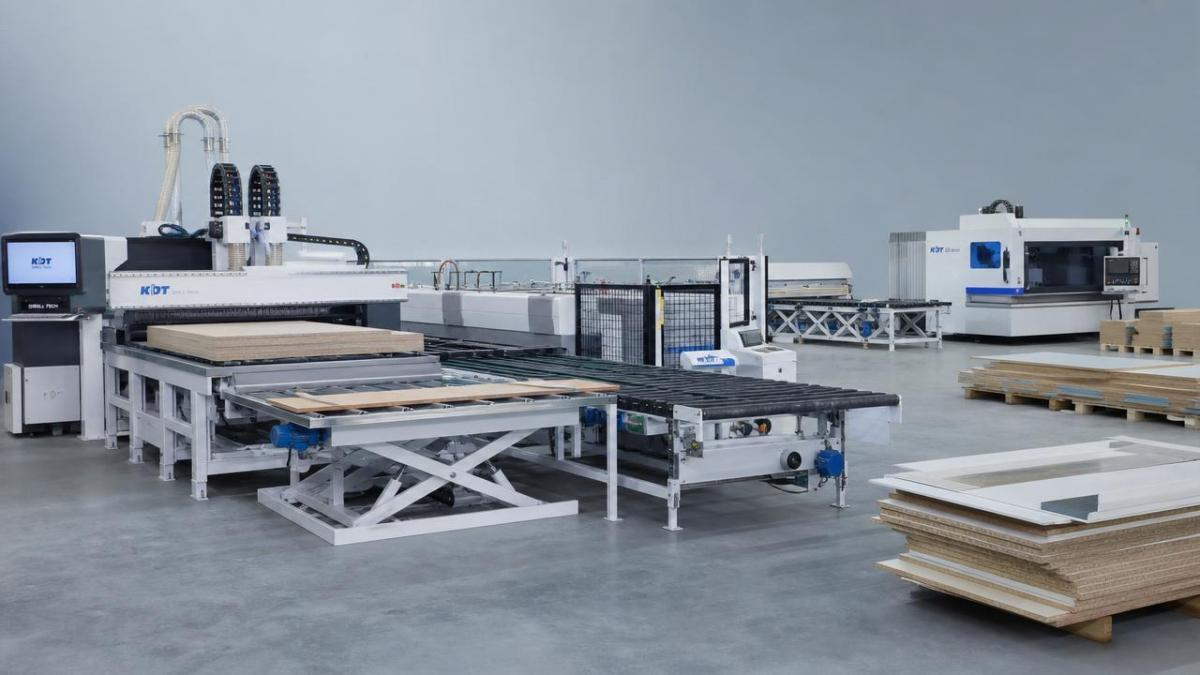
Automated woodworking solutions go further. They combine CNC routers with loading tables, labeling, sorting, conveyors, MES links, optimization software, and sometimes edge banding or robotic handling.
The difference becomes visible when batch production expands. One machine may cut well, yet delays appear before and after cutting, where labor, waiting time, and tracking errors accumulate.
Understanding the two models in practical terms
A standalone CNC machine is usually a single processing center. It may include automatic tool change, vacuum tables, and design software, but it often depends on manual upstream and downstream support.
Automated woodworking solutions are system-level setups. They are designed to reduce handoffs, standardize data flow, and keep material moving through cutting, identification, and next-step processing.
Simple output capacity does not fully explain the difference. A machine can be fast in cycle time yet slow in overall throughput if operators spend too much time lifting panels, scanning orders, or rechecking labels.
Where standalone CNC machines still make sense
They remain a strong fit when product mix changes often but order volume is not consistently high. They also suit phased investment plans and factories still building digital production discipline.
- Lower initial capital compared with full automated woodworking solutions
- Greater flexibility for workshops moving from manual methods
- Easier installation where floor space is limited
- Suitable for pilot expansion into custom panel production
Where system automation changes the result
Automated woodworking solutions begin to outperform when the challenge is not cutting complexity, but production coordination. This is common in cabinet lines, closets, office furniture, and whole-house customization.
In these settings, every board carries data, sequence, and delivery consequences. A missed label or delayed sort can disrupt edge banding, drilling, assembly, and shipment.
The real decision factors for batch production
The best comparison is not machine versus machine. It is workflow versus workflow.
This matters because batch production rarely fails at the spindle. It usually fails in queue management, nesting efficiency, wrong-part recovery, or labor inconsistency between shifts.
How broader manufacturing trends reshape the answer
PWFS tracks paper, print, packaging, and woodworking as connected industrial ecosystems. In each one, the strongest performers do not just buy faster machines. They build synchronized lines.
Corrugated board lines succeed through continuous flow. Offset presses win through registration control and stable feeding. Die-cutting systems depend on speed plus coordination. Woodworking now follows the same logic.
That shift is especially clear in panel furniture. Front-end design files, nesting logic, drilling patterns, and edge finishing now need to communicate with almost no manual interpretation.
This is where automated woodworking solutions gain strategic value. They reduce process friction between digital order intake and physical board output.
The hidden cost categories to watch
- Idle machine time caused by manual board preparation
- Rework from part misidentification and sorting errors
- Higher labor intensity during peak order periods
- Poor data visibility across cutting and edge processing
- Expansion bottlenecks when more orders arrive than people can coordinate
Typical production scenarios and the better fit
Not every factory needs the same level of automation. The better choice depends on order structure, product rhythm, and operational maturity.
Scenario A: Growing custom furniture output
When order sizes are small but total daily volume is rising, automated woodworking solutions usually create better flow. The system handles variation without depending on repeated manual decisions.
Scenario B: Moderate volume with varied prototypes
A standalone CNC machine may be the smarter fit. It offers control, flexibility, and lower investment pressure while preserving room for future upgrades.
Scenario C: Multi-process integration goals
If the target includes barcode traceability, MES visibility, automated labeling, and edge bander coordination, automated woodworking solutions align more naturally with that roadmap.
A practical framework for choosing well
A sound decision starts by mapping production loss points, not vendor brochures. The key is to identify where time and margin disappear during a normal week.
- Measure true throughput, including loading, sorting, and downstream waiting
- Review order variability, not only monthly board volume
- Check whether software can connect design, cutting, and edge processes
- Estimate labor risk during expansion or seasonal demand spikes
- Assess whether floor layout supports future automation modules
A useful test is simple. If output goals are blocked mainly by cutting capacity, a stronger standalone CNC machine may be enough. If output goals are blocked by coordination, automated woodworking solutions deserve closer attention.
What this means for the next investment decision
The choice is not about replacing skill with machinery. It is about deciding how much of production should depend on people remembering steps that software and automation can control more reliably.
Standalone CNC machines remain valuable, especially where flexibility and staged investment matter. Yet for sustained batch production, automated woodworking solutions often deliver stronger long-term returns because they improve the whole operating system.
The next step is to compare current bottlenecks against future order patterns, then evaluate where integration, traceability, and labor stability will matter most. That approach leads to a clearer answer than machine specifications alone.
Related News
Get weekly intelligence in your inbox.
No noise. No sponsored content. Pure intelligence.
