
What Corrugator Speed Suits a Medium-Volume Box Plant?
What corrugator speed is suitable for a medium-volume box plant? Usually, it is the fastest speed the plant can sustain profitably across its normal order mix—not the highest number printed on a machine brochure. A corrugator that can briefly run very fast on long, simple orders may still be the wrong investment if the plant lives on short runs, frequent flute changes, mixed paper quality, and demanding delivery windows.
For a medium-volume converter, corrugator selection is less about chasing peak meters per minute and more about matching the wet end to the real rhythm of the factory. That rhythm includes order sizes, board combinations, operator capability, preventive maintenance discipline, storage space, and the capacity of printers, die-cutters, flexo folder gluers, and finishing equipment downstream. If one part of that chain cannot absorb the output, extra corrugator speed simply becomes work-in-progress inventory.
Start with saleable board, not nameplate speed
A medium-volume box plant should begin with a practical question: how many square meters or square feet of usable board must reach converting each shift, after trim loss, setup board, downtime, quality holds, and changeovers? That is a much better planning figure than the theoretical output of a corrugator running continuously under ideal conditions.
The simple capacity relationship is familiar:
Saleable board output = running speed × working width × productive running time × yield.
The difficult part is defining “productive running time” honestly. A plant may schedule a full shift, yet lose meaningful time to paper splices, web breaks, glue adjustments, steam stabilization, order changes, flute changes, knife settings, warp correction, and routine cleaning. A high-speed line does not erase those events. In some plants, it makes the consequences more expensive because a mistake creates more off-spec board in less time.
This is why the right answer to “What corrugator speed is suitable for a medium-volume box plant?” is often a moderate-to-high operating speed with reserve capacity, rather than an extreme-speed specification. Reserve matters when demand peaks, when a key customer adds an urgent order, or when maintenance has reduced available production hours. But reserve is useful only if the line can hold bond, moisture, caliper, and warp control at that speed with the grades the plant actually sells.
The order profile decides more than annual tonnage
Two plants can consume similar annual paper tonnage and need very different corrugators. One may produce long runs of a few regular shipping cases in single wall board. Another may serve e-commerce sellers, food distributors, industrial parts suppliers, and local brands—each with changing dimensions, print requirements, and board specifications. The second plant will generally benefit more from quick, stable changeovers than from a machine designed primarily for sustained maximum velocity.
Look at the last six to twelve months of production data before discussing speed. Separate orders by run length, flute profile, board construction, paper grade, width, and customer quality requirement. The average order length can be misleading. A small number of very long runs may inflate the average while most daily production still consists of short, interruption-heavy work.
Plants with a high share of short-run work should give unusual attention to recipe management, automatic gap control, preheater settings, splice reliability, knife and scorer positioning, and operator visibility at the single facer and double backer. Those features may contribute more to usable output than another increment of maximum speed. A line that returns to stable board quality quickly after a change can outperform a theoretically faster line over the course of a week.
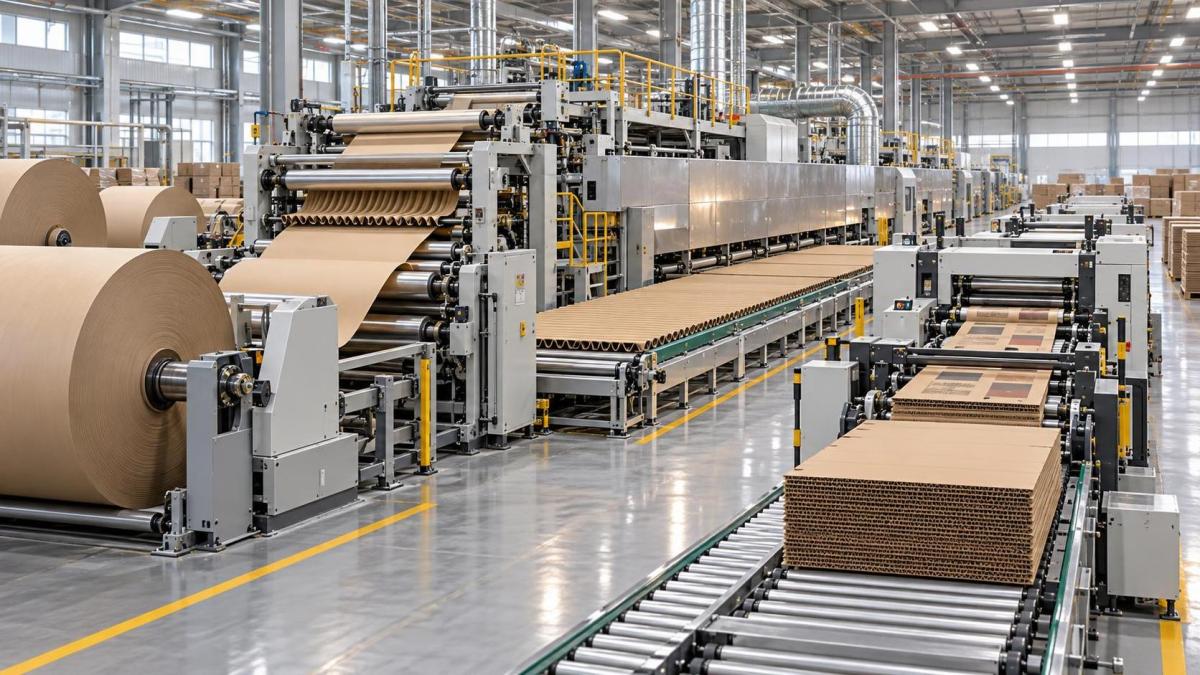
Board mix places a real limit on running speed
Not all corrugated board behaves the same way. Lightweight papers, recycled-content liners, heavy double wall constructions, demanding microflutes, and moisture-sensitive paper combinations each affect how aggressively a plant can run. The corrugator must apply heat, moisture, pressure, and adhesive in a controlled sequence. When that balance is off, the symptoms are familiar: poor pin adhesion, washboarding, delamination, excessive warp, crushed flute, uneven moisture, or board that looks acceptable at the stacker but causes trouble later in printing and converting.
Paper variability deserves particular respect. In practice, mills can supply paper with differences in moisture, stiffness, surface characteristics, and roll condition. Procurement may have a valid reason to qualify multiple paper sources, but production should test what those sources do to speed windows and adhesive performance. The lowest-priced paper is not necessarily the lowest-cost paper if it forces slower operation, higher starch consumption, more waste, or more customer complaints.
For a plant making a relatively narrow family of standard transport cases, a line optimized for sustained speed can make sense. For a plant with broad board variety, a more flexible operating envelope is generally safer. The purchase discussion should include the exact combinations that cause trouble today, not just an easy sample grade selected for an acceptance demonstration.
Do not let the corrugator outrun converting
A corrugator is the center of a board plant, but it is not the entire factory. Its useful speed is constrained by what happens after the stacker. If the downstream flexo folder gluer, rotary die-cutter, flatbed die-cutter, digital printer, or specialty finishing cell cannot consume board at a comparable pace, the plant must either build inventory or interrupt corrugator production.
That mismatch is common in growing operations. Management sees the corrugator as the bottleneck because it is physically large, capital-intensive, and highly visible. Yet the true limitation may be changeover time at converting, limited staging room, a shortage of forklift capacity, or a daily scheduling process that sends too many urgent jobs through the same converting machine.
Map the whole flow: reel storage, paper delivery, corrugation, board conditioning, stack handling, printing, cutting, folding, gluing, bundling, palletizing, and dispatch. Check where board waits and why. A faster wet end rarely fixes a downstream queue. In fact, it can hide scheduling problems by filling the floor with board that has not yet become revenue.
Speed is an operating-system decision
A corrugator at higher speed demands stable utilities and disciplined process control. Steam quality and pressure consistency, condensate removal, electrical supply, compressed air, starch kitchen performance, paper handling, and maintenance response all become more critical as the line runs harder. A speed target that works in a supplier demonstration may not be repeatable in a plant with inconsistent steam management or limited technical support.
Staffing is equally important. Medium-volume plants are often lean, and their most experienced people may cover setup, troubleshooting, quality checks, and training at the same time. Automation can reduce repetitive adjustments, but it does not remove the need to understand why a web is wandering, why a bond is weakening, or why warp has changed after a paper substitution. A plant should assess its operators and maintenance team with the same seriousness it gives to machine specifications.
This is where production data becomes valuable. A basic manufacturing execution system, or even well-maintained production records, can reveal the difference between scheduled speed, actual running speed, downtime cause, waste by reason, and output that passed final quality inspection. The goal is not to create an elaborate dashboard for its own sake. It is to avoid purchasing capacity for a problem that is actually caused by lost availability or unstable yield.
Questions to put to a corrugator supplier
A serious supplier conversation should move beyond “How fast can it run?” Ask for performance discussion around your board mix, paper sources, working widths, and order pattern. If the supplier cannot explain the trade-off between speed, heat transfer, adhesive application, tension control, and board quality, the discussion is not yet detailed enough.
- What operating speed is expected for each of our common flute and paper combinations, not merely the line’s maximum rating?
- How are changeovers handled, and which settings are stored or adjusted automatically?
- What utilities must be available at the machine inlet for stable production?
- Which wear parts and service skills are needed locally, and what is the realistic maintenance routine?
- How will the line connect with existing stack handling, board tracking, and converting schedules?
- What acceptance criteria will be used for bond quality, warp, moisture behavior, dimensional consistency, and waste?
Acceptance conditions deserve careful wording. Running a simple board grade for a brief period proves less than running representative materials, including the grades that are difficult to keep flat or well bonded. The plant should also clarify whether the quoted performance depends on a particular steam system, starch formulation, paper quality, or operator support arrangement.
A practical way to choose the speed band
Instead of choosing from a catalog speed alone, develop three production scenarios: a normal month, a heavy-demand month, and a disrupted month with realistic maintenance or paper-quality interruptions. Estimate saleable board requirements for each scenario. Then test whether a proposed line can meet the heavy-demand case without operating continuously at its practical limit.
If the machine only meets demand when every shift is perfect, it is undersized. If it provides far more output than converting, warehousing, and sales can absorb, it may be oversized. The more balanced choice usually gives the plant room to grow while preserving flexibility for the work it already has.
Capital cost should be evaluated alongside energy use, consumables, maintenance access, spare-parts lead time, training, and floor layout. A wider or faster line may appear attractive on a unit-cost calculation, but its financial logic changes if it requires major building work, utility upgrades, larger paper inventory, or substantial new downstream automation.
The sensible answer for a growing box plant
For most medium-volume operations, the best corrugator speed is a dependable production speed that accommodates common board grades, leaves recovery capacity for busy periods, and remains synchronized with converting. It should be selected on net saleable output per shift, not on peak mechanical speed.
That perspective aligns with the broader manufacturing view followed by Global Print, Woodworking & Furniture Systems: equipment value comes from how well a complete production system turns material into consistent finished products. In corrugated packaging, the line must coordinate paper, steam, adhesive, motion, data, and downstream conversion. The board may be made in seconds, but the investment decision should not be rushed.
Before committing, run the numbers using actual order history, inspect the downstream bottlenecks, and make suppliers demonstrate performance on representative board combinations. A corrugator that runs steadily, changes predictably, and produces board converters want to use is usually the machine that supports profitable growth.
Related News
Get weekly intelligence in your inbox.
No noise. No sponsored content. Pure intelligence.
