
Precision Die-Cutting Explained: Key Tolerances, Materials, and Converting Limits
Precision die-cutting sits at the point where packaging design, substrate behavior, and machine stability meet. In real converting environments, tiny deviations in cut depth, registration, or pressure can quickly become scrap, stoppages, or downstream folding problems.
That is why precision die-cutting matters far beyond the cutting station itself. It influences print-to-cut alignment, glue-line consistency, packing efficiency, and the practical limits of cartons, labels, protective inserts, and industrial components.
Across the PWFS equipment landscape, this topic also connects naturally with offset accuracy, folder-gluer stability, corrugated converting speed, and the broader move toward digitally managed, high-yield production lines.
What precision die-cutting really means on the production floor
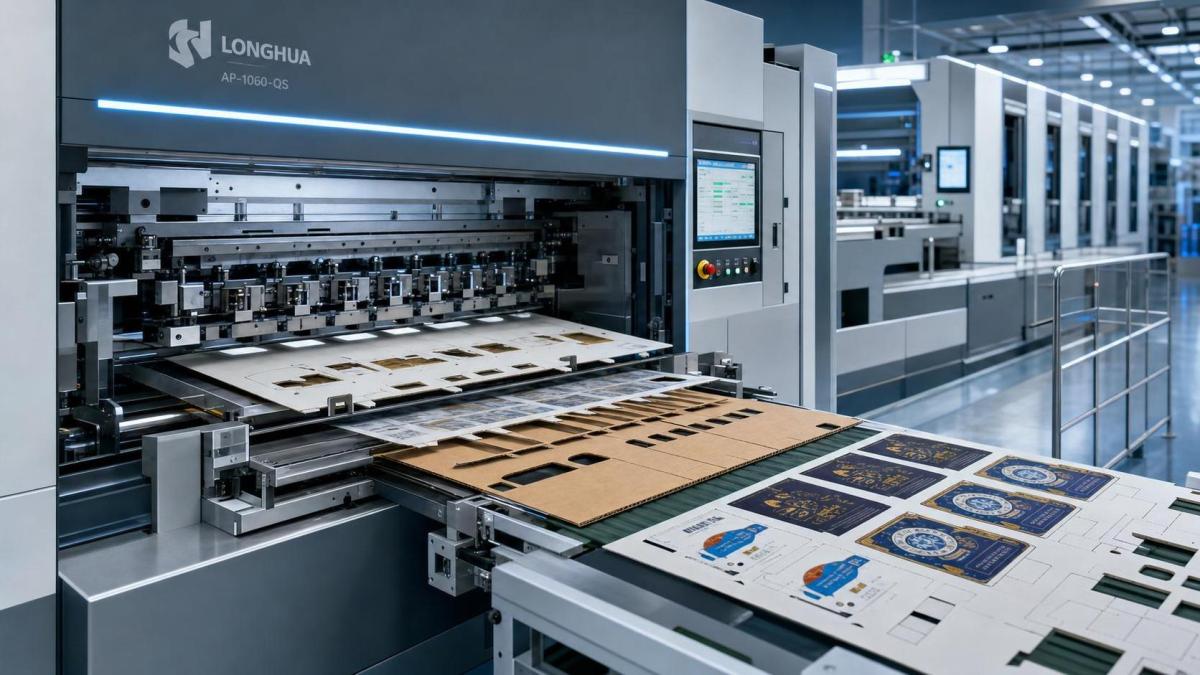
At a basic level, precision die-cutting is the controlled separation, creasing, perforating, or shaping of material to a defined geometry. The key word is not only “cutting,” but “repeatable.”
A part that looks acceptable once may still be a weak process. Evaluation depends on whether the same shape can be held over long runs, speed changes, and substrate variation.
In folding carton and label work, acceptable output often depends on three linked conditions: positional accuracy, edge quality, and stable material handling. If one drifts, the others usually follow.
This is especially relevant in PWFS-covered sectors, where die-cutters do not work in isolation. They inherit variation from corrugated lines and offset presses, then pass their own quality forward to folder-gluers and packing systems.
Why tolerances have become a bigger industry issue
Tolerance expectations are tightening for several reasons. Pack designs are becoming more complex, press speeds remain high, and brand owners expect cleaner visual alignment across shorter lead times.
E-commerce adds another pressure point. Shipping boxes, inserts, and retail-ready formats must convert efficiently, but they also need structural reliability under transport stress.
At the same time, whole-line automation leaves less room for manual correction. A small registration error in precision die-cutting may later trigger folding skew, gluing mismatch, barcode placement issues, or case-packing instability.
For that reason, converting limits are now judged less by nominal machine speed and more by stable yield under realistic production conditions.
Tolerance is not one number
When discussing precision die-cutting, tolerance usually includes several dimensions at once. Treating it as a single figure often leads to poor equipment comparisons.
- Cut-to-print registration, where graphics must align with the die profile.
- Part-to-part dimensional repeatability across a run.
- Crease accuracy, which affects fold memory and glue presentation.
- Depth control, important for kiss-cut, laminated, or multi-layer structures.
- Edge condition, including burrs, fiber pull, dusting, and crush.
A machine can post strong dimensional data and still perform poorly if creasing pressure fluctuates or if waste stripping becomes unstable at speed.
Materials define the real operating window
Material choice sets the true limits of precision die-cutting. Tooling quality matters, but substrate variability often decides whether a line runs smoothly or lives in constant adjustment.
Paperboard is generally predictable, yet coated surfaces, heavy calipers, recycled fiber content, and moisture shifts can all change cut resistance and crease behavior.
Corrugated board introduces another layer of complexity. Flute profile, liner bonding, warp, caliper variation, and compression history all affect knife penetration and panel accuracy.
Films, foams, tapes, and laminates raise different questions. Elastic recovery, adhesive flow, and heat sensitivity can reduce effective precision even when the die station itself is mechanically capable.
In practice, the most useful question is not whether a system can cut a material once. It is whether it can hold quality with that material at the target speed and waste level.
Where machine capability usually wins or fails
Precision die-cutting performance is strongly shaped by motion control, platen or rotary stability, sheet travel consistency, and the condition of tooling interfaces.
The most visible metric may be running speed, but less visible factors often decide usable output. These include vibration control, pressure uniformity, register correction response, and stripping reliability.
In high-precision offset and carton converting environments, print-to-cut harmony is critical. A highly accurate press loses value if the die station cannot track sheet movement with the same discipline.
That is one reason PWFS often frames equipment through system thinking. The die-cutter, folder-gluer, and upstream print platform must support the same yield philosophy, not just independent speed claims.
Signals that deserve close checking
- Registration stability after speed ramp-up, not only at startup.
- Pressure consistency across full sheet width and repeat jobs.
- Makeready time when changing substrate, tooling, or layout.
- Waste stripping behavior on complex windows, bridges, or small nicks.
- Data visibility for alarms, drift, and trend-based maintenance.
Applications that put precision die-cutting under pressure
Not every job stresses the process in the same way. Some emphasize registration, others material toughness, and others line integration.
Pharmaceutical and cosmetics cartons usually demand clean edges, exact fold geometry, and close print alignment. Even minor drift can affect presentation or pack assembly.
E-commerce transit packaging shifts attention toward corrugated consistency, structural repeatability, and downstream erecting efficiency. Here, precision die-cutting supports logistics performance as much as appearance.
Industrial labels, adhesive parts, and protective inserts often bring mixed-material challenges. The main issue becomes controlling depth and shape under variable compression and release behavior.
Across these uses, the common thread is simple: better precision lowers the hidden cost of rework, instability, and manual intervention.
A practical way to evaluate converting limits
A useful assessment starts with the intended job mix, not with brochure figures. Precision die-cutting should be judged against the most difficult recurring work, not the easiest sample.
It helps to define a realistic evaluation frame before comparing platforms.
- Map critical substrates by thickness, coating, flute, laminate, and moisture sensitivity.
- Separate dimensional tolerance from crease quality and stripping performance.
- Check repeatability over time, not only first-sheet accuracy.
- Review integration with print registration, gluing, inspection, and MES data flow.
- Estimate scrap risk during changeovers, not just during steady-state production.
This approach aligns with the PWFS view of modern converting. High-value equipment decisions depend on stitched intelligence across mechanics, materials, compliance, and production economics.
What to carry into the next comparison
Precision die-cutting is not best understood as a single machine feature. It is a process capability shaped by substrate variation, tooling discipline, kinematic control, and line-level coordination.
The strongest comparisons usually come from linking tolerance targets to actual business consequences: scrap, speed loss, fold quality, registration risk, and maintenance exposure.
A sensible next step is to build a short evaluation matrix around the hardest jobs in the portfolio. From there, differences in converting limits, usable speed, and yield consistency become much easier to see.
That kind of structured review turns precision die-cutting from a broad technical term into a practical decision tool for cartons, labels, corrugated formats, and other demanding converted products.
Related News
Get weekly intelligence in your inbox.
No noise. No sponsored content. Pure intelligence.
