
When does industrial packaging automation pay off?
For financial decision-makers, the key question is not whether industrial packaging automation is impressive, but when it starts delivering measurable returns. From corrugated lines and offset presses to folder gluers and CNC systems, the payoff depends on labor savings, throughput gains, waste reduction, and order mix. This article explains when industrial packaging automation becomes a sound capital investment and how to evaluate the break-even point with greater confidence.
In packaging, print, and panel-based manufacturing, capital is often tied up in long-life equipment with 7- to 15-year operating horizons. That makes timing critical. A well-chosen automation project can shorten lead times, stabilize quality, and reduce conversion cost per unit. A poorly timed one can lock a factory into underused capacity, integration delays, and weak payback.
For CFOs, finance directors, and investment committees, the right question is not simply “What does the machine do?” but “What does the system change?” Industrial packaging automation changes labor structure, uptime discipline, scrap rates, shift economics, and the factory’s ability to profit from short runs, mixed SKUs, and rush orders.
This is especially relevant in the environments tracked by PWFS, where corrugated board lines, offset presses, die-cutting and folder-gluing systems, CNC woodworking routers, and edge banders increasingly depend on data flow as much as mechanical performance. Once automation reaches the point where it improves both output and decision quality, payback becomes much easier to defend in financial terms.
What “paying off” really means in industrial packaging automation
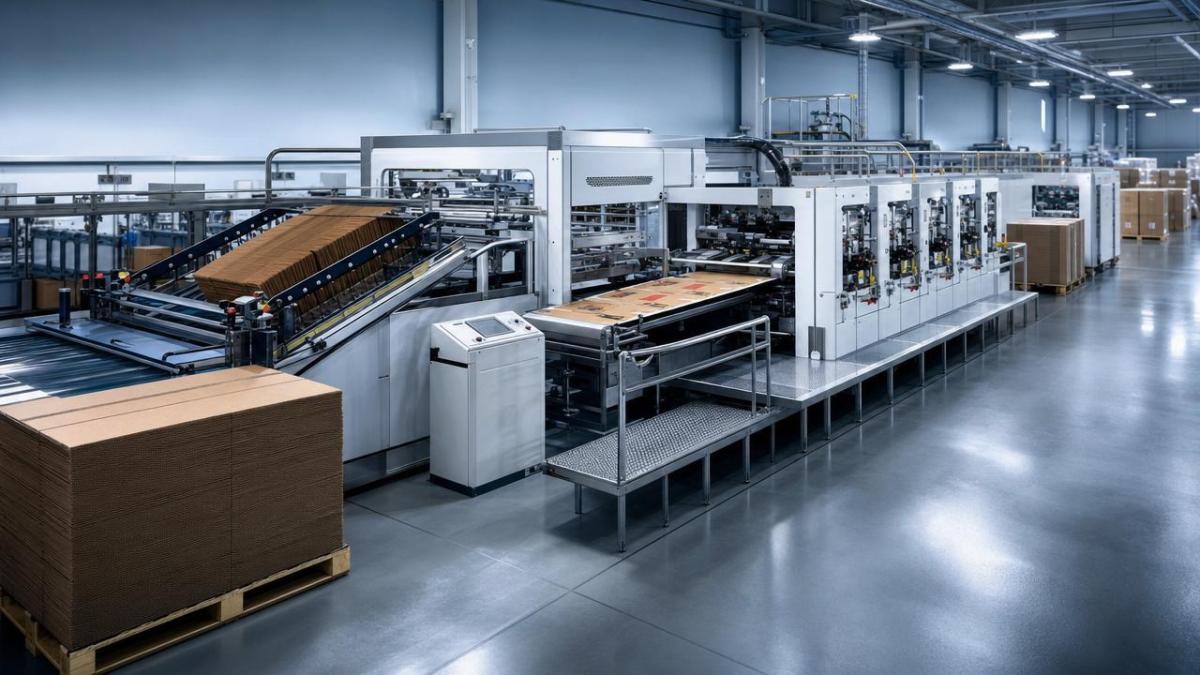
In finance discussions, industrial packaging automation pays off when the net operating benefit exceeds the full cost of ownership within an acceptable period. In many factories, that target window is 18 to 36 months for modular upgrades and 36 to 60 months for larger line investments. The answer depends on the baseline you start from and the bottleneck you remove.
For a corrugated plant, the value may come from higher line speed, fewer changeover losses, and lower board waste. For an offset packaging printer, the gain may come from better registration control, reduced makeready sheets, and more saleable output per shift. For a folder gluer or die-cutter, the financial impact often comes from reduced labor intensity and steadier throughput at high volume.
In woodworking-linked packaging and furniture systems, automation may also unlock a more profitable order mix. A CNC router connected to CAD/CAM and MES can process custom designs in batches of 1 to 50 with less manual interpretation, while automated edge banding can reduce rework on visible panels and improve consistency across repeat orders.
The five metrics finance teams should track first
- Direct labor reduction per shift or per 10,000 units
- Throughput gain in sheets, boxes, boards, or panels per hour
- Scrap reduction as a percentage of input material
- Changeover time reduction between jobs or SKU families
- Maintenance stability, measured by downtime hours per month
These five indicators create the foundation for a credible payback model. If a project improves only one metric by a narrow margin, the investment case may remain weak. If it improves 3 or more at once, especially labor, waste, and throughput, the economics usually become much more attractive.
Why output alone is not enough
A machine rated for 15,000 sheets per hour does not guarantee a financial return if makeready consumes 45 minutes, operators struggle with unstable settings, or downstream gluing cannot keep pace. Industrial packaging automation pays off when the line is balanced. A bottleneck shift of just 8% to 12% can erase much of the expected gain from a premium asset.
This is why financial reviewers should request a before-and-after flow map. It should include labor by station, average queue time, typical setup duration, planned maintenance intervals, and actual yield loss points. The business case becomes more reliable when the automation proposal addresses the full process, not one isolated machine center.
The table below shows common value drivers across the main equipment families covered by PWFS and the metrics most likely to influence payback timing.
The key conclusion is simple: industrial packaging automation becomes financially compelling when it improves multiple cost drivers simultaneously. The strongest projects rarely rely on one headline number. They produce a compound effect across labor, waste, speed, and order reliability.
The break-even point: when automation starts to outperform manual or semi-automatic operations
Break-even is not a fixed industry rule. It varies by shift pattern, wage level, substrate cost, run length, and utilization. In practical terms, industrial packaging automation usually starts to pay off faster when three conditions are present: capacity utilization above 60%, labor pressure across 2 or more shifts, and recurring quality losses that exceed 2% to 4% of material input.
For example, a factory running one shift at 45% load may not need a full automation leap. It may benefit more from selective automation such as automatic feeder upgrades, inline inspection, stackers, or digital workflow integration. By contrast, a plant running 16 to 20 hours per day with labor shortages and costly waste has a much stronger case for full-line automation.
A practical payback formula for finance approval
A disciplined investment review should calculate annual benefit in five parts: labor savings, scrap reduction, throughput contribution, avoided overtime, and reduced rework or claims. Then subtract annual maintenance, software, training, integration, and financing costs. This creates a more realistic view than headline ROI alone.
- Estimate current annual operating cost at the bottleneck process.
- Model the post-automation cost under conservative, target, and stress scenarios.
- Add one-off implementation costs over the first 6 to 12 months.
- Test utilization at 50%, 70%, and 85% to see how sensitive payback is.
- Approve only if the downside case remains manageable.
In most board converting or carton plants, the biggest modeling mistake is overestimating sustained speed and underestimating startup drag. Ramp-up often takes 8 to 16 weeks, and the first quarter may deliver only 50% to 70% of planned gains. A realistic payback schedule should reflect that.
What often moves payback from 48 months to 24 months
Payback accelerates sharply when automation replaces hard-to-staff manual tasks, reduces expensive paperboard waste, and increases sellable throughput without adding floor labor. In premium printed packaging, even a 1% to 2% reduction in spoilage can materially improve margin if substrate and finishing costs are high.
In corrugated operations, the economics improve when automated handling reduces product damage and line stoppages between wet-end and dry-end processes. In furniture-linked panel manufacturing, payback improves when CNC and edge banding cells reduce interpretation errors from custom designs and shorten delivery from 10 days to 5 or 6 days for repeatable jobs.
Where industrial packaging automation delivers the fastest returns
Not every process generates the same return profile. Financially, the best opportunities are usually where material value is high, manual intervention is frequent, and order complexity creates hidden cost. That is why automation in printing, converting, and digital job flow often outperforms simple speed upgrades alone.
High-volume corrugated and transit packaging
This segment benefits when demand is stable, SKU families are repeatable, and e-commerce volumes justify 2- or 3-shift production. Automated corrugator controls, stack handling, and in-line quality monitoring can reduce waste at startup and improve board consistency. When material consumption is measured in tons, even small percentage gains matter.
Offset-printed folding cartons
Here, industrial packaging automation pays off through better makeready discipline, fewer registration-related rejects, and smoother handoff into die-cutting and folder-gluing. The higher the graphics requirement, the more costly each unstable setup becomes. Automation is especially compelling when order volumes mix medium runs with frequent changeovers.
Short-run customization and mixed-SKU production
This includes packaging prototypes, promotional runs, retail-ready formats, and panel-based furniture or fixture production. In these settings, digital workflow, barcode-driven setup, CAD/CAM integration, and MES connectivity may generate more value than raw machine speed. Eliminating manual data transfer can prevent costly errors across 20, 50, or 100 micro-batches.
The following comparison helps finance teams identify where automation tends to return capital faster and where a phased approach is more prudent.
A clear pattern emerges: the faster the plant turns labor, material, and machine time into repeatable output, the more likely industrial packaging automation is to pay off quickly. Where demand is less predictable, staged investment usually protects capital better than a single large purchase.
Hidden costs that can delay ROI if finance teams miss them
Many automation proposals look attractive on paper because they focus on equipment speed and labor savings. Yet delayed ROI often comes from the non-obvious costs: floor preparation, utilities, software interfaces, training time, spare parts stocking, and output instability during commissioning. These items can add 8% to 20% to the effective project cost.
Integration and data discipline
If prepress, scheduling, job ticketing, and production reporting are disconnected, automation may simply make poor data move faster. That is why MES links, barcode control, and recipe management should be reviewed alongside the machine itself. A digital disconnect can reduce the expected return far more than a small speed shortfall.
Maintenance maturity
A highly automated line requires more disciplined preventive maintenance than a manual process. If the plant cannot support weekly inspections, critical spare coverage, and operator-level care routines, uptime assumptions may be unrealistic. In some cases, 3 unplanned stoppages per month are enough to weaken the economics materially.
Order mix mismatch
Automation selected for long, predictable runs may struggle if the business shifts toward small lots, versioning, and seasonal demand. Finance teams should require a 12-month order mix review by SKU count, run length band, changeover frequency, and gross margin. The best investment is the one aligned with the next 3 years, not the last 3.
Four questions to ask before approval
- Will this project remove a proven bottleneck or create isolated excess capacity?
- Can the plant sustain at least 65% utilization after ramp-up?
- Are scrap, setup, and rework measured accurately today?
- Is there a clear owner for commissioning, training, and data integration?
These questions matter because industrial packaging automation is not only a machine purchase. It is an operating model change. Finance teams that approve equipment without governance around implementation often see delayed benefits, even when the technology itself is sound.
A phased approval framework for CFOs and investment committees
The safest approach is often a staged model rather than an all-at-once decision. This is especially true in print and packaging environments where one upgrade can shift constraints downstream. A phased roadmap reduces capital risk and produces cleaner evidence for later expansion.
Phase 1: baseline and bottleneck validation
Over 4 to 6 weeks, measure actual throughput, labor loading, downtime causes, spoilage, and changeover time. Separate mechanical stops from planning stops. Validate which process loses the most contribution margin, not just which process looks the busiest.
Phase 2: targeted automation pilot or modular upgrade
For the next 8 to 12 weeks, test a feeder automation package, inspection module, digital job setup layer, or handling improvement. This phase is valuable because it converts assumptions into plant-specific evidence. In many cases, 1 modular intervention reveals whether full automation is justified.
Phase 3: full capital decision
Once the plant has proven gains in setup time, yield, or labor structure, the committee can review a larger investment with better confidence. This is where PWFS-style intelligence becomes useful: not just comparing machine specifications, but understanding the operating context, integration path, and strategic fit across print, converting, and woodworking workflows.
Decision checklist for final approval
- Payback modeled under conservative, target, and downside scenarios
- Ramp-up assumptions limited to credible 3- to 6-month timelines
- Utility, layout, software, and training costs included
- Order mix compatibility tested against at least 12 months of demand
- Ownership assigned for maintenance and digital workflow adoption
When these five items are covered, industrial packaging automation becomes much easier to approve because the project is tied to business reality, not vendor optimism. The result is better capital discipline and fewer surprises after installation.
Industrial packaging automation pays off when it solves a verified operating constraint, raises effective output, lowers waste, and fits the plant’s real order structure. In corrugated lines, offset printing, folder gluing, die-cutting, CNC routing, and edge banding, the best returns come from balanced systems rather than isolated machine speed. For financial decision-makers, the strongest cases are measurable, phased, and grounded in utilization, yield, and labor economics.
If you are assessing automation across packaging, print, or woodworking production, PWFS can help you compare scenarios, identify the true break-even point, and frame a more defensible investment case. Contact us to discuss your application, get a tailored evaluation path, and explore the right automation strategy for your factory.
Related News
Get weekly intelligence in your inbox.
No noise. No sponsored content. Pure intelligence.
