What is changing in digital print packaging this year?
Digital print packaging is changing fast this year, driven by shorter production runs, smarter automation, sustainability demands, and the need for sharper brand differentiation. For researchers tracking packaging trends, understanding how digital workflows, print quality, and converting efficiency are evolving is essential. This article explores the key shifts shaping the market and what they mean for packaging manufacturers, equipment suppliers, and decision-makers.
For B2B buyers and industry analysts, the most important question is no longer whether digital print packaging has a place in mainstream production. The real issue is where it fits best across corrugated, folding carton, and hybrid converting environments, and how fast plants can adapt without losing efficiency, color consistency, or margin control.
Across global packaging operations, the shift is closely tied to e-commerce box demand, SKU multiplication, traceability rules, and the pressure to connect printing, die-cutting, folder-gluing, inspection, and workflow software into one responsive system. That is why observers such as PWFS increasingly look at digital print packaging not as an isolated print method, but as part of a wider smart manufacturing chain.
Why Digital Print Packaging Is Moving Into a New Phase
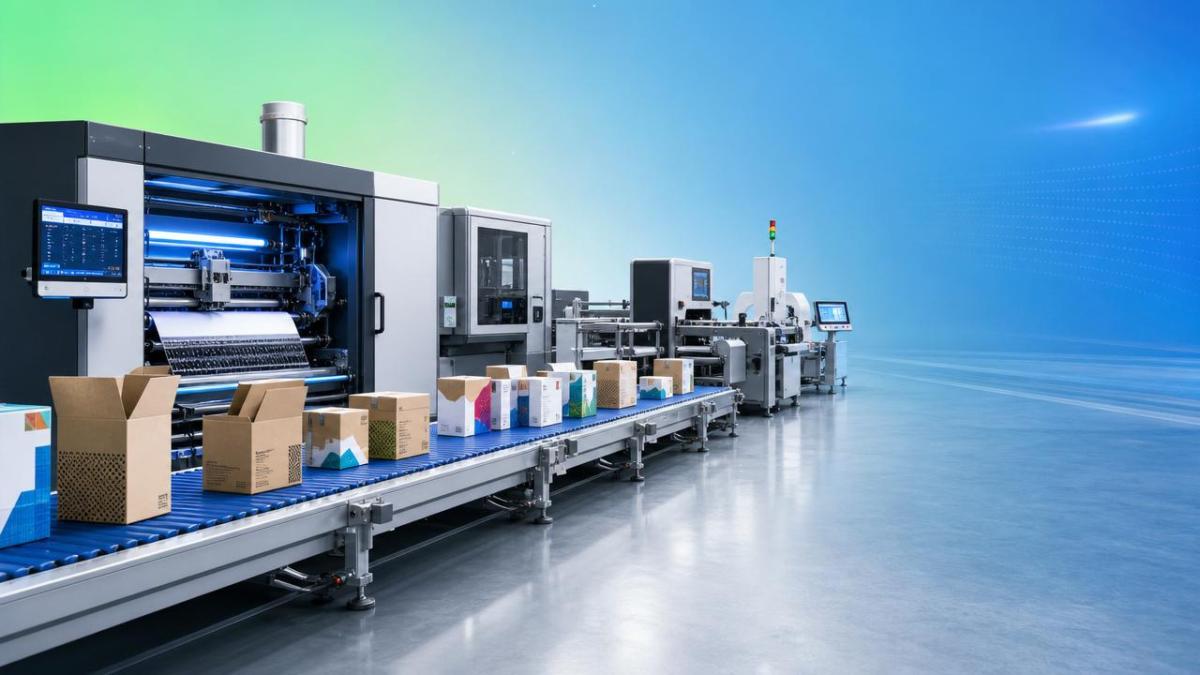
This year, digital print packaging is evolving from a short-run specialty into a more structured production option. In many plants, the trigger is a combination of 3 forces: run lengths under 5,000 sheets, lead-time pressure under 72 hours, and rising demand for versioned packaging across retail, pharma, food, and direct-to-consumer channels.
Traditional offset still dominates long runs because of its unit economics and mature color control at scale. However, when artwork changes frequently, when SKU counts exceed 50 to 200 variants, or when market tests need 1 to 3 pilot batches, digital print packaging reduces plate dependency and compresses prepress time dramatically.
Shorter Runs Are No Longer a Niche Requirement
Brand owners increasingly want packaging in smaller batches with faster refresh cycles. Seasonal campaigns that once ran for 8 to 12 weeks may now change every 2 to 4 weeks. For converters, that means makeready waste, plate cost, and scheduling friction matter more than before.
Digital print packaging supports this trend by removing several fixed setup steps. In practical terms, a plant can move from approved file to printed substrate in minutes rather than hours, especially for sample lots, regional customization, or promotional packs that would otherwise disrupt offset planning.
Automation Is Becoming the Real Differentiator
The market is no longer impressed by print engines alone. Buyers now evaluate end-to-end automation, including RIP speed, color management, barcode verification, sheet tracking, defect inspection, and data handoff to die-cutters or folder-gluers. A fast engine without stable workflow integration can create bottlenecks downstream.
This matters especially in corrugated and folding carton production, where finishing speed can exceed printing speed. If print data, cutting layout, and gluing instructions are not synchronized, the plant may lose 5% to 12% of its theoretical throughput through stoppages, queueing, or rework.
What researchers should track
- Average job size by substrate category, such as linerboard, coated cartonboard, or label stock
- Makeready time before and after workflow automation, often measured in 10 to 40 minute reductions
- Color repeatability across multiple shifts, especially for brand-critical SKUs
- Compatibility between digital print packaging lines and die-cutting or folding systems
The table below outlines how digital print packaging is typically being repositioned this year across major production scenarios.
The key takeaway is that digital print packaging is not replacing every conventional process. Instead, it is taking over jobs where response speed, version complexity, and data connectivity are more valuable than the lowest possible cost per impression on very long runs.
The Biggest Technical Changes in Digital Print Packaging This Year
Several technical shifts are reshaping how converters evaluate digital print packaging. The most visible changes involve substrate flexibility, color stability, finishing alignment, and software-driven production planning. These areas have direct implications for corrugated lines, offset complements, and automated carton converting systems.
1. Better integration with corrugated and carton converting
In the past, some digital installations created isolated print islands. This year, the focus is on linking print with downstream equipment such as flatbed die-cutters, rotary die-cutters, and folder-gluers. Plants want smoother data transfer from artwork to cut path, glue pattern, and inspection point.
For industrial users, registration tolerance and sheet stability remain critical. When digital print packaging feeds high-speed converting, even a small drift can affect crease accuracy, window patching, or glue application. That is why print-to-cut alignment within tight operational ranges is becoming a central buying criterion.
2. Color management is becoming more production-oriented
This year’s discussion is less about headline resolution and more about repeatable color under production conditions. Buyers want stable output over 2, 3, or 4 shifts, not just attractive samples. For packaging, especially cosmetics, healthcare, and premium consumer goods, visual consistency can influence shelf impact and approval cycles.
Converters are paying closer attention to calibration intervals, inline measurement, substrate profiling, and ink behavior on coated versus uncoated surfaces. In real plants, one well-managed profile library can save hours of manual correction and reduce rejected batches during brand audits.
3. Variable data is moving from novelty to function
Variable graphics, serialized codes, batch identifiers, and region-specific artwork are now practical packaging tools. In food, pharma, and cross-border retail, digital print packaging makes it easier to manage language variants, traceability marks, anti-mix controls, and limited-edition campaigns without fully resetting a conventional line.
For research teams, this means evaluating not just print quality but database reliability, file handling speed, and verification accuracy. A variable-data packaging line is only as good as its inspection logic and production discipline.
Common technical checkpoints in current evaluations
- Substrate compatibility across 3 to 5 board grades
- Workflow connection with MIS, MES, or prepress software
- Registration stability before die-cutting and folding
- Color repeatability across repeated jobs over 30 to 90 days
- Inspection coverage for codes, graphics, and missing print defects
The following table summarizes the main technical areas that buyers and researchers are comparing in digital print packaging projects this year.
What stands out is that the strongest digital print packaging lines are not defined by one isolated feature. They combine print performance with controllable finishing, stable color logic, and reliable plant-wide connectivity.
Sustainability, Compliance, and Cost Control Are Converging
Another major change this year is that sustainability is being evaluated together with profitability and compliance. Buyers no longer treat these as separate topics. In digital print packaging, substrate selection, ink behavior, spoilage rates, and traceability expectations all affect the final business case.
Lower waste is valuable, but only if the workflow is disciplined
Digital print packaging can cut waste by reducing plates, shortening setup, and matching output more closely to actual demand. However, those savings depend on disciplined file management, approval controls, and finishing readiness. A rushed short run can still generate costly scrap if print and converting are not synchronized.
In many operations, the practical gains come from avoiding overproduction. Instead of printing 20,000 units to justify setup cost, a converter may print 3,000 to 5,000 units, test demand, and replenish only when needed. That helps reduce obsolete inventory and warehouse pressure.
Compliance pressure is becoming more detailed
For packaging researchers, compliance is an increasingly important part of digital print packaging analysis. Buyers ask more questions about ink migration, substrate traceability, food-contact suitability, and code legibility. In export-oriented sectors, packaging documentation now influences supplier selection earlier in the buying cycle.
This is particularly relevant for companies monitoring FSC-aligned sourcing, batch traceability, and brand protection controls. Even when regulations differ by market, the trend is clear: documentation quality and process transparency are becoming part of commercial competitiveness.
Three risk areas buyers should not ignore
- Mismatch between print capability and food-grade or regulated packaging requirements
- Inadequate inspection for variable codes, leading to shipping or compliance errors
- Overestimating savings without counting finishing, software, and operator training costs
Researchers should also note that digital print packaging cost models are changing. The cost per sheet is only one part of the equation. Plants increasingly calculate total job cost across 4 layers: prepress time, waste, press time, and downstream handling. That broader view often explains why digital wins on selected jobs even when consumable cost appears higher.
How Manufacturers and Buyers Should Evaluate Digital Print Packaging Investments
For manufacturers, converters, and equipment suppliers, the right investment approach starts with job mapping rather than technology hype. A realistic assessment should examine at least 6 to 12 months of production data, including run lengths, version counts, turnaround time, defect causes, and finishing constraints.
Start with the job mix, not the machine brochure
If 70% of plant volume consists of long, stable runs over 20,000 sheets, digital print packaging may play a supporting role rather than a central one. If a large share of work involves frequent changeovers, urgent launches, or mixed-SKU production, the business case becomes stronger.
This is especially true for integrated factories that already operate corrugated board lines, offset presses, die-cutters, and folder-gluers. In those environments, the best result often comes from hybrid planning, where digital handles agile jobs and conventional lines absorb repeat high-volume work.
Review the full implementation path
A sound implementation plan usually involves 5 steps: job analysis, substrate testing, workflow setup, operator training, and production validation. Depending on plant complexity, this may take 4 to 12 weeks before the line reaches stable commercial rhythm.
Decision-makers should also assess service response, spare-part access, color support, and software update policy. In high-mix packaging plants, a delay of even 24 to 48 hours can disrupt dispatch schedules and customer commitments.
Practical evaluation checklist
- Identify jobs below the economic offset threshold
- Measure average changeover loss in current production
- Test print-to-cut accuracy on real converting routes
- Verify workflow compatibility with ERP, MIS, or MES tools
- Confirm compliance needs for target industries and export markets
- Model ROI using total process cost, not only print cost
For companies following the broader paper and wood manufacturing landscape, this discipline is familiar. The same logic used to evaluate corrugated board lines, CNC routers, or edge banders also applies here: machine performance matters, but system integration, uptime, precision, and flexibility determine long-term value.
Digital print packaging is changing this year because market demand is changing underneath it. More versions, faster replenishment, tighter compliance, and connected converting are pushing packaging producers toward smarter production models. The winners will be those who match technology choice to job structure, finishing reality, and workflow maturity rather than chasing trend language alone.
For researchers, suppliers, and manufacturing decision-makers, the next step is clear: compare your current production mix against the new demands of digital print packaging, identify the gaps in automation and finishing coordination, and build an evidence-based roadmap. To explore more equipment intelligence, packaging workflow insights, or tailored production strategies, contact PWFS to discuss your application in detail and get a more customized solution path.
Related News
Get weekly intelligence in your inbox.
No noise. No sponsored content. Pure intelligence.
