
What Acceptance Tests Should a Woodworking Machinery Supplier Provide?
For buyers investing in CNC routers, edge banders, or automated panel-processing lines, the key question is: What acceptance tests should a woodworking machinery supplier provide?
A robust factory acceptance test verifies machining accuracy, repeatability, safety interlocks, software integration, dust extraction, and production-cycle performance before shipment begins.
Clear, measurable criteria reduce commissioning risk, protect yield rates, and confirm that equipment can support flexible, high-speed custom furniture production from the first operating day.
Start With a Written Factory Acceptance Test Protocol
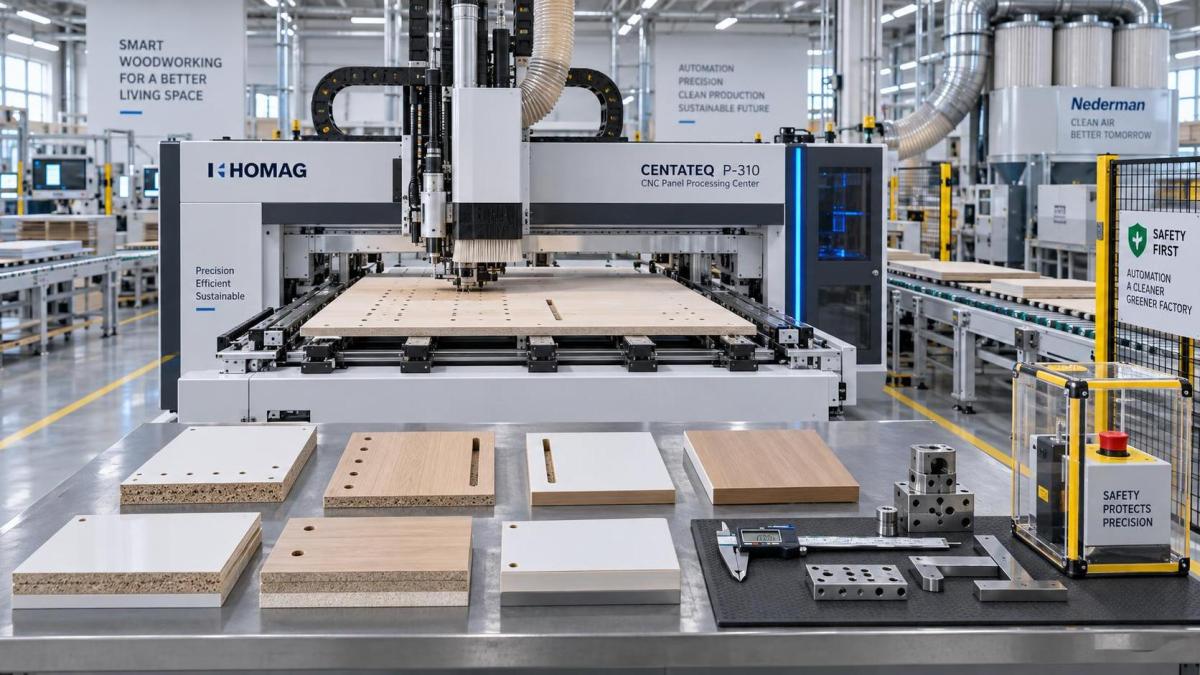
The most important acceptance deliverable is not a video of a machine moving. It is a signed, detailed factory acceptance test protocol.
This document should define exactly what the supplier will test, how performance will be measured, which materials will be used, and who approves results.
For woodworking machinery buyers, vague wording creates expensive disputes. Terms such as “high precision,” “stable operation,” and “fast production” are not test criteria.
Instead, the protocol should include numerical tolerances, test-piece drawings, production recipes, inspection methods, sample quantities, and pass or fail thresholds.
Both parties should approve the protocol before final machine assembly. Waiting until the factory visit gives the supplier too much flexibility to interpret requirements.
The protocol should identify the exact machine configuration, including spindle type, drilling heads, tool changers, automation modules, barcode systems, software version, and safety devices.
It should also state whether acceptance occurs using buyer-supplied materials, locally sourced panels, standard supplier test boards, or a combination of those options.
Material specification matters because particleboard, MDF, plywood, solid wood, laminated board, and composite panels behave differently during machining, drilling, and edge processing.
A meaningful test also names the responsible witnesses. These commonly include the buyer’s production manager, maintenance engineer, process specialist, and supplier project manager.
When travel is difficult, live video participation can support the process. However, remote review should supplement physical inspection, not fully replace it for complex lines.
The supplier should prepare a final test report showing raw readings, deviations, corrective actions, photographs of samples, machine settings, and outstanding open items.
Buyers should make final shipment authorization dependent on the accepted report. This creates a practical control point before equipment is packed and exported.
Verify Machining Accuracy Against Real Production Requirements
Machining accuracy is usually the first technical issue buyers consider, but it must be evaluated against the products the factory actually intends to manufacture.
A cabinet producer may need accurate hinge cups, shelf-pin drilling, dados, grooving, and connector holes. A door manufacturer may prioritize contour routing and profiling quality.
For a CNC router, acceptance tests should measure positioning accuracy, repeatability, squareness, diagonal deviation, Z-axis accuracy, and interpolation performance on curved toolpaths.
Suppliers should provide a test-piece drawing with defined dimensions, tolerances, hole locations, contour details, and measurement points before the test starts.
Measurement should use appropriate tools, including calibrated calipers, height gauges, bore gauges, dial indicators, coordinate measuring equipment, or laser measurement systems.
Buyers should not accept a general statement that “all dimensions are within tolerance.” The report should show individual measured values for each critical feature.
Repeatability deserves special attention because a machine can make one good panel yet drift during continuous production. Multiple test pieces reveal this problem.
Request repeated machining of the same programmed component, preferably across different table zones, tool positions, and production cycles. Compare all critical dimensions consistently.
For nested-based CNC systems, test different panel locations because vacuum distribution, spoilboard condition, gantry dynamics, and material support can affect dimensional outcomes.
For beam saws and panel sizing equipment, the protocol should cover cut length, cut width, squareness, edge chipping, trim quality, and repeated cutting accuracy.
Edge bander tests should include panel straightness, edge-band alignment, glue-line appearance, end-trim quality, corner finishing, scraping results, and buffing consistency.
Accuracy limits should reflect downstream assembly needs. A tolerance that looks acceptable on paper may still create visible gaps, poor door alignment, or connector failures.
Test Surface Quality, Edge Quality, and Tooling Results
Dimensional accuracy alone does not prove production readiness. Furniture buyers also need to evaluate the visible and functional quality of machined panel surfaces.
CNC router acceptance samples should show clean pocket bottoms, smooth contours, controlled chip-out, accurate boring, and no unacceptable burn marks or tool vibration patterns.
The supplier should identify all tools used during testing, including diameter, geometry, coating, rotation speed, feed rate, plunge rate, and expected service conditions.
This information helps buyers distinguish between a machine problem, unsuitable programming, poor tool selection, or material-related surface variation after installation.
Test components should include common but demanding features: small-radius corners, narrow parts, through cuts, blind holes, deep grooves, drilling patterns, and routed handles.
For laminated panels, inspect both the entry and exit sides of cuts. Excessive breakout can require rework, reduce component quality, and increase consumable use.
For solid wood or veneer-faced products, evaluate grain-direction effects, tear-out risk, sanding requirements, and finish readiness. Production materials should guide the evaluation.
On edge banders, inspect glue coverage after cutting representative samples. The bond should be continuous, with no visible dry areas, voids, squeeze-out, or unstable alignment.
PUR glue systems require additional checks for glue temperature, application consistency, cleaning process, moisture control, storage conditions, and operator safety requirements.
Laser edge-banding systems should be tested with the intended edge material and panel decor. Appearance can vary significantly across colors, textures, and panel finishes.
Buyers should retain approved physical test samples. Label them with date, program, material, tooling, and settings so they can be compared after commissioning.
Confirm Cycle Time, Throughput, and Automation Performance
Many woodworking machinery investments are justified by throughput improvements. Therefore, the acceptance test must validate production-cycle performance, not only isolated machine movements.
The supplier should run realistic job batches that reflect actual part mix, nesting complexity, drilling density, edge-band changes, and material-handling requirements.
A single simple rectangular panel is not a useful productivity demonstration. It minimizes tool changes, programming demands, handling delays, and motion complexity.
For CNC routers, measure loading time, barcode recognition, program selection, vacuum activation, machining duration, unloading time, label printing, and panel transfer.
For automated lines, record the complete cycle from infeed to finished output. Include buffers, conveyors, return systems, stackers, robots, and manual interventions.
Cycle-time results should separate theoretical machine speed from achieved production speed. Buyers need the latter because it determines staffing, capacity planning, and financial returns.
Ask the supplier to document interruptions during the trial. Frequent sensor faults, vacuum losses, barcode errors, jams, or manual adjustments reduce usable capacity.
For flexible custom production, test several product variants consecutively. The line should handle recipe changes without lengthy reconfiguration or dependence on specialized technicians.
Changeover tests are particularly important for factories producing small batches. Measure time needed to change tools, programs, edge tape, glue parameters, and material dimensions.
Suppliers should also demonstrate recovery after a planned interruption. Restart behavior affects real productivity when operators change panels, replace tools, or clear material faults.
Acceptance should distinguish between a short demonstration and sustained operation. A continuous run of representative work better exposes overheating, instability, and software communication failures.
Inspect Safety Systems and Compliance Documentation
Woodworking equipment combines high-speed cutters, moving gantries, heavy panels, pneumatic systems, vacuum devices, and electrical controls. Safety acceptance should never be treated as paperwork.
Buyers should test emergency-stop buttons at every relevant station. Activation must bring hazardous movement to a safe stop according to the machine design.
Protective fences, doors, light curtains, safety mats, interlocked guards, and access gates should be physically tested during machine movement, not merely inspected visually.
The supplier should demonstrate that safety circuits prevent restart until hazards are cleared and the required reset procedure is deliberately completed by an authorized operator.
For automated loading and unloading cells, test abnormal conditions such as panel misalignment, double-sheet pickup, conveyor obstruction, vacuum failure, and robot-area access.
Electrical acceptance should include cabinet inspection, labeling, grounding, cable protection, cooling, circuit diagrams, component lists, and verification of installed safety-rated devices.
Buyers should request applicable compliance documentation, such as CE-related documents where relevant, risk assessments, declarations, manuals, electrical schematics, and safety operating instructions.
Local compliance obligations vary by market. A buyer should verify national requirements independently rather than assuming export documentation automatically satisfies local installation rules.
Dust is both a health concern and a fire risk. Acceptance should verify that extraction connection points, hood design, airflow requirements, and chip collection arrangements are clear.
Where required, test whether the machine maintains acceptable chip evacuation during demanding operations. Poor extraction can damage surface quality, shorten tool life, and create hazards.
Validate Software, Data Flow, and Digital Production Integration
Modern woodworking machines are not standalone assets. Their commercial value depends heavily on reliable data flow between design, optimization, manufacturing, labeling, and reporting systems.
The acceptance test should confirm software versions, license status, controller configuration, user permissions, language settings, backup procedures, and remote support arrangements.
For custom furniture manufacturers, suppliers should demonstrate import of representative CAD or CAM data, including cabinet components, drilling patterns, machining features, and labeling information.
Test the complete digital route from order information to finished part. This may include ERP, MES, design software, nesting software, barcode scanning, and machine execution.
Buyers should verify that part IDs remain traceable throughout the process. Incorrect labels or mismatched programs can create costly assembly errors in batch-one manufacturing.
Ask for a controlled test involving several similar components with different dimensions or machining instructions. This exposes data-mapping and version-control weaknesses more effectively.
The supplier should show what occurs when a barcode cannot be read, a program is missing, an incorrect panel is loaded, or network communication is interrupted.
Good systems should provide understandable alarms, clear recovery steps, and useful diagnostic records. Operators need practical guidance rather than obscure controller error codes.
Cybersecurity and data ownership should also be addressed. Confirm who can access production data, how remote connections are approved, and how backups are protected.
Before shipment, obtain copies of machine parameters, PLC backups, HMI projects where contractually appropriate, post-processor settings, and recovery documentation for future service needs.
Check Reliability, Maintainability, and Service Readiness
A factory acceptance test cannot prove years of reliability, but it can reveal early warning signs and clarify how the supplier will support the equipment after delivery.
Buyers should inspect major installed components, including spindles, servo drives, gearboxes, vacuum pumps, pneumatic valves, controllers, sensors, linear guides, and lubrication systems.
Component brand, model, and regional availability matter. A high-performing machine can still cause major downtime when replacement parts are difficult to source locally.
Request the recommended preventive-maintenance schedule, including daily checks, lubrication intervals, filter replacement, calibration work, software backups, and tool-maintenance requirements.
The supplier should demonstrate routine service points. Operators and maintenance teams need safe access to filters, lubrication units, electrical cabinets, glue systems, and vacuum equipment.
For high-volume operations, ask about critical spare parts. A sensible package may include sensors, belts, contactors, vacuum cups, cutters, fuses, and wear components.
Service commitments should be measurable. Confirm response channels, typical response times, remote diagnostic capability, technician availability, warranty coverage, and exclusions affecting critical components.
Training should be included in acceptance planning. A technically successful trial has limited value if the buyer’s operators cannot safely run, adjust, maintain, and troubleshoot equipment.
Training records should identify participants and completed topics. Include operation, programming, tooling, safety, daily maintenance, alarm recovery, quality inspection, and emergency procedures.
For complex lines, consider a second acceptance milestone after installation. Site acceptance testing confirms that local power, air, extraction, materials, and workflow match factory conditions.
Use Acceptance Results to Protect the Investment
Acceptance testing is not intended to create unnecessary friction with a woodworking machinery supplier. It is a structured way to align expectations before shipment and installation.
The strongest acceptance tests connect technical measurements with business outcomes: lower rework, fewer assembly failures, predictable capacity, safer operation, and faster custom-order fulfillment.
Buyers should prioritize the risks that most affect their factory. A high-mix cabinet shop needs reliable data handling, while a volume producer may emphasize sustained cycle time.
Do not allow a supplier’s standard checklist to become the entire evaluation. Standard tests are useful, but they rarely reflect every buyer’s product, materials, and process requirements.
Instead, build a tailored protocol around critical parts, intended workflows, production targets, compliance duties, and downstream quality expectations. This improves accountability on both sides.
The answer to what acceptance tests should a woodworking machinery supplier provide is therefore comprehensive: accuracy, quality, throughput, safety, integration, maintainability, and documented evidence.
When these areas are measured before shipment, buyers gain a clearer basis for payment approval, installation planning, workforce training, and long-term production confidence.
A well-executed acceptance test turns machinery procurement from a promise-based transaction into a verifiable manufacturing investment with defined performance expectations.
Related News
Get weekly intelligence in your inbox.
No noise. No sponsored content. Pure intelligence.
