
Automated Packaging Lines for Mixed SKUs: How to Improve Throughput Without Bottlenecks
Where mixed-SKU packaging lines usually slow down first
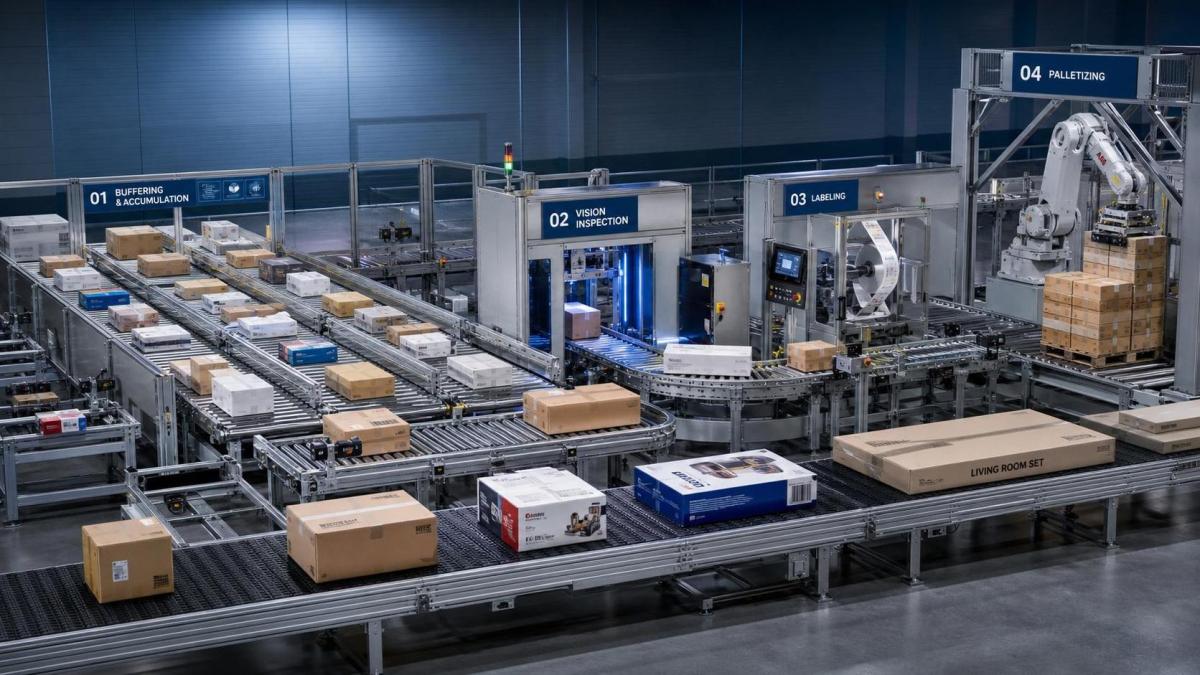
Automated packaging lines are often introduced to raise output across diverse orders, not just to replace labor.
The problem appears when mixed SKUs behave differently on the same line.
Small cartons, printed retail packs, flat-packed furniture components, and corrugated shippers do not create the same flow conditions.
In practical operations, throughput losses rarely come from one dramatic breakdown.
They usually come from brief stops, uneven infeed, rework loops, unstable stacking, and delayed handoffs between machines.
That is why automated packaging lines for mixed SKUs need to be judged as connected systems.
PWFS follows this issue closely across corrugated board lines, offset printing, folder-gluers, die-cutting systems, and woodworking equipment.
The common lesson is simple.
High speed on one machine does not guarantee high throughput across the full packaging flow.
Why the same automated packaging lines perform differently by scenario
Mixed-SKU environments differ because product geometry, surface quality, batch size, and routing logic vary at the same time.
A corrugated e-commerce line may face high carton volume with frequent size shifts.
A folding carton operation may have stricter print registration and orientation requirements.
A furniture packaging cell often handles heavy, flat, scratch-sensitive components that require careful buffering and labeling.
So the real question is not whether automated packaging lines are fast enough.
It is whether the line logic matches the SKU mix, order rhythm, and downstream handling constraints.
This is where many line upgrades go off track.
They benchmark nameplate speed, but ignore how mixed SKUs disturb line balance.
In e-commerce corrugated flow, buffering matters more than raw speed
For shipping cartons, automated packaging lines often run between converting output and dispatch pressure.
Corrugated board lines and converting equipment may produce at impressive speeds, yet the final line still stalls.
The reason is usually mismatch, not lack of machine capacity.
A short burst from die-cutting or folder-gluing can overwhelm case erecting, labeling, or pallet build logic.
When SKU sizes rotate rapidly, the line needs enough accumulation to absorb micro-stoppages without crushing board edges.
More commonly, the smart move is to invest in controlled buffering, not just faster conveyors.
- Use dynamic accumulation zones between converting and final pack-out.
- Group similar carton footprints when daily order peaks are predictable.
- Tie pallet patterns to live SKU data instead of fixed recipes.
- Track short stoppages by source, not only by total downtime.
That last point matters.
Repeated ten-second interruptions often hide a larger throughput loss than a single visible stop.
In printed carton lines, quality control can become the hidden constraint
Automated packaging lines for printed cartons work under tighter visual and positional tolerances.
Offset presses and folder-gluers may hold excellent precision, but mixed SKUs change the inspection burden.
Different artwork, coating behavior, carton stiffness, and fold memory all influence line stability.
In this setting, throughput improves when inspection is integrated into motion, not added as a stop-and-check layer.
A vision station that rejects too aggressively can be as harmful as poor print control.
The better approach is to separate critical defects from cosmetic variation that does not disrupt downstream packing.
This reflects a broader PWFS view.
Micron-level color registration has value only when the whole automated packaging line can sustain flow around that quality standard.
What usually deserves closer checking
- How fast the line recovers after an auto-reject event.
- Whether carton orientation changes during transfer or accumulation.
- If changeover settings are recipe-based or operator-dependent.
- Whether print quality alarms stop the full line unnecessarily.
Furniture and panel packaging need synchronization, not only automation
In woodworking and furniture systems, mixed SKUs are rarely simple cartons.
They may include panels, hardware kits, labels, protective layers, and sequence-specific packing instructions.
CNC routers and edge banders already create a highly flexible upstream environment.
That flexibility becomes a packaging challenge when one missing component delays a complete set.
Here, automated packaging lines must act as synchronization platforms.
The line should confirm kit completeness, surface protection, label accuracy, and shipping sequence before final closure.
A fast wrapper alone will not solve throughput if parts arrive out of order.
This is one reason MES connectivity matters in flexible manufacturing.
Data has to tell the line what belongs together, what can wait, and what must be rerouted.
Different scenarios need different line design priorities
A mixed-SKU strategy becomes clearer when design priorities are compared directly.
The main takeaway is practical.
Automated packaging lines should be tuned for the dominant disturbance in each scenario, not for an average theoretical case.
Mistakes that create bottlenecks even on modern automated packaging lines
Several misjudgments appear repeatedly across paper and wood product operations.
- Choosing equipment by maximum speed while ignoring changeover frequency.
- Assuming similar SKU dimensions mean similar handling behavior.
- Treating inspection, labeling, and palletizing as secondary tasks.
- Missing the impact of board warp, coating slip, or panel surface sensitivity.
- Underestimating software integration between production, packaging, and warehouse signals.
In real installations, the bottleneck often moves.
After one machine is upgraded, the next coordination point becomes the new limit.
That is why bottleneck analysis should be repeated after each major process change.
A practical way to improve throughput without losing flexibility
The strongest automated packaging lines are not always the most complex.
They are the ones with visible rules, controlled variation, and recoverable disturbances.
Start by mapping where SKUs diverge in dimensions, graphics, weight, and routing.
Then check which of those differences truly require mechanical adjustment.
Some issues belong in hardware, while others are better solved through recipes, buffering, or sequencing logic.
- Measure throughput by sustained good output, not peak cycle speed.
- Create SKU families based on handling behavior, not only dimensions.
- Set alarms by production impact level, so small deviations do not freeze the line.
- Review maintenance intervals around transfer, sensing, and accumulation zones first.
- Use data links across converting, packing, and dispatch to reduce waiting decisions.
For operations spanning corrugated packaging, printed cartons, and furniture components, this system view is especially useful.
It matches the PWFS perspective that precision mechanics, flexible processing, and digital coordination must work as one chain.
Before the next line upgrade, it helps to document actual stoppage patterns, compare scenario-specific constraints, and rank which bottlenecks are mechanical, procedural, or data-driven.
That kind of review makes automated packaging lines more adaptable, and it usually protects throughput better than another isolated speed increase.
Related News
Get weekly intelligence in your inbox.
No noise. No sponsored content. Pure intelligence.
