
Industrial Printing Equipment Buying Guide: Offset, UV, or Web Press for Volume and Cost?
Industrial Printing Equipment Buying Guide: Offset, UV, or Web Press for Volume and Cost?
Choosing the right industrial printing equipment can decide whether a plant grows efficiently or carries hidden cost for years.
For most buyers, the challenge is not comparing brochures. It is matching production reality with the right press platform.
Offset, UV, and web press systems all look attractive on paper. In practice, each one wins under different volume, substrate, and cost conditions.
This guide breaks down industrial printing equipment choices in plain business terms, so capital planning becomes clearer and less risky.
Start with the real buying question
Many teams ask which industrial printing equipment delivers the best print quality. That is too narrow.
The better question is this: which platform gives the lowest cost per saleable unit at your target output level?
That shift matters because a beautiful print result means little if makeready waste, downtime, or labor expense erodes margin.
In actual operations, industrial printing equipment should be judged by five filters:
- Monthly and seasonal production volume
- Substrate range, including paperboard, film, labels, or specialty stock
- Target print quality and color consistency
- Total operating cost, not only purchase price
- Expansion potential for automation and future product mix
Once these points are clear, the right industrial printing equipment usually becomes much easier to identify.
Where offset presses make the most sense
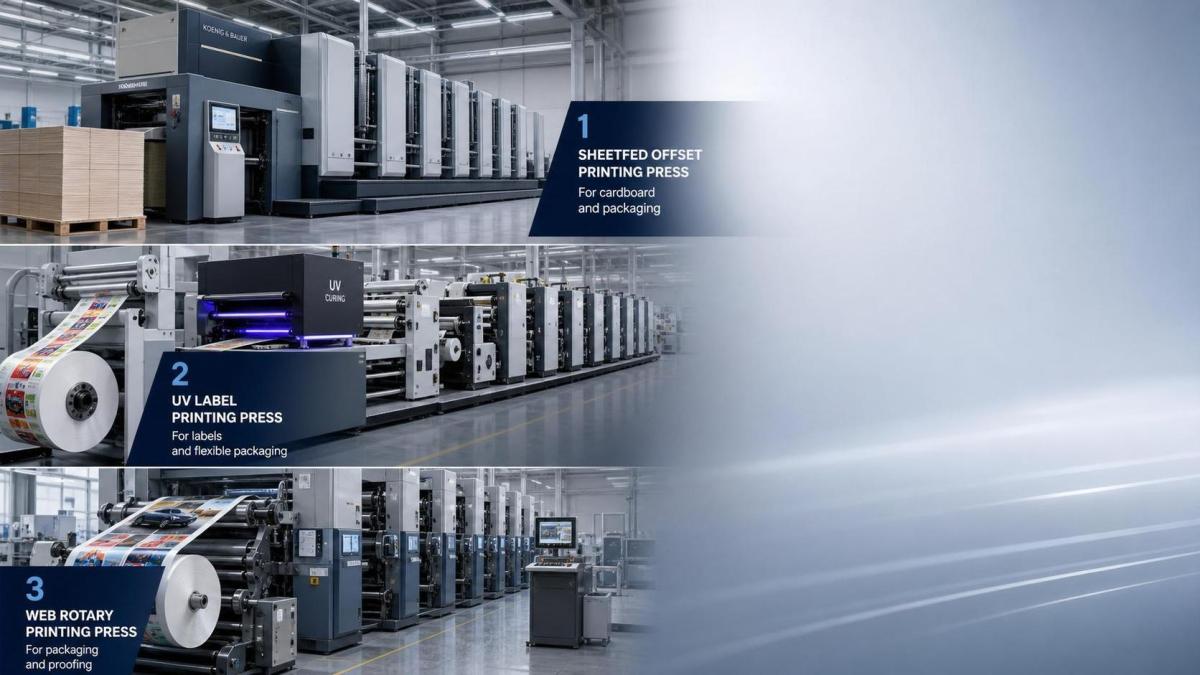
Offset remains one of the most trusted forms of industrial printing equipment for folding cartons, commercial print, and high-quality packaging graphics.
Its biggest strength is stable image quality at medium to high sheet volumes.
If a plant produces large batches with repeat jobs, offset often delivers an attractive unit cost after setup is absorbed.
Best fit for offset
- High-volume carton runs with strict color expectations
- Brand packaging with repeat SKUs
- Plants that can plan production in longer batches
- Operations with skilled pressroom color control
Key trade-offs
Traditional offset industrial printing equipment usually needs plates, setup time, and disciplined maintenance.
That means short runs can become expensive very quickly.
More importantly, the true cost is often hidden in changeover waste, operator dependency, and the need for reliable humidity and ink control.
So if the schedule changes every day, offset may not be the most flexible industrial printing equipment choice.
When UV presses justify the premium
UV press technology attracts attention because it expands what industrial printing equipment can print and how fast sheets can move to finishing.
UV curing allows printing on non-absorbent materials, specialty substrates, and premium packaging surfaces.
That flexibility is valuable in cosmetics, pharmaceuticals, luxury cartons, promotional packaging, and high-impact retail displays.
Why buyers choose UV industrial printing equipment
- Faster drying and shorter finishing turnaround
- Better performance on plastics, metallized stock, and coated surfaces
- Sharper visual effect for premium applications
- Reduced waiting time between print and post-press steps
Where caution is needed
The premium comes from higher capital cost, curing systems, energy demand, and stricter consumable management.
In some sectors, compliance also matters more, especially for food-contact or low-migration packaging.
So UV industrial printing equipment is not automatically the profitable option. It becomes profitable when premium output or substrate breadth drives customer value.
From a buying perspective, the question is simple: does UV capability raise sell price, order retention, or speed enough to offset ownership cost?
Why web presses win on sustained volume
If output volume is very high and continuous, web press systems become hard to ignore.
This type of industrial printing equipment is designed for long runs, roll-fed efficiency, and strong throughput economics.
Labels, flexible packaging, inserts, newspapers, and some high-volume commercial applications fit this model well.
Web press advantages
- High running speed over extended production windows
- Lower unit cost at large scale
- Efficient inline finishing possibilities
- Better labor productivity per printed output unit
Web press limits
Web industrial printing equipment is less forgiving when order sizes are unstable or SKU complexity grows.
It also demands strong process engineering, material planning, and maintenance discipline.
For buyers, this means the business case should rely on dependable volume, not optimistic forecasts alone.
A practical comparison for cost and volume
This comparison shows why no single industrial printing equipment platform is always best.
The most expensive mistake is buying for peak ambition instead of everyday production reality.
Hidden cost drivers buyers often miss
Purchase price is only the visible layer of industrial printing equipment investment.
In many evaluations, the bigger cost differences appear after installation.
- Makeready time and start-up waste
- Energy use under real production load
- Ink, coating, and curing consumable expense
- Operator skill dependency and training burden
- Spare parts lead time and service response
- Compatibility with die-cutting, folding, or finishing lines
This is where experienced buyers gain an edge. They model cost per good unit, not cost per machine hour.
That approach makes industrial printing equipment comparisons much more realistic, especially in packaging environments with tight delivery windows.
How to choose with more confidence
A useful buying process starts with operational data, not sales presentations.
- Map the top twenty jobs by revenue, volume, and margin.
- Separate repeat work from short-run or rush work.
- Measure waste, changeover time, and finishing bottlenecks.
- Test whether the new industrial printing equipment removes a real constraint.
- Calculate ROI using conservative utilization assumptions.
If most profitable work comes from repeat carton production, offset is often the rational choice.
If margin depends on substrate diversity and premium appearance, UV may create stronger commercial value.
If the business runs nonstop on predictable, very large volumes, web industrial printing equipment usually deserves serious attention.
Final decision framework
The right industrial printing equipment is the one that fits demand pattern, factory discipline, and customer value at the same time.
Offset supports reliable high-quality packaging at strong repeat volumes. UV expands premium applications and substrate flexibility. Web press systems dominate sustained output economics.
Before signing, ask one last question: which industrial printing equipment keeps cost under control when the schedule gets messy, not just when the factory runs perfectly?
That answer usually reveals the smartest investment path, and it helps turn equipment buying into a long-term margin decision instead of a short-term technical purchase.
Related News
Get weekly intelligence in your inbox.
No noise. No sponsored content. Pure intelligence.
