
Digital Print Packaging vs Conventional Printing: How to Choose for SKU Variety and Lead Time
Packaging decisions now sit closer to revenue strategy than simple print procurement. When SKU counts rise, launch windows shrink, and brand visuals matter across shelves and e-commerce, the choice between digital print packaging and conventional printing becomes a practical business question. It affects not only unit cost, but also obsolete stock, artwork agility, compliance control, and the ability to respond when demand changes faster than forecasts.
Why this comparison matters now
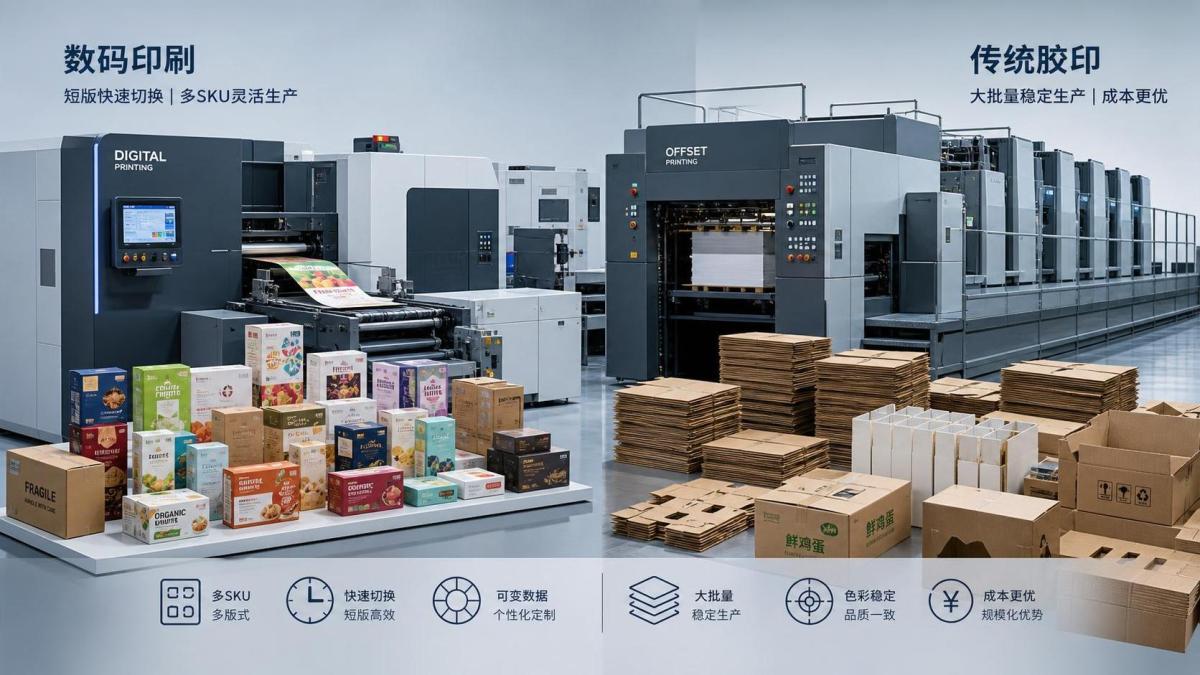
The pressure comes from several directions at once. Consumer brands manage more formats, more seasonal variants, and more market-specific labels. Retail packaging must work beside shipping cartons. At the same time, supply chains are less tolerant of overproduction.
That is why digital print packaging is no longer viewed only as a niche option for prototypes. It is increasingly part of mainstream packaging strategy, especially where lead time and SKU variety influence profitability.
This shift is especially visible in the industrial systems observed by PWFS. Corrugated board lines, high-precision offset presses, die-cutters, and folder-gluers all connect to the same business reality: packaging must combine visual accuracy, manufacturing speed, and flexible conversion without wasting board, ink, or time.
Two print paths with different strengths
Conventional printing usually refers to processes such as offset, flexo, or gravure, depending on the packaging format. These methods rely on plates, setup time, and longer press preparation, but they reward scale with lower unit costs and stable repeatability.
Digital print packaging works differently. Artwork moves from file to press with minimal setup. Variable content is easier to manage. Short runs become commercially viable because the economics are driven less by plates and makeready.
Simple comparisons can be misleading, though. The real decision is not digital versus traditional in the abstract. It is which method fits the mix of run length, graphic complexity, substrate type, finishing needs, and replenishment rhythm.
SKU variety changes the economics
SKU variety is often the turning point. A brand may not print huge total volume, yet still operate dozens of versions by language, channel, flavor, size, or promotional design. In that case, aggregate demand can look large while each SKU remains relatively small.
Conventional printing struggles when many short runs trigger repeated plate changes, color approvals, and line scheduling losses. The press may be highly productive, but the workflow around it becomes fragmented.
Digital print packaging handles this environment more naturally. It reduces the penalty for versioning. Artwork updates can move faster. Regional compliance changes, QR-based campaigns, or retailer-specific packs can be introduced without the same inventory burden.
That advantage matters in corrugated and folding carton applications alike. Where converters serve fast-moving launches, digital capability can protect margins by reducing stock write-offs rather than merely lowering print setup time.
Where conventional still wins
High-SKU complexity does not automatically eliminate conventional printing. If demand per SKU is stable and predictable, long scheduled runs on offset or flexo can still deliver excellent economics. This is particularly true when color consistency, special coatings, or high-speed downstream finishing dominate the total value equation.
PWFS closely tracks these production realities because the press is only one part of the system. A powerful offset line paired with efficient die-cutting and folder-gluing may outperform a digital route when the workflow is standardized and replenishment risk is low.
Lead time is more than press speed
Many decisions fail because lead time is measured only by impressions per hour. That misses the real bottlenecks. Total lead time includes artwork approval, prepress, plate making, substrate allocation, press queue, finishing, packing, and shipment.
Digital print packaging often shortens the beginning of that chain. Files are processed faster. Changeovers are simpler. Reorders can be smaller and more frequent. For volatile markets, this can reduce safety stock and improve launch responsiveness.
Conventional printing, however, can still deliver short effective lead times when demand is forecast accurately and production is planned in blocks. Large offset presses running with micron-level registration remain unmatched for high-volume visual consistency.
In practical terms, the faster method is not always the one with the fastest setup. It is the one that creates the shortest reliable path from approved design to converted packaging in the warehouse.
What to evaluate beyond headline print cost
A narrow price-per-thousand comparison usually hides the real trade-offs. The more useful view is total packaging cost across the product lifecycle.
- Include plate costs, color matching effort, and makeready waste.
- Measure inventory risk for slow-moving or seasonal SKUs.
- Check whether smaller batches improve cash flow and forecast accuracy.
- Review finishing compatibility with die-cutting, creasing, and gluing stages.
- Confirm food-contact, migration, traceability, and sustainability requirements.
That last point deserves attention. Packaging is increasingly judged by compliance performance as much as visual appeal. Ink migration rules, FSC traceability, and substrate sourcing standards can affect technology choice, especially in food, health, and premium retail categories.
This is where a systems view becomes useful. PWFS emphasizes the connection between print physics, converting stability, and production intelligence. A technically elegant print result has limited value if it disrupts die-cut registration, slows folder-gluing, or raises reject rates.
Common scenarios and the better fit
Most packaging programs do not need a single answer. They need a selection logic.
Short campaign, many designs
Digital print packaging is usually stronger here. Seasonal packs, test-market launches, influencer collaborations, and localized e-commerce assortments benefit from low setup friction and shorter replenishment cycles.
Long-running core SKU
Conventional printing often makes more sense. Predictable demand allows longer runs, and the cost per unit improves significantly once setup is absorbed across volume.
Premium graphics with tight brand control
The answer depends on substrate, finish, and tolerance requirements. High-end offset remains powerful for exacting color reproduction, while advanced digital print packaging continues to close the quality gap in selected applications.
Mixed portfolios
Many of the best programs are hybrid. Core volumes stay on conventional lines. Variant-heavy, urgent, or test-market work moves to digital. This approach aligns well with modern MES-driven planning and flexible converting operations.
A practical framework for choosing
A useful decision model starts with four questions. They are simple, but they reveal most of the answer.
- How many units will each SKU actually need, not just the whole portfolio?
- How often will artwork, language, or regulatory content change?
- What is the cost of carrying excess packaging inventory for three to six months?
- Which finishing and conversion steps could limit theoretical print advantages?
If variability is high, replenishment windows are short, and waste from obsolete stock is painful, digital print packaging deserves serious consideration. If volumes are steady, graphics are fixed, and conversion lines favor long runs, conventional printing remains highly competitive.
The best next step is usually not choosing a technology in isolation. It is mapping SKU behavior, approval workflows, and downstream converting constraints together. That creates a decision standard that can be reused across categories, plants, and future packaging changes.
In other words, the right print choice is rarely about trend adoption. It is about aligning packaging format, operational rhythm, and business risk with the production system that handles them best.
Related News
Get weekly intelligence in your inbox.
No noise. No sponsored content. Pure intelligence.
