
Why CNC furniture manufacturing cuts rework in custom jobs
For custom furniture projects, rework often starts with small mistakes that spread fast. A wrong hole position, misread drawing, or manual size conversion can affect every following step.
CNC furniture manufacturing reduces those risks by connecting design, cutting, drilling, and nesting through one data flow. That makes bespoke production more accurate, repeatable, and easier to control.
When dimensions change late, digital files update faster than handwritten notes. This helps keep materials, labor hours, installation timing, and customer expectations aligned across the whole job.
What does CNC furniture manufacturing actually change in custom jobs?
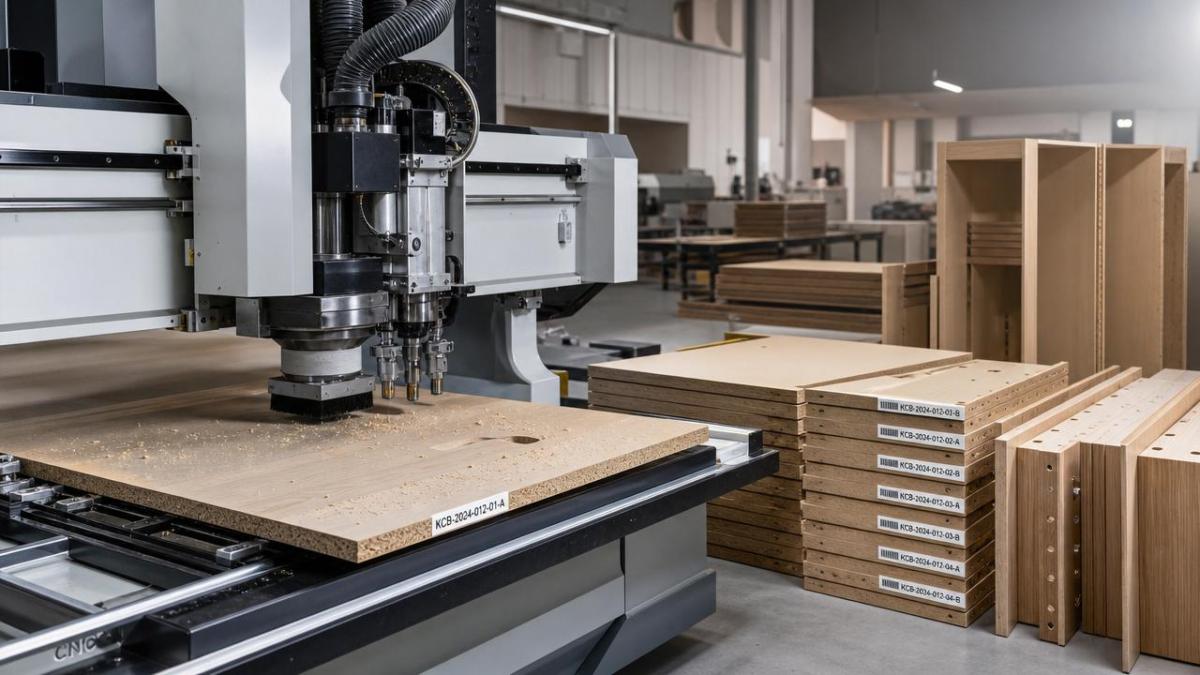
CNC furniture manufacturing changes how instructions move from design to the workshop floor. Instead of relying on repeated manual interpretation, machines read production-ready files directly.
That shift matters most in custom work. Every cabinet, wardrobe, vanity, or shelving system may have different widths, drilling patterns, and edge details.
With traditional methods, each variation creates another chance for confusion. CNC furniture manufacturing converts variation into controlled digital parameters rather than risky manual judgment.
It also standardizes repeatable operations:
- Panel sizing with tighter dimensional consistency
- Drilling patterns aligned to hardware requirements
- Grooving and routing matched to assembly logic
- Nesting layouts that reduce material waste
- Part labeling that supports faster downstream sorting
In the broader industrial context, this is where woodworking joins digital manufacturing. The same logic seen in advanced packaging and print automation now drives furniture precision too.
Why does CNC furniture manufacturing cut rework more effectively than manual methods?
Rework usually comes from inconsistency, not only from visible mistakes. A panel may look correct, yet fail during fitting because one hidden process step drifted off target.
CNC furniture manufacturing lowers that drift by keeping execution tied to exact coordinates. The machine repeats programmed actions without fatigue, assumption, or measurement memory errors.
This matters in custom interiors where tolerances accumulate. If one base cabinet is off, countertops, fillers, doors, and installation sequencing can all suffer.
Key reasons rework drops include:
- Fewer drawing interpretation errors between design and production
- Better repeatability across batches of unique parts
- More accurate hole placement for hinges, cams, and connectors
- Reduced panel mix-ups through coding and labeling
- Faster correction cycles when changes occur before machining
Manual craftsmanship still has value, especially for finishing and exceptions. Yet for standardizable custom panel work, digital precision removes many common failure points before they become costly defects.
Where does rework usually hide?
It often hides between departments. Design may assume one hardware system, while production uses another drilling map. Installation then discovers the mismatch at the site.
CNC furniture manufacturing helps because shared digital rules can connect those stages earlier. That creates fewer surprises when parts reach assembly and delivery.
Which custom furniture scenarios benefit most from CNC furniture manufacturing?
Not every woodworking task gains equally. The strongest benefits appear where variation is high but process logic remains structured and repeatable.
Typical high-impact scenarios include:
- Whole-house customization with many room-specific panels
- Built-in wardrobes with nonstandard heights and widths
- Kitchen cabinetry needing strict hardware alignment
- Retail fixtures requiring repeated branded dimensions
- Hospitality furniture with multi-room consistency demands
- Office storage systems with phased project delivery
These jobs combine customization with deadline pressure. CNC furniture manufacturing supports both by reducing setup confusion while preserving design flexibility.
It is especially valuable when projects include many mirrored, modified, or room-dependent components. In such cases, manual checking becomes slower and less reliable as complexity rises.
How should CNC furniture manufacturing be judged before adoption or expansion?
The best evaluation is not machine speed alone. Rework reduction depends on the full process chain, including software preparation, material handling, labeling, and edge processing.
A practical review should examine these factors:
In other words, CNC furniture manufacturing works best when it is treated as a system, not only as a standalone machine purchase.
What signals show the process is ready?
Look for frequent design changes, recurring panel errors, rising installation callbacks, or heavy dependence on a few experienced workers. Those signals often point to preventable process fragility.
What risks and misconceptions can limit CNC furniture manufacturing results?
One common misconception is that CNC furniture manufacturing automatically eliminates all mistakes. In reality, poor source data can still produce precise but wrong parts.
Another risk is focusing only on cutting. Rework may still appear later if edge banding, hardware selection, packaging, or site measurement remain disconnected.
Watch for these pitfalls:
- Unverified design libraries with outdated hardware rules
- Weak tool maintenance causing hidden dimensional drift
- Insufficient training for file preparation and exception control
- No feedback loop from installation to engineering updates
- Overlooking material behavior like chip-out or board warpage
Advanced woodworking systems perform best when paired with disciplined process governance. That principle is familiar across corrugated, offset, die-cutting, and automated furniture production alike.
How does CNC furniture manufacturing affect cost, lead time, and project control?
The direct savings often appear in scrap, labor repetition, and fewer site fixes. However, the larger value usually comes from schedule predictability and stronger delivery confidence.
When custom parts are right the first time, installation becomes smoother. Teams spend less time trimming panels, remaking doors, or waiting for corrected components.
That improves several business outcomes:
- Shorter overall production cycles
- Better material yield through optimized nesting
- Lower hidden costs from urgent remakes
- Fewer installation delays and coordination conflicts
- More scalable handling of mixed custom order volumes
CNC furniture manufacturing also supports more transparent planning. Once digital data drives operations, performance can be tracked through throughput, first-pass yield, and defect trend analysis.
Quick FAQ comparison table
Why CNC furniture manufacturing cuts rework in custom jobs becomes clear when the entire workflow is examined. Better data continuity creates better part accuracy, and better part accuracy reduces downstream disruption.
For operations balancing customization with delivery pressure, CNC furniture manufacturing offers a practical path toward fewer remakes, cleaner installation, and more stable margins.
A useful next step is to map where errors currently originate: design changes, drilling mismatch, panel labeling, assembly fit, or site correction. That review shows where digital machining can create the fastest return.
Within the wider paper, print, and woodworking intelligence landscape, PWFS continues tracking how connected production systems turn precision into profitability across both packaging and furniture industries.
Related News
Get weekly intelligence in your inbox.
No noise. No sponsored content. Pure intelligence.
