
How to choose industrial woodworking equipment wisely
Choosing industrial woodworking equipment wisely is critical for balancing output, precision, cost, and long-term flexibility.
In furniture, panel processing, and customized interiors, the right machine affects yield, lead time, energy use, and product consistency.
From CNC routers to edge banders, industrial woodworking equipment now connects software, automation, and material science in one production flow.
A careful selection process reduces downtime, supports future product changes, and protects capital from short-lived buying decisions.
Understanding industrial woodworking equipment and its production role
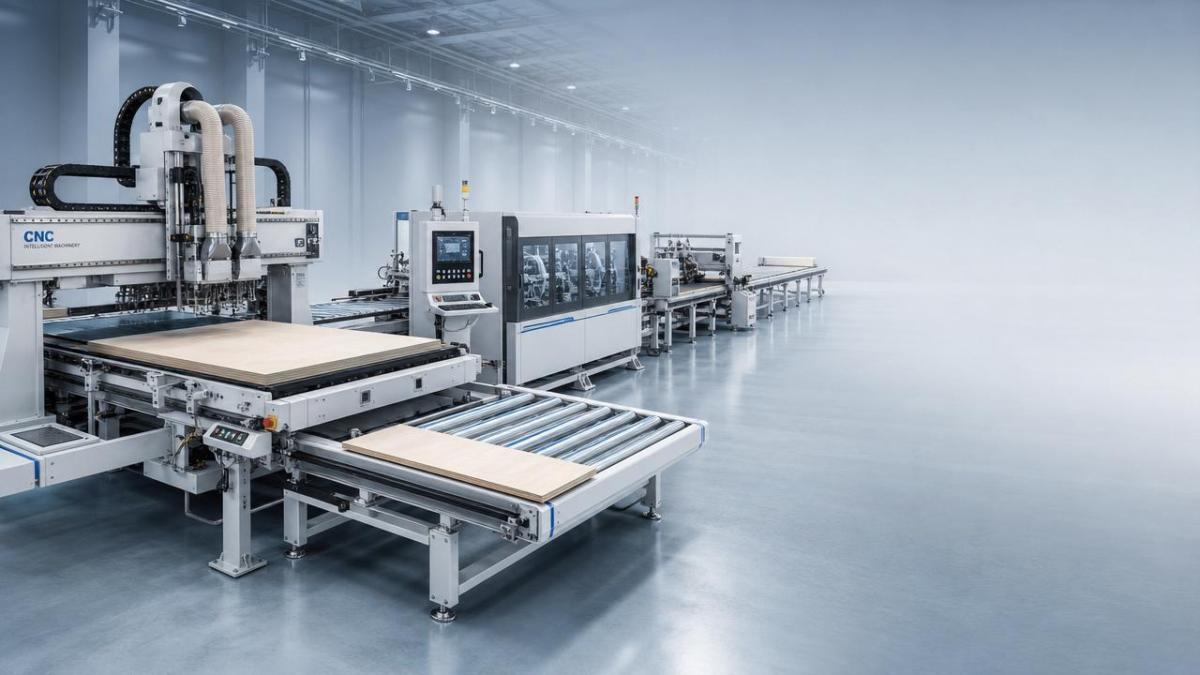
Industrial woodworking equipment refers to machines used to cut, drill, route, shape, seal, and finish wood-based panels at commercial scale.
This category includes CNC routers, beam saws, nesting lines, drilling centers, sanding systems, panel edge banders, and automated handling units.
Unlike light workshop tools, industrial woodworking equipment is designed for repeatability, integration, and multi-shift performance.
Selection should never focus on a single machine alone.
It should consider the entire process, from digital design input to final panel quality, packaging, and delivery speed.
For businesses following flexible manufacturing trends, industrial woodworking equipment also needs software compatibility and modular automation potential.
Core machine groups
- CNC routers for cutting, grooving, drilling, and contour shaping.
- Beam saws and panel saws for high-speed, straight-line cutting.
- Drilling centers for hinge holes, connectors, and hardware preparation.
- Panel edge banders for sealing and improving appearance and durability.
- Dust collection and material handling systems for safety and productivity.
Industry signals shaping equipment decisions
The market for industrial woodworking equipment is changing because product variety is growing while delivery windows are shrinking.
Whole-house customization, shorter batch runs, labor constraints, and sustainability demands are now central decision factors.
PWFS tracks these shifts across woodworking, furniture systems, and connected automation.
These signals show why buying industrial woodworking equipment based only on price often creates hidden operational costs later.
Business value created by the right industrial woodworking equipment
Well-matched industrial woodworking equipment improves more than cutting speed.
It supports stable quality, cleaner workflows, lower material waste, and better use of skilled labor.
In custom furniture and panel processing, accuracy errors multiply across drilling, edging, assembly, and installation.
A precise machine therefore protects downstream efficiency.
Key business benefits
- Higher throughput through optimized feeds, tool changes, and automated loading.
- Better consistency across repeated orders and multiple shifts.
- Lower board waste through nesting efficiency and accurate cutting paths.
- Improved edge quality and moisture resistance with advanced edge banding.
- Stronger capacity for customization without sacrificing delivery speed.
For integrated production environments, industrial woodworking equipment can also become a bridge between design software and factory execution.
That link is increasingly important in Industry 4.0 planning.
Typical equipment categories and selection focus
Different applications require different combinations of industrial woodworking equipment.
The table below highlights common categories and the main points worth comparing.
Practical criteria for choosing industrial woodworking equipment wisely
A strong buying decision comes from comparing process fit, not just brochure specifications.
The following criteria help evaluate industrial woodworking equipment with fewer blind spots.
1. Match the machine to actual product mix
Review board sizes, material types, thickness ranges, batch frequency, and finish expectations before shortlisting any machine.
An oversized machine may waste capital, while an underspecified one limits growth.
2. Verify precision under production conditions
Catalog tolerance is not enough.
Check repeatability, thermal stability, vibration control, and accuracy after continuous shifts and varied workloads.
3. Evaluate software and data connectivity
Modern industrial woodworking equipment should communicate with CAD/CAM, MES, barcode systems, and production scheduling tools.
This reduces manual errors and supports traceable workflows.
4. Assess maintenance and service response
Downtime cost often exceeds purchase savings.
Check spare parts availability, remote diagnostics, training quality, and local technical support before final selection.
5. Include operating cost, not only purchase price
Compare energy consumption, tooling wear, glue use, reject rates, dust extraction needs, and labor dependence.
These define total cost of ownership.
6. Confirm upgrade and automation potential
Future-ready industrial woodworking equipment should allow loading modules, labeling, robotic handling, or line integration later.
This keeps expansion practical without full replacement.
Common decision mistakes and how to avoid them
Many equipment problems begin long before installation.
They usually come from incomplete process mapping or unrealistic expectations.
- Buying for peak speed while ignoring daily order variation.
- Skipping software integration checks until after delivery.
- Underestimating dust extraction, power, air supply, and floor layout needs.
- Comparing machines without using the same sample materials and programs.
- Ignoring operator learning time and maintenance discipline.
Factory acceptance testing, sample validation, and process simulation can prevent these issues before capital is committed.
A structured path for the next equipment decision
The smartest way to choose industrial woodworking equipment is to start with process targets, then evaluate machines against measurable operational outcomes.
Define required throughput, tolerance, changeover time, digital integration, and lifecycle cost in one comparison framework.
Use sample panels, real production files, and maintenance scenarios during supplier review.
That approach creates a more reliable investment case.
For businesses tracking advanced print, packaging, and wood systems, PWFS offers intelligence that connects machine physics, automation logic, and industrial scalability.
A disciplined evaluation today can turn industrial woodworking equipment into a long-term advantage in quality, customization, and profitable growth.
Related News
Get weekly intelligence in your inbox.
No noise. No sponsored content. Pure intelligence.
