
Is CNC furniture production worth the setup cost now?
For finance decision-makers, the real question is not whether CNC furniture production is advanced, but whether its setup cost can deliver measurable payback now. As labor costs rise, custom demand accelerates, and lead-time pressure grows, CNC furniture production is increasingly shifting from a capital-heavy option to a strategic investment. This article examines whether the numbers, risks, and long-term efficiency gains truly justify adoption today.
For companies operating in panel furniture, whole-house customization, and integrated woodworking lines, the answer depends less on headline machine price and more on throughput, order mix, labor substitution, scrap control, and digital coordination. In the PWFS view, CNC furniture production should be assessed as part of a connected manufacturing system, not as a standalone machine purchase.
That distinction matters to CFOs, plant investors, and approval committees. A router, nesting line, drill bank, edge bander interface, and MES connection can either create a 24-month payback path or become an underutilized asset. The difference usually comes down to planning discipline, production fit, and implementation timing.
Why CNC furniture production setup costs are under fresh financial review
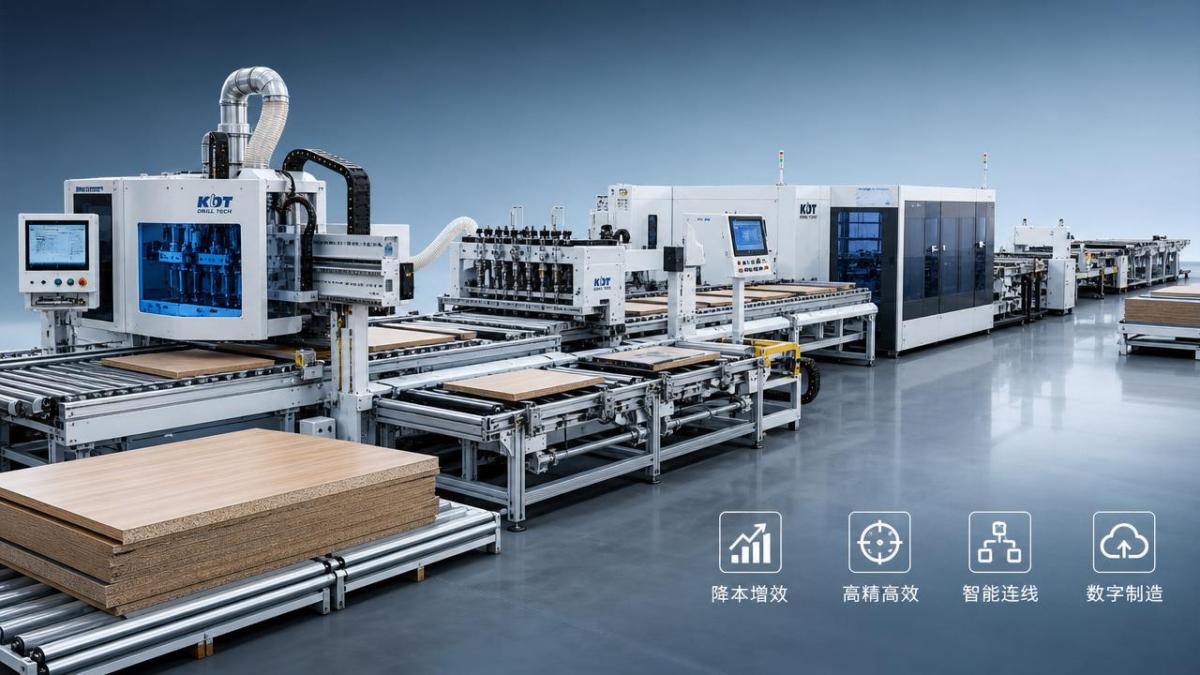
The economics of CNC furniture production have changed materially in the last 3 to 5 years. Three pressures are now converging: labor inflation, smaller batch sizes, and tighter delivery promises. In many furniture plants, manual or semi-manual production still depends on high-skill operators, yet customer demand increasingly favors batch size 1 to batch size 20 orders.
For a finance approver, this creates a measurable mismatch. Traditional workflows can look cheaper at the purchase stage, but they often generate hidden cost in rework, scheduling delays, panel mistakes, overtime, and inefficient board utilization. CNC furniture production reduces those losses when order complexity rises above a basic threshold.
The cost structure is broader than the machine invoice
Setup cost usually includes 5 cost layers: machine acquisition, software integration, operator training, layout adjustment, and commissioning downtime. For a mid-range panel furniture operation, the initial commitment may span 1.0x to 1.6x the visible machine price once tooling, dust collection, labeling, and data flow preparation are included.
However, the return side also has 5 layers: labor reduction, scrap savings, output consistency, shorter lead times, and improved order acceptance. Plants that evaluate only capital expenditure often reject CNC furniture production too early, while plants that model total operational effect usually make a more balanced decision.
What has made the investment more attractive now
- Custom cabinet and wardrobe demand now requires faster SKU switching, often several times per shift.
- Lead-time expectations have compressed from 15 to 20 days toward 7 to 12 days in many competitive markets.
- Panel yield optimization software can reduce waste by roughly 3% to 8% in common nesting scenarios.
- One CNC cell can consolidate 2 to 4 manual processing steps depending on line design.
- Digital order files reduce interpretation error between design, production, and installation teams.
These changes are especially relevant for manufacturers linked to the broader paper-and-wood flexible manufacturing trend that PWFS tracks. The same market logic that rewards automated die-cutting and high-speed folding in packaging also rewards precision, repeatability, and digital connectivity in furniture production.
A practical view of setup cost components
Before approval, it helps to break the investment into controllable blocks rather than treating it as one large number. The table below outlines common setup elements finance teams should review during CNC furniture production planning.
The key conclusion is that setup cost is manageable when broken into transparent categories. It becomes risky only when software, tooling, and process adaptation are omitted from the original business case and later appear as unplanned capital or operating expense.
When CNC furniture production delivers payback fast enough to justify approval
CNC furniture production is usually worth the setup cost when at least 3 of 4 conditions are present: frequent customization, recurring labor bottlenecks, scrap above control targets, or unstable lead times. If a plant mainly produces simple, repetitive components in large batches, payback may be slower. But if order variation is high, the economics improve quickly.
In practical approvals, many decision-makers target a 18 to 36 month payback window. For plants facing high order volatility, strong installation demand, or rising labor replacement pressure, the payback can become acceptable even sooner, especially when the CNC cell replaces multiple manual stations.
Four signals that the investment case is strong
1. Custom order ratio is rising
If more than 30% to 40% of monthly orders involve size variation, drilling differences, or mixed-material processing, manual planning costs rise sharply. CNC furniture production handles file-driven variation with less setup loss, making custom work more profitable instead of more disruptive.
2. Skilled labor dependence is becoming expensive
A workshop that relies on 3 to 6 highly experienced operators for cutting accuracy carries both wage pressure and continuity risk. When one operator leaves, production quality and schedule can drop immediately. CNC systems transfer part of that skill dependency into standardized programming and repeatable execution.
3. Scrap and rework are reducing margin
Even a 2% to 5% avoidable material loss matters when board costs are rising. In panel furniture, repeated drilling errors, labeling mistakes, and wrong nesting decisions create hidden cash leakage. CNC furniture production improves traceability and repeatability, particularly when linked with barcode labeling and order routing logic.
4. Delivery promises are limiting sales growth
If sales teams repeatedly reject profitable orders because production needs 12 to 18 days while the market demands 7 to 10 days, the real cost is not just inefficiency. It is lost revenue. Faster digital processing can expand order acceptance without adding equivalent headcount.
Simple decision matrix for finance teams
The following matrix can help approval teams judge whether CNC furniture production is strategically justified now, later, or only in limited scope.
This matrix shows why CNC furniture production should not be judged by machine cost alone. A plant with a moderate budget but strong customization pressure may justify the investment more easily than a larger factory producing standard panels with low variation.
How to evaluate the hidden risks behind the setup cost
Not every CNC furniture production project succeeds. Some fail because the machine is wrong; many fail because the process around the machine is weak. Finance teams should examine at least 6 risk points before approving capital: file quality, line balancing, operator training, utility readiness, maintenance planning, and downstream coordination with edge banding and assembly.
The most common approval mistakes
- Buying capacity for peak demand without enough average monthly volume.
- Ignoring software workflow and focusing only on spindle speed or axis count.
- Underestimating tool wear, dust extraction load, and consumable planning.
- Failing to align CNC output with edge bander, sorting, and packaging stations.
- Expecting full productivity in the first 7 days after installation.
These are not minor technical details. They directly affect depreciation efficiency, labor cost absorption, and the speed at which capital converts into usable output. In other words, the setup cost is only worth it when the line reaches reliable utilization.
A safer implementation sequence
A disciplined rollout often follows 4 stages over 6 to 12 weeks. Stage 1 validates product mix and layout. Stage 2 installs equipment and utility support. Stage 3 runs pilot orders and parameter tuning. Stage 4 connects production data, labeling, and downstream handoff. This phased approach reduces commissioning shock and helps finance teams release funds against milestones.
For plants already operating edge banders, panel saws, or drilling centers, integration matters more than raw speed. A CNC router producing 30% more parts than the next station can handle does not create true productivity. It only shifts the bottleneck. PWFS consistently sees better results when investments are reviewed as a flexible manufacturing cell instead of isolated assets.
Operational checkpoints before sign-off
- Confirm expected daily board volume across 1 shift and 2 shift scenarios.
- Verify acceptable cutting tolerance and drilling repeatability for target products.
- Review spare parts lead time, especially for electrical and motion components.
- Define training hours for operators, programmers, and maintenance technicians.
- Set a ramp-up KPI window, such as 30, 60, and 90-day utilization targets.
If these checkpoints are documented before procurement, CNC furniture production becomes much easier to govern financially. It also strengthens supplier comparison because bids can be assessed on total implementation quality, not only initial quotation.
What finance decision-makers should ask suppliers before approving CNC furniture production
Good supplier questions shorten the distance between capital approval and measurable output. In furniture manufacturing, this is critical because machine performance depends on software logic, process tuning, and after-sales responsiveness almost as much as on mechanical design.
Five questions that expose the real business case
What product mix is the line optimized for?
A supplier should be able to explain whether the recommended CNC furniture production setup fits cabinets, wardrobes, office panels, or mixed-material jobs. The answer affects tooling, drilling configuration, and cycle-time assumptions.
What is the realistic ramp-up period?
Ask for a practical window such as 2 to 4 weeks for stable pilot output and 6 to 10 weeks for normalized productivity. Immediate full-rate promises are usually unreliable.
How does the system connect with design and order data?
The value of CNC furniture production increases sharply when CAD, order splitting, labeling, and shop-floor execution are linked. Manual re-entry reduces the ROI and raises the chance of order errors.
What support is included after installation?
Response time, spare part policy, remote diagnostics, and training refreshers should all be clarified. A lower machine price can become expensive if downtime lasts 48 to 72 hours for ordinary faults.
Which KPI baseline should be used for ROI tracking?
The most useful KPIs are usually labor hours per order, material yield, on-time delivery rate, rework percentage, and average order cycle time. These metrics make the investment case auditable after go-live.
A finance-oriented conclusion
Is CNC furniture production worth the setup cost now? For factories facing higher labor cost, rising customization, and tighter delivery expectations, often yes. But the justification depends on system fit, not automation hype. The strongest approvals are built on transparent setup categories, a realistic 18 to 36 month payback model, and a phased implementation plan tied to operational KPIs.
For businesses following the manufacturing intelligence perspective of PWFS, CNC furniture production is no longer just a machinery upgrade. It is a strategic node in digital paper-and-wood flexible manufacturing, where precision cutting, order data, and downstream finishing must work as one profit system.
If you are evaluating a new line, replacing labor-intensive processing, or comparing CNC investment paths for custom furniture production, now is the right time to review the numbers in detail. Contact us to get a tailored assessment, discuss equipment fit, or explore more solutions for efficient woodworking and furniture manufacturing.
Related News
Get weekly intelligence in your inbox.
No noise. No sponsored content. Pure intelligence.
