
Folder Gluers Explained: Types, Key Sections, and Where Each Configuration Fits
Folder-gluers sit at the last decisive stage of carton converting, where printed and die-cut blanks become saleable boxes. That final step looks simple from a distance, yet the wrong configuration can limit box styles, waste board, slow changeovers, or create unstable seams. In a market shaped by e-commerce volume, branded shelf impact, and tighter production control, understanding how folder-gluers are built and where each format fits has become a practical requirement rather than a technical side topic.
Why folder-gluers matter beyond line speed
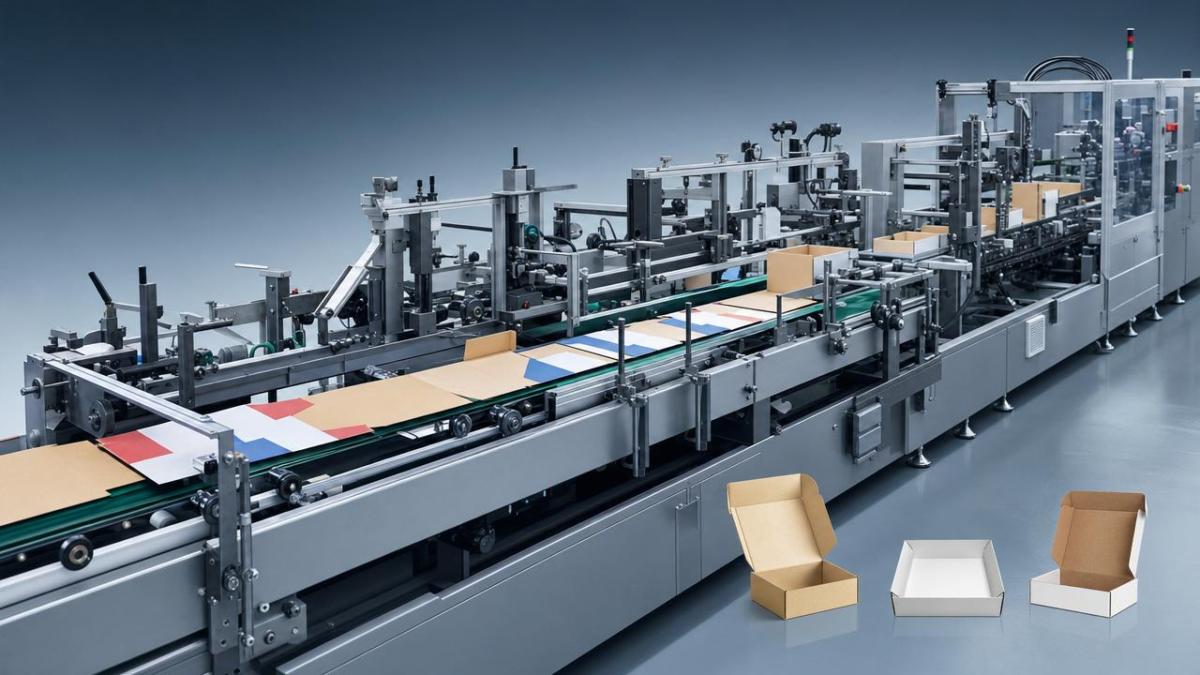
A folder-gluer does more than fold and bond paperboard. It protects the value already created upstream by corrugated board lines, offset presses, and die-cutting systems.
If print registration is precise but the fold is off, the package still fails on shelf. If a blank is die-cut cleanly but glued poorly, the box can collapse during filling.
That is why PWFS treats folder-gluers as part of a wider production intelligence chain. Their performance links packaging aesthetics, structural accuracy, material efficiency, and downstream packing stability.
The current spotlight comes from three pressures. SKU counts keep rising. Delivery packaging must run faster. Premium cartons need tighter tolerances with fewer manual touches.
How folder-gluers actually work
At a basic level, folder-gluers feed flat blanks, align them, pre-break key creases, apply adhesive, complete the folding sequence, and deliver compressed bundles for setting.
That sequence sounds linear, but each stage affects the next. Feeding instability can distort alignment. Uneven glue transfer can reduce bond strength. Poor folding geometry can mark printed surfaces.
Modern folder-gluers rely on synchronized belts, carriers, servo-driven modules, and inspection functions to keep cartons consistent at high speed. The objective is not only throughput.
The real objective is repeatable carton quality across different substrates, box styles, and order lengths. This is where machine configuration begins to matter more than headline speed figures.
The machine sections that define real performance
Feeder and alignment
A stable feeder keeps blanks separated, square, and correctly introduced. Board thickness variation, warp, and print varnish can all affect pickup and tracking.
The alignment section corrects side lay and running position. This directly influences fold symmetry and glue placement.
Pre-breaking and folding rails
Pre-breaking is essential for cartons that must open smoothly or hold a precise erected shape. It reduces spring-back and helps difficult materials fold without cracking.
Folding rails and carriers then guide the blank through a controlled path. On higher-end folder-gluers, this section often determines flexibility for complex carton work.
Gluing, transfer, and compression
Glue systems must match both substrate and carton design. Cold glue remains common, but nozzle precision, viscosity control, and clean application are critical for reliable bonds.
The transfer and compression sections stabilize the folded blank and hold pressure long enough for secure setting. Weak compression often shows up later as seam failure in filling lines.
Inspection and delivery
Inspection systems increasingly check glue presence, barcode readability, blank ejection, and folding accuracy. This matters most in pharmaceutical, cosmetic, and regulated consumer packaging.
A good delivery section also protects stack quality. Neat collection supports easier counting, packing, and transfer to filling or shipping operations.
Main folder-gluer types and where they fit
Not all folder-gluers are intended for the same carton family. The right type depends on structure, run length, setup frequency, and the value of the packaged product.
Straight-line folder-gluers are usually the first reference point. They suit folding cartons with relatively direct geometry and are common in food, household, and volume retail packaging.
Crash-lock bottom systems are valuable when boxes must open quickly during manual or automatic filling. They are common in consumer goods, takeaway packs, and promotional carton formats.
Four-corner and six-corner folder-gluers support more elaborate structures. These formats are often chosen for cosmetics, confectionery, pharmaceuticals, and presentation-driven packaging.
Where configuration choice changes business results
Configuration affects more than output speed. It also changes setup time, waste generation, labor dependence, and the practical range of cartons that a converting line can accept.
For short runs and frequent artwork changes, changeover speed can matter more than maximum cartons per hour. For regulated packaging, inspection options may outweigh raw mechanical speed.
In corrugated-related applications, folder-gluers must also cope with heavier board behavior and structural stiffness. In premium paperboard work, surface protection and crisp folding become more critical.
This is why machine fit should be judged in context with die-cut accuracy, print finish, adhesive behavior, and filling-line expectations. A folder-gluer never works in isolation.
Signals the industry is watching closely
Several trends are reshaping how folder-gluers are evaluated. One is the move toward mixed production, where converters must switch between standard cartons and value-added structures without heavy downtime.
Another is data visibility. More lines now connect inspection, setup memory, and MES-level reporting. That shift supports the broader automation direction highlighted across PWFS coverage.
Sustainability is also becoming more concrete. The focus is not only lighter board grades, but also glue control, waste reduction, and more stable production that avoids rework.
Compliance adds another layer. Food contact packaging and pharmaceutical cartons demand confidence in bond integrity, print handling, traceability, and inspection consistency.
What to check before comparing folder-gluers
A useful comparison starts with the carton portfolio, not the brochure cover. Machines that look similar on paper can perform very differently once actual blank designs and substrates are introduced.
- Map the current box styles and note which ones create setup delays or quality complaints.
- Check substrate range, including board warp, coating, caliper variation, and glue compatibility.
- Review changeover logic, job memory, and accessibility of rails, carriers, and glue heads.
- Look at inspection functions in relation to customer requirements and error-cost exposure.
- Compare compression path length and delivery stability, not just top mechanical speed.
- Assess how the folder-gluer fits upstream die-cutting quality and downstream packing conditions.
In practical terms, the best machine is often the one that removes recurring friction from the whole converting flow, even if its peak speed is not the highest advertised.
A practical way to move from interest to evaluation
The clearest next step is to define the carton mix, required output stability, and quality risk points before reviewing machine categories. That gives structure to every later comparison.
From there, it becomes easier to judge whether straight-line, crash-lock, multi-corner, or modular folder-gluers fit the real workload. The goal is not to buy complexity for its own sake.
It is to match folding architecture, glue control, inspection depth, and automation level with the type of packaging operation being built. For anyone tracking packaging machinery through the wider PWFS lens, that systems view usually leads to better decisions than speed comparisons alone.
Related News
Get weekly intelligence in your inbox.
No noise. No sponsored content. Pure intelligence.
