
Folder-Gluers Explained: Types, Line Configurations, and Key Setup Parameters
Folder-gluers sit at the last decisive stage of carton converting. After printing and die-cutting have done their work, these machines turn flat blanks into finished boxes that can move directly into packing, shipping, or retail filling.
That final step sounds simple, yet it often decides whether a line runs profitably. A clean fold, stable glue line, and square carton affect filling speed, shelf appearance, transport strength, and reject rates all at once.
For PWFS, which tracks corrugated lines, offset presses, die-cutters, folder-gluers, and woodworking automation, this matters because production quality is always connected. Micron-level print accuracy means little if the folding and gluing stage breaks the geometry.
Why folder-gluers matter more than ever
Carton demand keeps rising with e-commerce, pharmaceuticals, cosmetics, food distribution, and short-run promotional packaging. At the same time, box designs are becoming more complex, while lead times are getting shorter.
This pushes folder-gluers into a more strategic role. They are no longer just finishing equipment. They are speed regulators, quality filters, and waste-control tools inside a broader packaging workflow.
In practical terms, one unstable setup can cancel gains made upstream. If feeder timing drifts, if fold rails fight the blank memory, or if glue volume changes with speed, the line quickly produces waste instead of value.
That is why current attention is not only on headline speed. The stronger question is whether folder-gluers can hold repeatable performance across changing substrates, small batches, and tighter quality expectations.
What a folder-gluer really does on the line
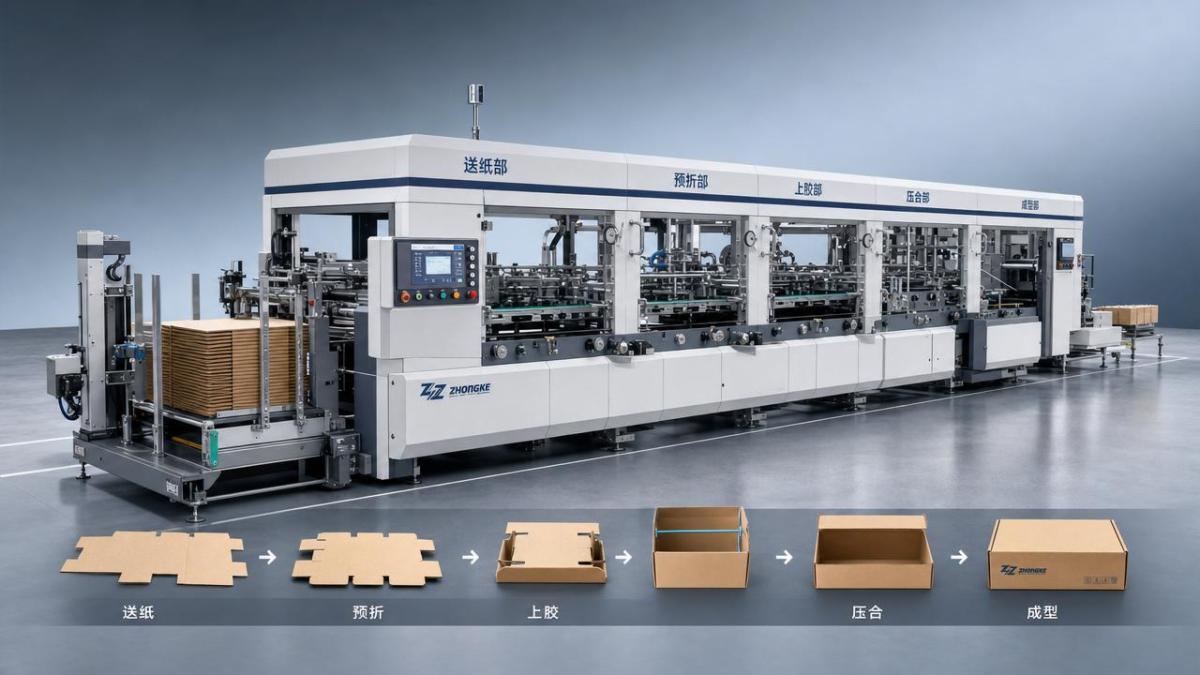
A folder-gluer aligns, folds, applies adhesive, compresses, and delivers the carton in a controlled sequence. Each section depends on the previous one, so small mechanical errors tend to multiply downstream.
The feeder introduces blanks consistently. The pre-break and folding sections help the board remember its creases. The glue system places adhesive exactly where the structure needs bonding. The compression section sets the joint before discharge.
When operators talk about “easy” box styles, they usually mean blanks that track predictably through this sequence. Difficult jobs often combine warped material, heavy ink coverage, tight tolerances, unusual glue flaps, or multi-point structures.
Understanding folder-gluers, then, means reading the box as a moving geometry problem, not just a machine setting problem.
Main types of folder-gluers and where they fit
Not every machine is built for the same carton family. The right type depends on structure complexity, substrate behavior, speed target, and changeover frequency.
Straight-line equipment remains the backbone for volume work. Crash-lock and multi-corner systems offer more value when box functionality matters more than simple throughput.
In many plants, the real question is not which machine is fastest. It is which folder-gluers can cover the broadest job mix without unstable setups between orders.
Line configurations that shape daily performance
Line configuration decides how flexibly the machine responds to different carton designs. A basic straight path may be enough for side-seam work, but more demanding jobs need added modules and tighter control points.
Feeder and alignment section
Poor feeding creates double sheets, skew, and timing variation. Suction strength, gate position, and belt speed must match blank weight, curl, and surface condition.
Pre-break and folding rails
Pre-break improves carton opening performance and reduces spring-back. Rail geometry should support the crease, not force it. Too much aggression often marks the board or twists the carton body.
Glue application system
Disc guns and nozzle systems each have strengths. The critical point is repeatability at real speed, especially where varnish, coated stock, or narrow glue flaps increase bonding risk.
Compression and delivery
A good bond needs proper pressure and dwell time. If cartons leave compression too early, glue may still be wet. If pressure is uneven, the seam looks closed but opens later.
Key setup parameters that deserve constant attention
Most output problems come from a small set of variables. Watching these closely brings faster troubleshooting than chasing random adjustments across the whole machine.
- Blank quality: warped sheets, cracked creases, dust, and uneven die-cut edges reduce stability before folding even starts.
- Machine speed: higher speed changes blank behavior, glue transfer, and compression timing. A stable job at 180 m/min may fail at 260 m/min.
- Belt pressure and rail position: these control tracking and fold accuracy. Small shifts can change carton squareness dramatically.
- Glue volume and temperature: too little glue weakens the seam, while excess glue causes squeeze-out, marking, and contamination.
- Compression length: this affects bond setting, especially on coated board, laminated surfaces, and difficult crash-lock jobs.
- Environmental conditions: humidity and temperature influence board memory, adhesive response, and static behavior.
Usually, the most useful setup habit is to lock one stable reference job and compare deviations against it. That turns folder-gluers from trial-and-error machines into controlled production assets.
Typical problems and what they usually point to
Many defects look similar at discharge, yet their causes are different. Reading symptom patterns helps narrow the true source quickly.
This is where line knowledge matters. Folder-gluers do not fail in isolation. Print coating, die-cut pressure, and substrate storage conditions often show up as gluing defects later.
How folder-gluers fit into a wider converting strategy
PWFS follows folder-gluers alongside corrugated lines, presses, die-cutters, and digital production systems because packaging performance is cumulative. Each process transfers its strengths and weaknesses to the next one.
A well-printed sheet with poor creasing raises folding risk. A die-cut blank with edge dust weakens glue reliability. A fast machine without setup discipline creates impressive speed numbers and disappointing saleable output.
That is why many competitive plants now look at three linked goals together: yield rate, changeover speed, and carton consistency. Folder-gluers are central to all three.
More advanced lines also connect setup data, inspection signals, and job recipes through MES or digital production records. This does not replace experience, but it helps make good setups repeatable across shifts.
What to review before the next machine decision
Whether the goal is better daily running or future line planning, a useful starting point is simple. Review the current job mix, identify the carton styles causing the most stops, and map those issues to feeder, fold, glue, or compression behavior.
Then compare machine capability with real production needs, not brochure speed. Look closely at setup repeatability, module flexibility, adhesive compatibility, and how well the line handles coated board, micro-flute, or multi-corner work.
For many operations, the best next step is not a dramatic rebuild. It is building a sharper parameter standard for folder-gluers, linking it to upstream blank quality, and treating the machine as a precision system rather than a simple finishing stage.
That approach creates clearer decisions, faster troubleshooting, and more saleable cartons from every shift.
Related News
Get weekly intelligence in your inbox.
No noise. No sponsored content. Pure intelligence.
