
Is an Offset Printing Machine Suitable for Short-Run Packaging?
Is an Offset Printing Machine Suitable for Short-Run Packaging?
Is an offset printing machine suitable for short-run packaging? Sometimes, yes—but not by default. The answer is not simply “offset for long runs, digital for short runs.” That rule is useful as a first filter, yet it breaks down quickly when a packaging job involves repeat orders, demanding brand color, unusual board grades, special coatings, or a converting line that is already set up for sheetfed production.
For a one-off launch of a few cartons with variable artwork, digital printing is often the practical choice. It avoids plate-making, shortens prepress, and makes version changes far less painful. But packaging converters see plenty of jobs that are “short” only in a commercial sense: a brand may order a modest first batch, then reorder the same artwork several times during the year. In that situation, offset can become a sensible production route, especially when visual quality and downstream converting stability matter more than the speed of the first proof.
The real decision should be made around total job cost, not the quoted printing price alone. Plates, makeready waste, press time, drying, coating, die-cutting, folding, gluing, warehousing, and the risk of rework all belong in the calculation. A carton that looks economical on press may become expensive if it slows the folder-gluer or produces inconsistent creases after heavy ink coverage.
Why Short Runs Are Not One Single Category
“Short run” means different things to different plants. A boutique cosmetics brand may consider several thousand cartons a substantial order. A high-volume folding-carton converter running a fast sheetfed line may treat that quantity as a short setup-sensitive job. The equipment mix changes the judgment. So does the number of SKUs.
A packaging project with one design, one substrate, and a repeatable spot-color specification is fundamentally different from a project with twelve regional language versions, changing promotional panels, and serialized codes. The first may suit offset surprisingly well. The second usually favors digital, hybrid workflows, or a carefully separated production plan in which fixed graphics are produced conventionally and variable information is added later.
Brand owners also tend to underestimate the operational cost of artwork instability. If copy, regulatory text, barcode placement, or ingredient declarations are still moving, plate-based printing can create avoidable exposure. Waiting until files are truly approved is not bureaucracy; it is often the cheapest decision in the job.
Where Offset Earns Its Place
Offset remains highly attractive when packaging must look polished under close inspection. It is particularly strong for images with smooth tonal transitions, fine type, intricate line work, large solid areas that need controlled ink balance, and designs where color consistency must hold across repeated production cycles. High-precision offset presses are built around registration discipline: plate, blanket, impression, ink-water balance, and sheet transport all have to work together. When they do, the printed result is difficult to dismiss as merely functional.
This matters in premium cartons for cosmetics, personal care, confectionery, pharmaceuticals, spirits, and consumer electronics, where the pack is handled before the product is purchased. A subtle skin-tone image, a deep brand blue, or a fine metallic-effect design can expose weaknesses in a rushed process. Offset also provides broad compatibility with familiar packaging boards and with downstream finishing processes such as aqueous coating, varnishing, embossing, foil application, die-cutting, and high-speed folding-gluing.
There is another practical advantage: a converter whose workflow is already centered on offset may have established color-management procedures, experienced press crews, approved inks, and well-understood finishing windows. Moving a short job to a different technology is not automatically cheaper if it creates unfamiliar materials, extra outsourcing, or conversion problems at the next stage.
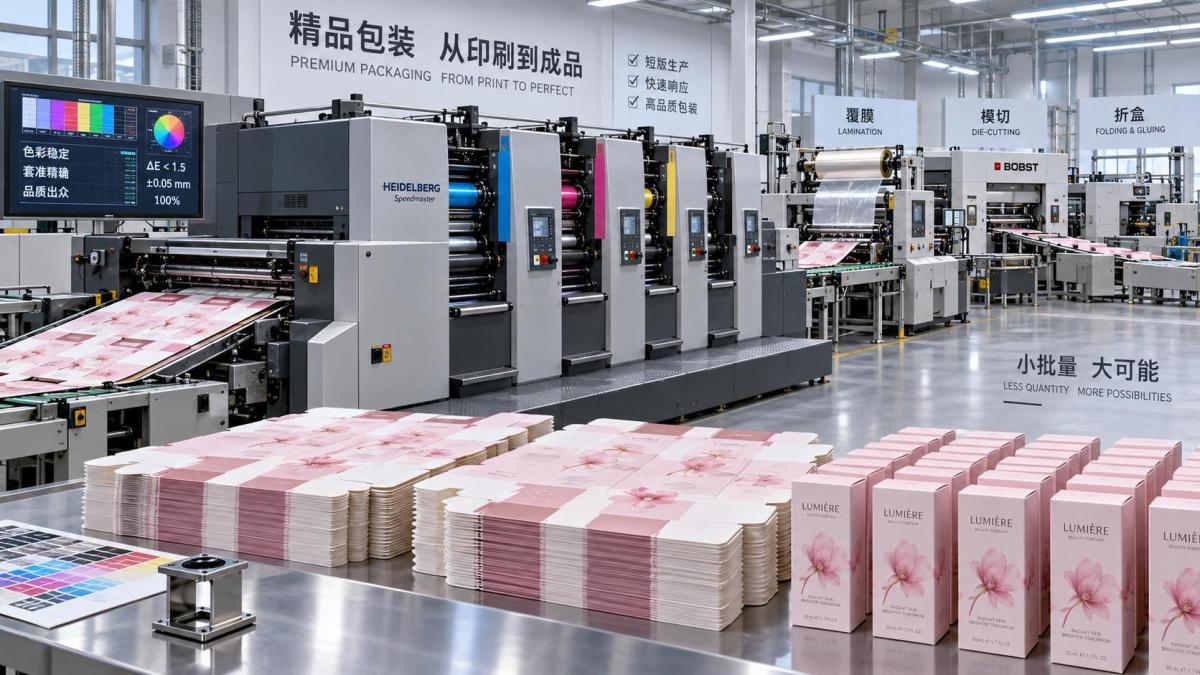
The appeal increases when short orders repeat. Plates and setup effort are incurred at the beginning, but the commercial picture changes if the same carton is reordered without major artwork revisions. That is why purchase history matters. A buyer who only asks, “How many cartons do we need this month?” can miss the better question: “How many identical or near-identical cartons are likely to be needed over the product’s selling cycle?”
The Costs That Make Offset a Poor Fit
Offset has fixed work before the press reaches stable production. Plates must be made and checked. The press must be set up for the chosen board, ink sequence, color targets, and finishing requirements. Operators need sheets to bring color and registration into tolerance. Those setup sheets are not a theoretical issue in packaging; they consume the same board and may require the same coating or treatment as sellable output.
For very small quantities, the fixed burden can overwhelm the lower running cost per sheet. A short job may also become inefficient when it requires frequent wash-ups, several spot colors, difficult opaque inks, or a schedule that leaves no room for color stabilization and drying. The temptation is to rush makeready. That is usually where a “cheap” offset job develops expensive quality disputes.
Versioning is the other major limitation. Different language panels, retailer-specific graphics, seasonal promotions, and localized compliance information can mean separate plate sets. Digital printing handles this kind of file-based variation more naturally. Offset can still be used, but only if the stable base artwork is substantial enough to justify it or if the order quantities for each version are no longer genuinely small.
Turnaround should be viewed honestly as well. Offset presses can run at extraordinary production speeds once they are ready; some industrial sheetfed systems are designed around outputs in the range of many thousands of sheets per hour. Yet speed after makeready is not the same as shortest order-to-delivery time. Prepress approval, plate production, press scheduling, drying or curing, and finishing queues may decide the actual delivery date.
Do Not Judge Printing Without Looking at Converting
Packaging is not a printed sheet. It becomes a package only after cutting, stripping, creasing, folding, and gluing—or, in some structures, lamination and additional decoration. A print decision that ignores those stages is incomplete.
Consider a reverse-tuck carton with heavy dark coverage running across crease lines. Ink build, coating selection, grain direction, and board stiffness can all affect fold behavior. If the die-cutting and folder-gluing team receives sheets with poor registration, scuff-prone surfaces, or cracking at the score, the problem does not stay in the pressroom. It shows up as slower machine speed, rejected blanks, weak glue performance, or visible defects on retail shelves.
This is why well-run converters involve the die-cutter and folder-gluer teams early, particularly for compact cartons, complex locking structures, and premium finishes. High-speed converting equipment can turn printed blanks into cartons rapidly, but it expects a controlled input. Registration between print and die is not a cosmetic detail when windows, panels, or fine borders must align.
For corrugated retail-ready packaging, the question becomes more layered. Litho-laminated corrugated formats can deliver high-end graphics, but they add a lamination stage and introduce board-flatness and registration considerations. Direct digital print may be more flexible for limited campaigns. Neither route is automatically superior; the desired presentation, structural requirements, and fulfillment environment should lead the choice.
A Practical Way to Choose the Print Method
Before selecting offset or digital, separate the job into the parts that are fixed and the parts that change. Then assess whether the project needs a fast prototype, a retail-ready pilot batch, or a repeatable production program. These are different manufacturing problems, even when the carton artwork looks identical.
Ask the converter for two estimates when the answer is not obvious: one for the immediate quantity and another based on the expected annual demand or realistic repeat pattern. Request that each quote states what is included—plates, proofs, coatings, die-cutting, make-ready allowance, packing, and any storage assumptions. Comparing incomplete quotes is a common source of bad decisions.
Color, Compliance, and Material Questions That Cannot Be Left Until Later
A packaging buyer should not assume that a visually approved proof resolves every production issue. The intended substrate must be part of approval whenever color is critical. The same artwork can behave differently on uncoated board, coated folding boxboard, metallized material, or a laminated surface. Ink absorption, surface smoothness, gloss, and the interaction with varnish all affect the final appearance.
For food, pharmaceutical, or personal-care packaging, the print process also has to fit the relevant material-contact and migration requirements for the actual market and package structure. It is not enough to describe ink as “safe” in general terms. The substrate, print side, barrier properties, curing or drying conditions, and intended use all matter. These points should be reviewed with qualified suppliers and against applicable local requirements before production is released.
Traceability and material sourcing may matter too. Where a brand requires chain-of-custody claims or specified board origins, documentation needs to follow the actual supply chain rather than being added as a marketing line at the end. PWFS follows these practical intersections of color control, converting mechanics, and manufacturing intelligence because packaging quality is rarely determined by one machine alone.
Offset Is Best Treated as a Production Strategy, Not a Default Technology
An offset press is suitable for short-run packaging when the job has stable artwork, sufficient repeat potential, demanding graphic requirements, and a finishing path that benefits from conventional sheetfed production. It is less suitable when quantity is truly minimal, deadlines are dominated by approval changes, or every pack needs different content.
The strongest packaging operations do not frame the choice as offset versus digital in ideological terms. They build a workflow that uses each process where it makes commercial and technical sense. Start with the finished carton, not the press: define the shelf appearance, board, regulatory constraints, SKU logic, delivery date, and repeat forecast. Once those are clear, the appropriate printing method is usually much easier to see.
Related News
Get weekly intelligence in your inbox.
No noise. No sponsored content. Pure intelligence.
