
Industrial Printing Equipment Selection Guide: Speed, Substrates, Color, and Curing
Industrial Printing Equipment Selection Guide: Speed, Substrates, Color, and Curing
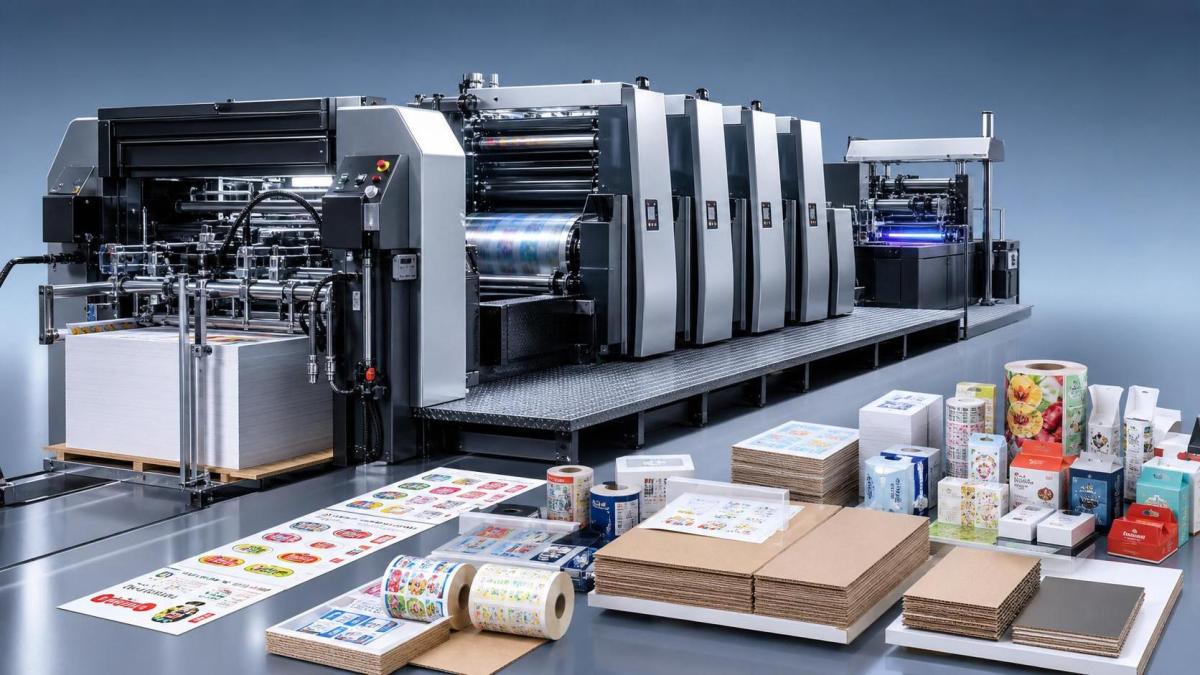
Choosing the right industrial printing equipment starts with one simple truth. Headline speed never tells the full production story.
In real factories, throughput depends on setup time, substrate range, drying stability, and register control.
That is why industrial printing equipment evaluation must connect machine specs with product mix, quality targets, and operating conditions.
For packaging, labels, folding cartons, corrugated sheets, and coated boards, the wrong platform creates waste long before output reaches rated speed.
The better approach is practical. Check how the press behaves across substrates, color loads, and curing windows under normal shift pressure.
At PWFS, this kind of assessment matters because paper and board converting lines succeed only when print quality and downstream efficiency stay synchronized.
So, instead of asking which industrial printing equipment is fastest, ask which system stays stable when the work gets complicated.
Start with the Production Reality, Not the Brochure
A serious review begins with SKU structure, order size, substrate mix, and changeover frequency.
This matters because industrial printing equipment performs differently in long-run standardized work and short-run customized manufacturing.
For example, a press optimized for high-volume carton work may struggle with frequent version changes or sensitive coated materials.
In actual operations, technical selection should answer five baseline questions before comparing vendors.
- What substrates run most often, and how often do they change?
- What quality tolerance is required for solids, gradients, and small text?
- How critical is drying speed before die-cutting, folding, or lamination?
- How much downtime is acceptable during wash-up and setup?
- Which standards apply to migration, traceability, or environmental compliance?
These questions quickly separate suitable industrial printing equipment from machines that only look impressive in a catalog.
Speed Means Effective Output, Not Peak Mechanical Rate
Manufacturers often promote maximum speed first. It is useful, but only in context.
The better metric is effective output across a full shift, including makeready, plate changes, cleaning, inspection, and operator interventions.
Industrial printing equipment with a slightly lower top speed can deliver better daily volume if waste ramps down faster.
Ask suppliers for job-based performance data, not only line-speed claims.
- Average setup time by substrate class
- Waste sheets to color approval
- Sustained speed on heavy ink coverage
- Performance after extended production hours
- Recovery time after stoppages
This is especially important for corrugated packaging and folding carton plants tied to tight downstream schedules.
If print delivery becomes unstable, die-cutters, folder-gluers, and packing stations all lose rhythm.
Substrate Compatibility Is Often the Real Deciding Factor
Many industrial printing equipment purchases fail because substrate behavior was underestimated during evaluation.
Paper, linerboard, cartonboard, synthetic stock, and specialty-coated materials react differently under transport, pressure, and heat.
A system that runs beautifully on flat SBS may lose stability on warped corrugated sheets or absorbent uncoated stock.
That is why substrate testing should cover more than printable thickness.
- Check feeder consistency across light and heavy materials.
- Review vacuum, transport, and sheet alignment controls.
- Confirm ink adhesion on coated and low-energy surfaces.
- Evaluate curl, scuff, and edge damage after curing.
- Verify downstream suitability for creasing, folding, and gluing.
In practical terms, the best industrial printing equipment is the one that keeps substrate variation from becoming a daily quality problem.
Color Accuracy Requires More Than CMYK Capability
Most presses can print CMYK. Fewer can hold color consistently across long runs, repeat jobs, and mixed environmental conditions.
For technical evaluation, color performance should be treated as a control system question, not only a printhead or unit count question.
Key variables include registration stability, ink density control, dot gain behavior, closed-loop inspection, and operator dependence.
This becomes even more critical when branded packaging needs repeatable shelf appearance across sites and batches.
- Measure register accuracy at rated operating speed.
- Ask how the press compensates for temperature and humidity shifts.
- Review spectrophotometric controls and automated correction logic.
- Check support for spot colors, extended gamut, and repeat order matching.
- Confirm whether inspection data integrates with MES or quality systems.
For industrial printing equipment used in consumer packaging, color drift is not a cosmetic issue. It is a cost, compliance, and brand risk issue.
Curing Performance Directly Affects Productivity and Risk
Curing is where theoretical print quality becomes production-ready output.
Whether the platform uses UV, LED-UV, hot air, IR, or hybrid systems, curing performance must match substrate sensitivity and production pace.
Poor curing can cause set-off, blocking, odor, weak adhesion, cracking, and failure in finishing operations.
That means industrial printing equipment selection should include curing validation under real ink loads and realistic shop temperatures.
A useful review checklist looks like this.
- Energy consumption by curing mode and substrate type
- Heat impact on thin, coated, or distortion-prone materials
- Cure completeness at full production speed
- Safety controls and lamp maintenance requirements
- Food-packaging suitability and low-migration compatibility
From a lifecycle view, stable curing often improves ROI more than a small speed advantage.
Automation, Data, and Operator Load Shape Long-Term Value
A modern industrial printing equipment decision should also look beyond print mechanics.
Labor availability, repeatability, and integration with digital workflows now influence selection as much as press architecture.
This is where advanced automation starts to matter.
Presetting, auto-registration, viscosity control, inspection feedback, and predictive maintenance all reduce dependence on individual operator skill.
For plants moving toward Industry 4.0, connected industrial printing equipment also supports faster root-cause analysis and stronger scheduling discipline.
If two systems print similarly, the one with lower operator strain usually wins over time.
How to Compare Industrial Printing Equipment in a Structured Way
A structured scoring model prevents selection from drifting toward price alone or isolated performance claims.
The model should reflect actual production priorities and downstream constraints.
- Assign weights to speed, substrate range, color stability, curing, and automation.
- Use your own jobs during supplier trials whenever possible.
- Score both startup performance and sustained production behavior.
- Include waste, energy use, maintenance, and service responsiveness.
- Validate compliance needs before commercial negotiation.
This method creates a more realistic view of total ownership cost.
It also helps explain why the best industrial printing equipment is not always the cheapest machine or the fastest one.
A Practical Final Filter for Better Selection
Before final approval, narrow the decision to a simple question. Which industrial printing equipment keeps quality stable when production conditions are less than ideal?
That includes substrate variability, urgent order switching, long shifts, downstream pressure, and tighter compliance demands.
In many cases, the winning platform is the one that produces fewer surprises, not the one with the most dramatic launch presentation.
For packaging and industrial manufacturing, reliable print performance supports the entire converting chain.
When industrial printing equipment is matched correctly to speed, substrates, color, and curing, output becomes more predictable, waste drops, and ROI becomes much easier to defend.
Use that framework as your final filter, and the selection process will become clearer, faster, and far more resilient in real production.
Related News
Get weekly intelligence in your inbox.
No noise. No sponsored content. Pure intelligence.
