
What limits speed in corrugated board production today?
In corrugated board production, speed is no longer defined by line rating alone. For technical evaluation, the true ceiling usually appears inside process stability, not on the nameplate. Steam balance, paper variation, adhesive response, warp control, and section synchronization now decide whether higher speed can be sustained without costly quality loss.
This matters across the broader industrial chain. Corrugated packaging supports e-commerce logistics, retail display, food distribution, and export shipping. When corrugated board production slows, box plants face missed schedules, unstable conversion, and rising waste. Understanding modern speed limits is therefore essential for both equipment assessment and operating improvement.
Operating speed in corrugated board production: a practical definition
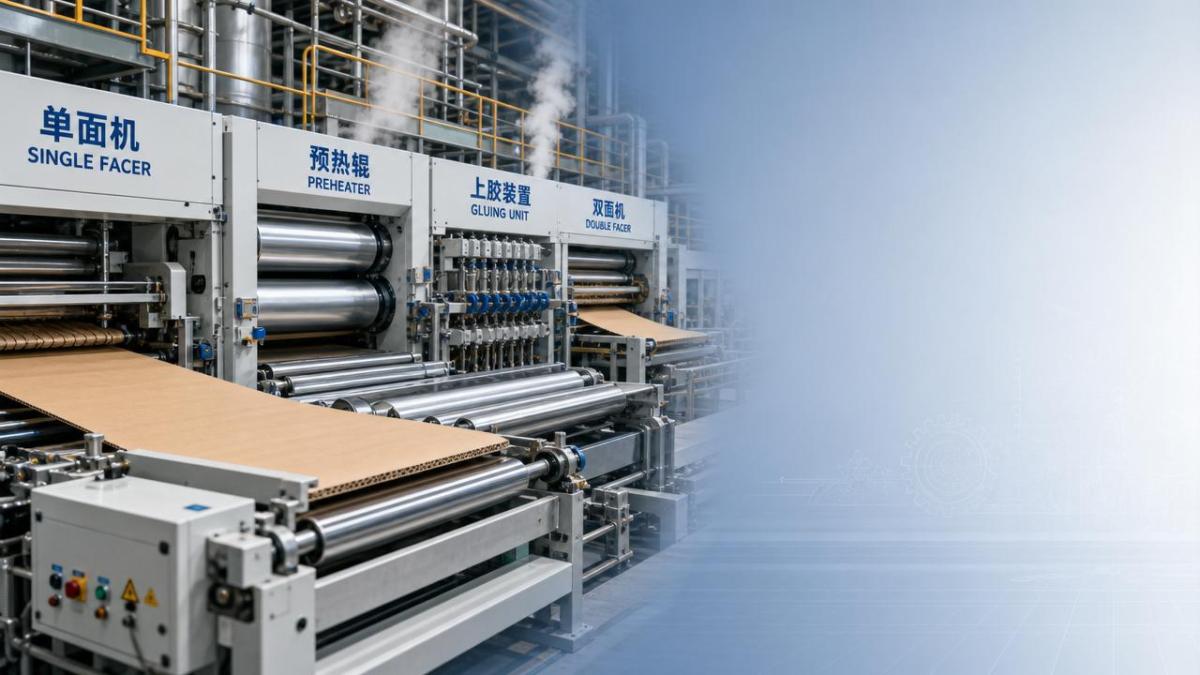
In practice, speed in corrugated board production means stable output at acceptable board quality. A line may briefly reach a high mechanical speed, yet fail to hold bonding strength, moisture balance, or flatness. Sustainable speed is the more useful measure.
That definition connects wet-end preparation with dry-end handling. Single facer performance, preheater response, glue application, double backer heat transfer, slitting accuracy, and stacker coordination all influence final throughput. One unstable section can cap the entire system.
For this reason, corrugated board production should be judged through three linked indicators:
- net board output per hour
- quality consistency across flute profiles and board grades
- waste and stoppage rate during recipe changes
Any review of corrugated board production speed should therefore separate nominal machine capability from validated process capability. This distinction is increasingly important in mixed-order packaging environments.
The main bottlenecks limiting line speed today
Several limits dominate modern corrugated board production. They are usually interactive rather than isolated. A line can compensate for one weak point, but not for many at once.
Steam and thermal stability
Heat quality remains the foundation of corrugated board production. Poor steam pressure stability reduces paper conditioning, flute formation, adhesive gelatinization, and drying efficiency. The result is speed reduction, board warp, or weak bonding.
Thermal imbalance also appears when preheaters and hot plates react too slowly to grade changes. Heavy papers and light papers require different energy profiles. Without responsive control, operators often lower line speed to protect quality.
Paper quality variation
Paper is no longer fully predictable. Recycled content shifts, moisture differences, caliper spread, stiffness inconsistency, and surface absorption changes can all constrain corrugated board production. Even strong machinery cannot erase unstable raw material behavior.
At higher speed, these variations become amplified. Web tension fluctuates faster, flute formation grows less forgiving, and glue pickup may become uneven. This often explains why speed gains on test paper fail under commercial supply conditions.
Adhesive performance under fast cycling
Glue chemistry plays a direct role in corrugated board production speed. Viscosity, solids, temperature, penetration, and gelatinization behavior must match flute geometry and paper absorbency. If the glue system lags, the line must slow.
Fast lines need uniform application and repeatable bonding windows. Excess adhesive creates drying load and warp. Insufficient adhesive causes delamination risk. Speed is therefore limited by how precisely the glue system supports the chosen board mix.
Warp control and moisture balance
Warp remains one of the clearest hidden speed limits in corrugated board production. A board may leave the double backer intact, yet still fail later in printing, die-cutting, or box forming because of cross warp or longitudinal warp.
When moisture profile and heat distribution drift, operators usually reduce speed to regain control. This is especially true for lightweight papers, high recycled grades, and quick order changes between different flute combinations.
Synchronization between wet and dry sections
Modern corrugated board production depends on timing discipline across the full line. The single facer may run well, but slitting, scoring, cutoff accuracy, transfer belts, and stacker response can still become the limiting point.
Frequent order changes intensify this issue. Recipe transitions, knife positioning, score setup, and downstream buffering all affect effective throughput. In many plants, synchronization losses reduce average speed more than any single mechanical constraint.
Current industry signals shaping corrugated board production performance
The present market environment creates new expectations for corrugated board production. Throughput still matters, but production flexibility now shares equal importance with board quality and energy discipline.
These signals show why corrugated board production evaluation must move beyond headline meters per minute. The stronger benchmark is repeatable output under realistic commercial complexity.
Why these limits matter for business performance
When corrugated board production runs below stable potential, the cost impact spreads quickly. Waste rises, adhesive use becomes less efficient, energy consumption per square meter increases, and converting operations inherit more defects.
A speed limit is therefore not only a technical issue. It influences schedule reliability, board availability for printing and die-cutting, and final package quality in transport. In integrated packaging systems, every unstable board grade creates downstream penalties.
This is especially relevant for intelligence-driven industrial ecosystems such as PWFS, where corrugated lines connect with offset printing, die-cutting, folder-gluing, and automated workflow logic. Weak corrugated board production stability can reduce the value of every later process.
Typical production situations where speed ceilings appear
Not all operating contexts face the same limitations. In corrugated board production, speed ceilings often differ by board mix, order pattern, and downstream requirement.
- Lightweight e-commerce board often exposes warp and bonding sensitivity.
- Heavy-duty transport board typically stresses heating and drying capacity.
- Print-grade board raises the standard for flatness and surface consistency.
- Mixed small-batch production magnifies synchronization and changeover losses.
- High-recycled input often increases variability across moisture and stiffness.
These scenarios explain why one corrugated board production line may perform differently across customer portfolios, even with identical installed equipment and rated speed.
Practical ways to assess and improve corrugated board production speed
A useful improvement path starts with measurement discipline. Speed losses should be mapped by cause, not guessed from daily averages. Short disruptions and quality-related slowdowns often hide the true limit.
Focus areas for evaluation
- Track steam pressure, condensate behavior, and hot plate thermal uniformity.
- Measure incoming paper moisture and variation by supplier and grade.
- Validate glue viscosity and temperature against actual running speed.
- Record warp trends by flute type, basis weight, and shift condition.
- Analyze changeover time, cutoff stability, and stacker interruptions.
Improvement principles
First, stabilize thermal conditions before pushing line speed. Heat inconsistency often creates several other defects at once. Second, segment recipes by real paper behavior, not by nominal specification alone.
Third, align adhesive strategy with board architecture and target throughput. Fourth, improve digital visibility across both wet and dry sections. The best corrugated board production gains usually come from system coordination rather than isolated upgrades.
Finally, compare maximum speed with saleable speed. If quality concessions are required to hold output, the line has not truly improved. In corrugated board production, sustainable quality remains the real capacity benchmark.
A grounded next step for line review
A practical next step is to conduct a structured audit around steam, paper, glue, warp, and synchronization. Review data by board grade and order pattern, then identify where speed reductions first begin and where waste accelerates.
For organizations following PWFS intelligence, this approach fits a broader industrial logic. Corrugated board production should be evaluated as part of an interconnected packaging system, where upstream process discipline protects downstream printing, converting, and delivery performance.
If the goal is higher throughput with dependable board quality, the most valuable question is not how fast a line can run once. It is how consistently corrugated board production can run well, every shift, across changing grades and real market pressure.
Related News
Get weekly intelligence in your inbox.
No noise. No sponsored content. Pure intelligence.
