
What really determines corrugated box production efficiency?
In corrugated box production, efficiency is not determined by speed alone. For business evaluation, the real drivers are system coordination, waste control, uptime, labor balance, and delivery stability.
A fast machine can still underperform if changeovers are slow, board quality fluctuates, or downstream bottlenecks interrupt flow. That is why corrugated box production must be judged as one connected process.
From board lines to printing, die-cutting, folder gluing, and data systems, every link affects output, cost, and return on investment. The questions below explain what really determines production efficiency.
What does efficiency really mean in corrugated box production?
Efficiency in corrugated box production means usable output at consistent quality, with low waste, predictable labor needs, and reliable delivery. It is not simply sheets per minute.
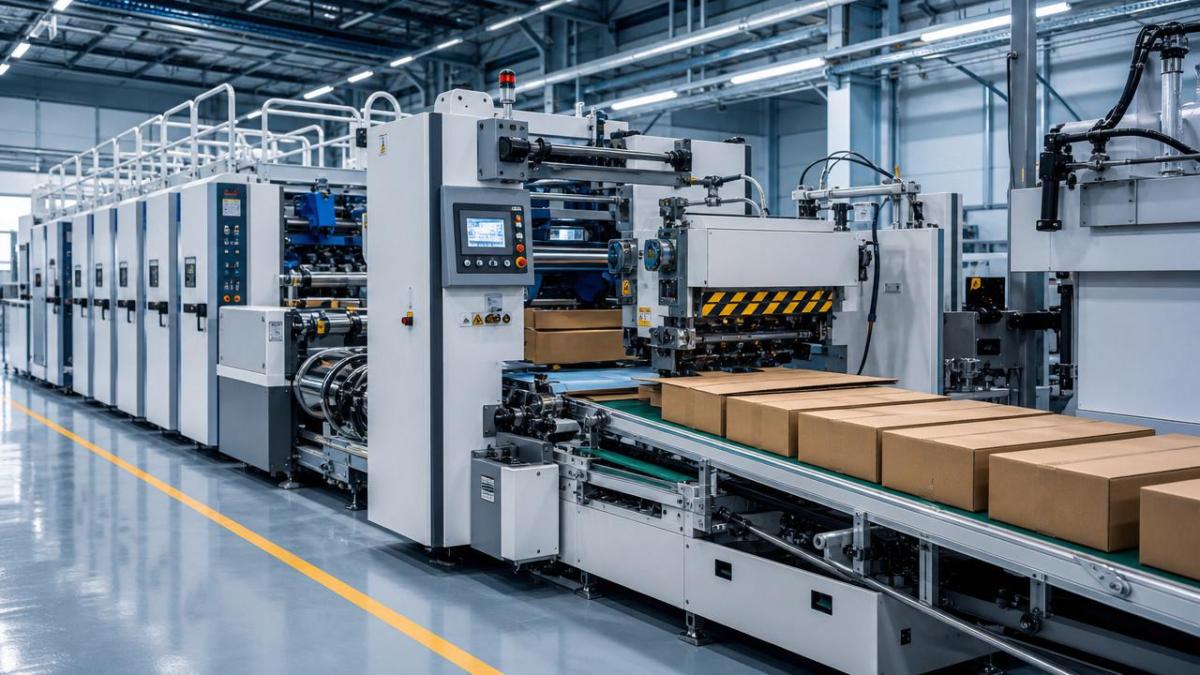
A plant may advertise top line speed. Yet real performance depends on how many sellable boxes leave the line per shift, per operator hour, and per unit of energy.
The most useful indicators usually include these metrics:
- Net output after rejects and rework
- Overall equipment effectiveness and uptime
- Setup and order changeover time
- Board waste, ink waste, and glue consumption
- On-time delivery and order accuracy
When these metrics improve together, corrugated box production becomes more profitable and more scalable. Focusing on speed alone often hides losses elsewhere in the line.
Why is the board line the foundation of corrugated box production efficiency?
Every later process depends on board consistency. If the corrugated board line produces warped sheets, unstable flute profiles, or uneven bonding, downstream efficiency declines immediately.
Poor board quality creates feeding problems in printing, inaccurate die-cutting, glue defects, and stacking instability. This means hidden downtime across the entire corrugated box production chain.
Key board-line efficiency factors include temperature control, moisture balance, adhesive application, paper tension, and stable speed matching across single facer, bridge, and cut-off sections.
Good board quality improves more than appearance. It supports registration accuracy, machine feeding stability, and compression strength of finished boxes.
In high-volume corrugated box production, the board line acts like the heartbeat. If its rhythm is unstable, every connected machine loses effective capacity.
Warning signs from the board stage
- Frequent sheet curl or warp
- Delamination during printing or folding
- Compression strength below target
- Excess trim loss or unstable sheet size
How do printing, die-cutting, and folder gluing affect overall output?
Downstream converting determines whether board becomes saleable packaging at low cost. In corrugated box production, these stages often create the biggest practical bottlenecks.
Printing efficiency depends on registration stability, ink control, plate condition, cleaning speed, and feeder reliability. Minor color or register drift can trigger large volumes of rejects.
Die-cutting adds another layer. Tool wear, pressure inconsistency, and poor sheet alignment reduce cut quality and force slower running speeds.
Folder gluing is where many hidden losses appear. Glue application must remain precise at speed. Folding geometry must stay consistent, or bundles become difficult to pack and ship.
The strongest corrugated box production systems synchronize these sections. They prevent one machine from running fast while the next machine creates queues, stoppages, or rework.
What improves converting efficiency most?
- Quick-change tooling and recipe storage
- Stable feeder and transport systems
- Accurate registration and pressure control
- Preventive maintenance for rollers, belts, and bearings
- Inline inspection to catch defects early
Is automation more important than machine speed in corrugated box production?
In many cases, yes. Automation often delivers greater real gains than raw speed because it reduces interruptions, handling delays, and dependence on manual correction.
Automatic order changeover, stack transfer, quality inspection, and palletizing shorten non-productive time. That matters greatly in corrugated box production with frequent order variation.
Automation also improves repeatability. Consistent settings lower reject rates and support better planning. This is especially valuable when jobs include multiple box sizes, graphics, or board grades.
However, automation must match process design. A highly automated line cannot compensate for weak workflow, unstable board quality, or poor production scheduling.
The best result comes from combining suitable machine speed with intelligent material flow, recipe management, and data visibility.
Where automation usually adds the most value
- Short-run and mixed-order environments
- Labor-constrained operations
- Plants with high manual handling losses
- Facilities seeking stable delivery performance
How should production efficiency be judged when comparing equipment?
Equipment comparison in corrugated box production should start with total system behavior, not brochure speed. The strongest line is the one that sustains output under real order conditions.
A useful comparison should include capacity, order mix flexibility, maintenance access, digital integration, and waste performance. Service response and spare parts availability also matter.
Below is a practical comparison table for evaluating corrugated box production efficiency.
What are the most common mistakes that reduce corrugated box production efficiency?
The most common mistake is treating each machine separately. Corrugated box production fails when isolated optimization creates system imbalance.
Another mistake is underestimating changeover loss. A line can look fast on long runs but become inefficient when real order patterns include frequent size or print changes.
Some operations also focus too little on maintenance discipline. Small mechanical deviations can trigger large quality losses in printing, slotting, die-cutting, and gluing.
Data blindness is another problem. Without accurate waste, downtime, and job-time records, it becomes impossible to locate the true efficiency barrier.
Finally, labor planning is often overlooked. Even advanced corrugated box production lines lose performance if operator training, standard work, and troubleshooting routines are weak.
Quick risk checklist
- Buying speed instead of process balance
- Ignoring board quality variation
- Accepting long setup times as normal
- Lacking integrated production data
- Delaying preventive maintenance
How can corrugated box production efficiency be improved step by step?
Start with measurement. Track uptime, waste, changeover time, and net output by order type. Real corrugated box production improvement begins with visible loss mapping.
Next, stabilize the board line. This creates immediate benefits across printing and converting. After that, reduce setup time through standard tooling, recipes, and operator guidance.
Then review bottlenecks in material flow. Conveyor layout, stack handling, and pallet discharge often create avoidable waiting time.
Digital integration is the next lever. MES connectivity, production dashboards, and job traceability help align planning with actual machine behavior.
Finally, treat efficiency as continuous control, not a one-time project. Corrugated box production improves most when quality, maintenance, and scheduling are managed together.
Practical action sequence
- Measure actual net output and losses
- Stabilize board consistency
- Cut setup and changeover time
- Improve inspection and maintenance routines
- Add automation where labor and handling losses are highest
- Connect machines to production data systems
What really determines corrugated box production efficiency is not one machine, one speed rating, or one isolated upgrade. It is the combined performance of board quality, converting accuracy, automation, uptime, and data-driven control.
When evaluating a line, focus on sustainable output, waste reduction, changeover capability, and system coordination. Those factors reveal the true value of corrugated box production equipment.
For stronger decisions, compare actual production scenarios, not ideal test conditions. A clear efficiency map today creates better capacity, lower cost, and more reliable delivery tomorrow.
Related News
Get weekly intelligence in your inbox.
No noise. No sponsored content. Pure intelligence.
