
Why high-speed printing can raise waste before output improves
High-speed printing is often treated as a direct path to more output, lower unit cost, and stronger delivery performance.
Yet in real production, high-speed printing can raise waste before output improves.
That early waste appears in paper loss, ink instability, registration drift, start-up spoilage, and more frequent stoppages.
This pattern matters across packaging, commercial print, corrugated conversion, and integrated paper-and-wood manufacturing systems.
For intelligence platforms like PWFS, the lesson is clear.
Speed only becomes value when process control, material behavior, machine dynamics, and digital coordination mature together.
The market signal is changing: high-speed printing is no longer judged by rated speed alone
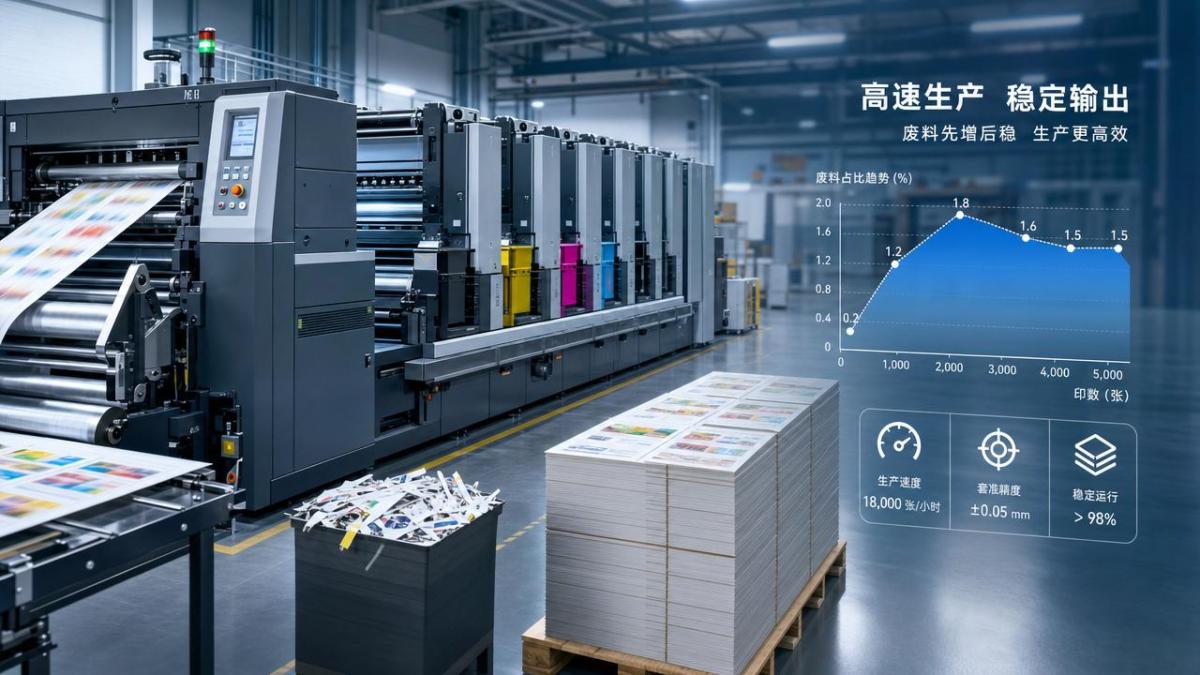
Across modern plants, the benchmark is shifting from maximum sheets per hour to stable saleable output per hour.
That distinction explains why high-speed printing sometimes disappoints during early ramp-up.
A press may run faster mechanically, while the total system performs worse commercially.
Packaging graphics now demand tighter color tolerance, shorter runs, and faster job changeovers.
At the same time, substrate diversity is expanding.
Operators move between lightweight paper, coated board, recycled liner, specialty carton stock, and brand-sensitive packaging grades.
Under these conditions, high-speed printing becomes a systems challenge, not just a machine setting.
Why high-speed printing can increase waste in the first stage
The root cause is simple.
When speed rises, small process errors scale faster than teams can correct them.
Several forces drive this effect:
In short, high-speed printing magnifies process sensitivity before it delivers stable throughput gains.
The hidden physics behind early waste growth
Mechanical vibration becomes a quality issue
At higher speeds, rollers, cylinders, feeders, belts, and grippers operate closer to dynamic limits.
Small imbalance can create oscillation, bounce, or slip.
Those effects quickly show up as register variation and sheet handling loss.
Ink transfer windows narrow
High-speed printing shortens contact time in the inking train and on substrate contact points.
If viscosity, temperature, fountain balance, or blanket condition is slightly off, defects appear faster.
The result is not only more waste, but also unstable color consistency.
Paper and board behave differently under acceleration
Recycled content, moisture variation, fiber direction, and coating quality all matter more at speed.
A substrate that runs acceptably at moderate speed may fail at a higher line rate.
That is common in corrugated top sheets, folding carton jobs, and mixed commercial work.
Why output often improves only after waste peaks
The transition follows a learning curve.
Early on, teams focus on making the press run faster.
Later, they learn how to keep the entire workflow stable at that faster rate.
This usually happens in three stages:
- Speed increase stage: machine speed rises, but waste and stoppages increase.
- Control adjustment stage: settings, maintenance, and operator routines become more precise.
- Stabilization stage: saleable output finally exceeds the previous baseline.
Many disappointing high-speed printing projects fail because they stop in stage one or two.
The technology is blamed, while the process transition remains incomplete.
The impact reaches beyond the press itself
When high-speed printing raises waste, the damage spreads across the full value chain.
- Material cost rises through spoilage, extra makeready, and discarded semi-finished goods.
- Delivery reliability weakens when repeat jobs need longer stabilization time.
- Color consistency becomes harder across shifts, sites, or duplicate orders.
- Finishing quality suffers if die-cutting, folding, gluing, or stacking receives unstable input.
- Sustainability claims lose credibility when throughput growth depends on greater waste generation.
This is especially relevant for packaging ecosystems tracked by PWFS.
Corrugated lines, offset presses, folder gluers, die cutters, and digital production systems must work as one coordinated architecture.
What deserves the closest attention during a high-speed printing upgrade
The most effective improvements usually come from process discipline, not from chasing top speed instantly.
- Track saleable output, not rated speed, as the main performance indicator.
- Measure waste by cause: startup, register drift, color error, feeder issue, or downstream jams.
- Standardize substrate specifications and incoming moisture control.
- Stabilize ink temperature, viscosity, and fountain solution condition.
- Audit mechanical wear on bearings, blankets, rollers, grippers, and transport components.
- Synchronize print speed with die-cutting, folding, gluing, and packing capacities.
- Use data capture to identify the exact speed threshold where defects accelerate.
A practical response model for reducing waste before chasing peak speed
This model fits both commercial print environments and packaging operations with corrugated, carton, or hybrid converting steps.
The broader trend: speed is becoming smarter, not simply faster
The future of high-speed printing is not a race toward headline speed figures.
It is a shift toward intelligent speed, where automation protects quality as line rates rise.
That includes better sensors, adaptive register control, stable consumables, machine health analytics, and stronger digital coordination.
For sectors linked to packaging and furniture systems, the same principle applies everywhere.
Any production cell running faster than its control logic will create hidden waste.
Any production cell combining speed with process intelligence will create durable output gains.
Next-step focus for turning high-speed printing into real productivity
Start by identifying where waste rises first when high-speed printing increases.
Then separate machine limits from material limits, process limits, and coordination limits.
Build speed in stages, validate each stage with saleable output data, and lock proven settings into repeatable standards.
That approach turns high-speed printing from a risky promise into a measurable operational advantage.
In today’s market, the winners will not be those who print fastest once.
They will be those who sustain high-speed printing with low waste, stable quality, and synchronized downstream performance.
Related News
Get weekly intelligence in your inbox.
No noise. No sponsored content. Pure intelligence.
