
Industrial Corrugated Board Lines: Key Specs, Output Targets, and Layout Planning Basics
Why industrial corrugated board lines now demand closer planning
Industrial corrugated board lines sit at the center of modern packaging capacity, especially where e-commerce volume, SKU variation, and delivery speed keep rising.
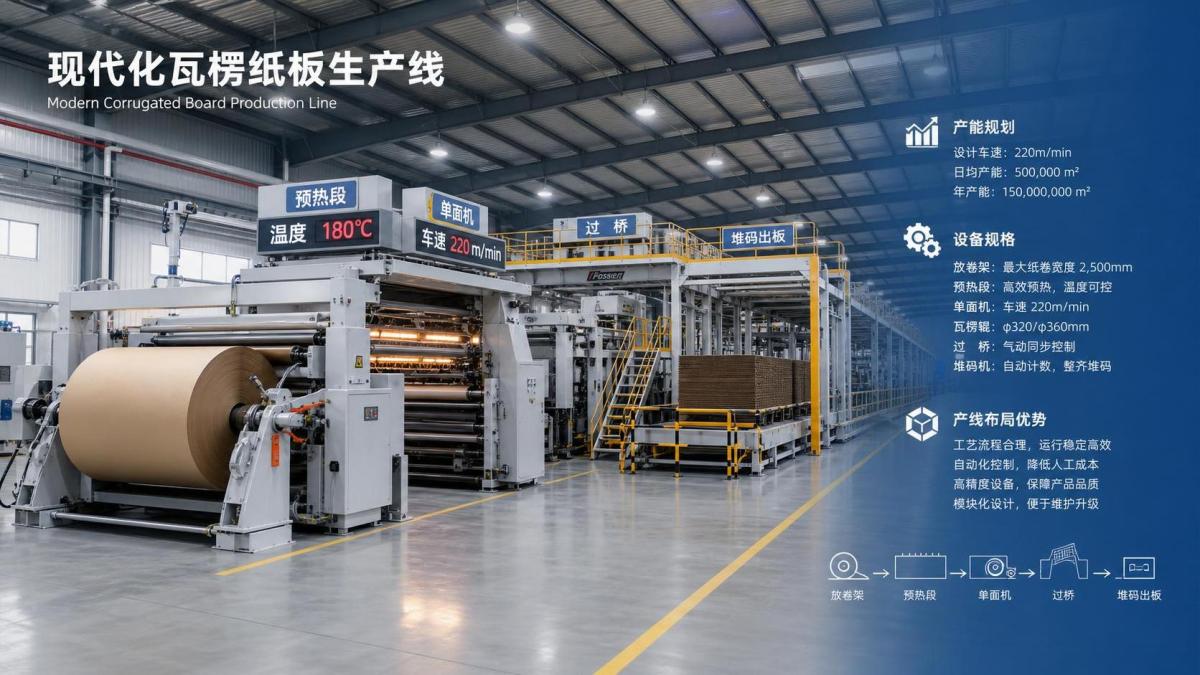
For new plants and retrofit projects, the line is not only a machine purchase. It is a coordinated production system shaped by paper grades, steam, glue, labor flow, downstream conversion, and site geometry.
That is why early decisions on speed class, working width, flute mix, and layout often have a larger financial impact than small differences in quoted equipment price.
Within the broader print and converting landscape, PWFS tracks this topic as one of the core physical engines behind global logistics. Corrugated board remains the protective layer for daily parcel movement, retail-ready packaging, and many industrial shipments.
A good plan starts with a simple idea: output, board quality, and future flexibility must be balanced together. If one element is misread, the whole project may underperform.
What a corrugated line really includes
When people discuss industrial corrugated board lines, they often focus on maximum speed. In practice, the line should be understood as a chain of tightly linked processes.
A standard configuration usually includes mill roll stands, preheaters, a single facer, bridge, glue unit, double facer, slitter scorer, cut-off, stacker, and control system.
Performance depends on how these sections work together under changing paper moisture, flute changes, order size, and operator response time.
In facilities linked to offset printing, die-cutting, and folder gluing, board line stability matters even more. Variation at the corrugator stage travels downstream and affects print registration, converting speed, and scrap rates.
This is one reason PWFS treats corrugated production as part of a larger manufacturing intelligence chain rather than an isolated machine category.
The specifications that shape real performance
Several specifications deserve close attention before comparing suppliers. The most important ones are not always the most visible in a brochure.
Key technical points
- Working width affects board formats, trim loss, and compatibility with downstream sheet sizes.
- Design speed shows mechanical capability, but sustainable running speed is the more useful planning number.
- Flute profile range determines whether the line can support transport packaging, shelf-ready packs, or higher graphics requirements.
- Paper basis weight range influences the mix of lightweight economy board and heavier compression-resistant grades.
- Heating and steam control directly affect bonding stability, warp control, and startup consistency.
- Automation level shapes order change time, operator dependence, and long-run repeatability.
For many projects, the decisive question is not whether a line can reach a headline speed. It is whether it can hold board flatness and bond quality during the actual product mix.
A line running slower with stable quality may outperform a faster line that loses efficiency during every grade change, flute switch, or shift handover.
Output targets should be based on net productivity
Capacity planning for industrial corrugated board lines often goes wrong when projects use theoretical output instead of net output.
Theoretical output assumes steady speed, full width usage, ideal paper condition, and no interruptions. Actual output never looks like that.
A more reliable approach uses three filters: sellable board volume, order structure, and operating losses.
Usually, a realistic target starts from monthly demand by board grade and size family, then works backward into average line loading, shift pattern, and reserve capacity.
This method also helps reveal whether the real bottleneck sits inside the corrugator or later in printing, die-cutting, or finishing.
Layout planning is a production decision, not only a building decision
The layout of industrial corrugated board lines influences efficiency from the first day of operation. Poor arrangement creates hidden losses that are difficult to recover later.
The line itself may stretch across a large footprint, but the surrounding zones matter just as much: paper storage, splicing access, boiler and condensate routing, scrap handling, sheet logistics, and maintenance clearance.
A practical layout should keep material moving forward with minimal crossing traffic. Rolls should enter smoothly, finished stacks should leave cleanly, and fork traffic should not interrupt operators.
Layout basics worth checking early
- Allow straight, safe roll delivery to the wet end.
- Reserve enough overhead and side space for maintenance removal paths.
- Place utility rooms where steam, air, and power runs stay efficient.
- Match stacker discharge with conveyor, warehouse, or converting line flow.
- Protect future expansion zones for wider width or automation upgrades.
In retrofit cases, layout work becomes more delicate. Existing columns, roof limits, and old utility corridors can constrain the line more than the equipment specification itself.
Current industry pressure points behind line selection
Today’s market asks corrugated plants to do several things at once: run faster, reduce waste, handle lighter papers, and stay flexible for mixed order sizes.
That pressure explains why industrial corrugated board lines are increasingly evaluated through digital control, recipe management, and plant-wide data integration.
PWFS follows this shift closely across print and woodworking systems. The common pattern is clear: productivity improves most when machine physics and information flow are designed together.
For corrugated operations, that means moisture control, adhesive application, speed synchronization, and order scheduling should not live in separate decision silos.
Sustainability also changes the selection logic. Lightweight containerboard, energy efficiency, starch optimization, and waste heat recovery are no longer side topics.
They influence operating cost, compliance positioning, and even customer acceptance in export markets where traceability and resource performance are increasingly examined.
Where the line creates business value
The value of industrial corrugated board lines is not limited to board production volume. Their real contribution appears across service, cost control, and supply chain responsiveness.
A stable line supports better box compression consistency, cleaner print surfaces, and smoother converting downstream. That improves delivery reliability for fast-moving packaging programs.
In sectors with volatile order patterns, flexible line control helps absorb changes without creating excessive work-in-progress or emergency overtime.
For integrated sites, the corrugator also shapes the economics of the whole plant. Better board quality upstream often means fewer hidden losses in die-cutting, printing, stacking, and warehouse handling.
This upstream leverage is easy to underestimate during procurement and very expensive to rediscover after commissioning.
A practical framework for the next decision
Before moving toward supplier comparison, it helps to organize the project around a few disciplined questions.
- What board mix will define the first three years, not only the first six months?
- Which output number matters most: peak speed, monthly sellable area, or on-time service stability?
- How much utility capacity is already available, and where are the hidden retrofit costs?
- Which downstream processes depend most on board flatness and bonding consistency?
- What expansion path should remain open for automation, width, or product range growth?
When these questions are answered clearly, industrial corrugated board lines become easier to compare on substance rather than on brochure claims.
The next useful step is usually a structured demand model, a utility check, and a layout review tied to actual order profiles. That creates a stronger base for technical evaluation and a more resilient investment decision.
Related News
Get weekly intelligence in your inbox.
No noise. No sponsored content. Pure intelligence.
