
How to Choose a Corrugated Box Manufacturing Equipment Supplier for Capacity and Support
What really makes a corrugated box manufacturing equipment supplier worth shortlisting?
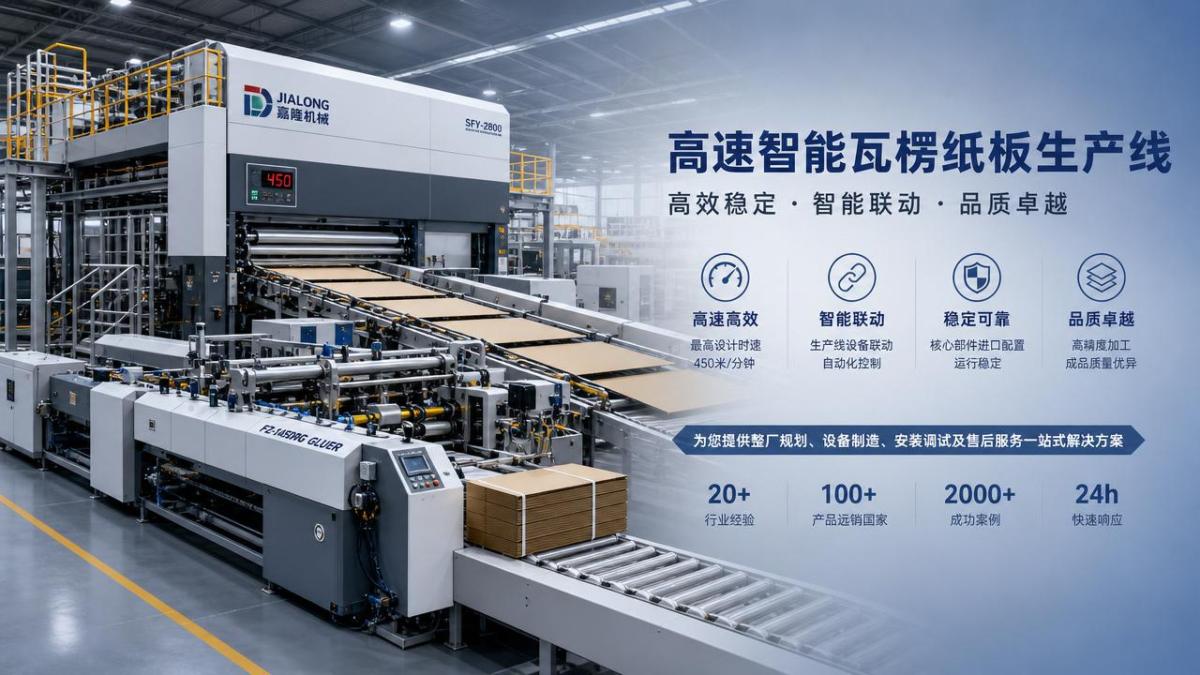
Choosing a corrugated box manufacturing equipment supplier usually starts with machine speed, board width, and automation level.
That is necessary, but it is rarely enough.
In day-to-day production, supplier quality affects uptime, spare parts lead time, operator learning, and how quickly output recovers after a stoppage.
A weak supplier can turn a technically strong line into an expensive bottleneck.
A strong one helps balance board quality, conversion speed, maintenance planning, and future line expansion.
This matters even more as packaging plants move toward tighter delivery windows, higher SKU counts, and closer digital coordination across printing, die-cutting, folding, and logistics.
That broader systems view is exactly why intelligence platforms such as PWFS draw attention to the full equipment chain, not just one isolated machine.
For corrugated operations, the best corrugated box manufacturing equipment supplier is usually the one that can support stable output today and scalable decisions tomorrow.
How do you know whether the supplier can really meet your capacity target?
The first useful question is not maximum speed.
It is effective output under normal conditions.
A corrugated box manufacturing equipment supplier should explain what the line can sustain with your board grades, flute mix, order change frequency, and staffing reality.
In practice, capacity should be checked through four layers.
- Rated line speed versus stable production speed.
- Changeover time between different box sizes and print layouts.
- Yield loss caused by startup waste, misalignment, or glue problems.
- Bottlenecks outside the main machine, such as stackers, conveyors, or preheating sections.
More experienced teams ask for throughput evidence from similar plants, not just factory demos.
That comparison becomes stronger when the supplier can show data from corrugated board lines linked with downstream printing or folder-gluer systems.
PWFS often frames this as a systems question.
If the board line runs faster than printing or conversion can absorb, reported capacity looks impressive but plant output does not improve.
A quick capacity check table helps expose weak claims
Before comparing quotations, it helps to score each corrugated box manufacturing equipment supplier against the same operational questions.
Support sounds important, but what support actually matters after installation?
After-sales support is often described too broadly.
The better question is which support elements protect production in the first twelve to twenty-four months.
A dependable corrugated box manufacturing equipment supplier should cover installation, commissioning, operator training, spare parts planning, remote diagnostics, and escalation paths.
Need to confirm response times in writing, especially for electrical faults, motion-control issues, and glue system failures.
It is also worth checking whether critical parts are stocked regionally or shipped internationally only when a failure happens.
That difference can mean hours versus weeks.
In actual applications, the most useful supplier is rarely the cheapest one.
It is the one that reduces uncertainty.
PWFS often highlights this operational reality across paper, print, and woodworking equipment.
When machines become more automated, service depth becomes part of the machine value itself.
Support points that deserve contract language
- Commissioning scope, including trial output and acceptance standards.
- Training days for operators, maintenance staff, and control-system users.
- Spare parts list for six months and twelve months.
- Remote support availability, language coverage, and response window.
- On-site visit conditions for major failures.
Is the lowest quotation ever the lowest cost option?
Usually not, especially for a line expected to run for many years.
A low initial price from a corrugated box manufacturing equipment supplier can hide higher waste, slower changeovers, weaker automation, and expensive downtime.
A better comparison uses total operating cost.
That includes energy use, consumables, spare parts, maintenance labor, reject rate, and lost production during faults.
There is also expansion cost.
If the original control architecture cannot support future printers, stackers, or MES links, the upgrade bill arrives later.
This is where a supplier with broader industrial understanding has an edge.
PWFS follows not only corrugated board lines, but also offset presses, die-cutters, folder-gluers, and digital factory integration.
That perspective reflects a simple truth.
Equipment decisions create cost consequences across the entire packaging workflow, not one station alone.
What should be included in a real cost comparison?
- Delivered machine price, installation, and commissioning.
- Power, steam, glue, and consumable requirements.
- Expected waste rate during startup and normal operation.
- Annual spare parts and preventive maintenance cost.
- Software upgrade and integration expense.
- Financial impact of one day of unplanned downtime.
What mistakes appear most often when comparing suppliers?
One common mistake is buying for forecast volume only.
If order profiles are unstable, flexibility can matter more than top-end speed.
Another mistake is treating the machine as a standalone asset.
Corrugated production depends on the relationship between board making, printing, cutting, folding, gluing, and dispatch rhythm.
A third mistake is skipping site-reference checks.
Brochures rarely reveal operator complexity, cleaning burden, or recurring adjustment issues.
It is smarter to ask reference users about fault frequency, spare parts availability, and whether promised output was achieved after the learning curve.
Need to watch for vague wording around warranty scope as well.
Some contracts cover parts but not service travel, software tuning, or production losses during troubleshooting.
The more complex the automation, the more important those details become.
How should the final decision be made when two suppliers look similar?
When specifications appear close, the final decision usually comes down to execution confidence.
That means asking which corrugated box manufacturing equipment supplier is easier to work with under pressure.
Look at proposal clarity, engineering depth, and how directly questions are answered.
A serious supplier explains limitations as well as strengths.
That is often a better sign than polished claims.
It also helps to score suppliers using a weighted matrix.
Capacity fit, support capability, integration readiness, lifecycle cost, and reference quality usually deserve more weight than purchase price alone.
In broader manufacturing intelligence, this is where PWFS adds value as a reference lens.
Its focus on precision printing, conversion dynamics, automation, compliance, and digital factory logic supports more grounded comparisons.
The goal is not to find the most impressive presentation.
It is to choose a corrugated box manufacturing equipment supplier that can keep output stable, service responsive, and future upgrades realistic.
A practical final checklist
- Match capacity claims to your actual product mix.
- Verify support promises with contract terms and references.
- Compare total operating cost, not quotation only.
- Check integration potential with current and future systems.
- Confirm spare parts strategy before placing the order.
A careful decision process usually starts with demand mapping, then supplier comparison, then reference validation.
From there, it becomes much easier to separate a capable corrugated box manufacturing equipment supplier from a merely competitive quote.
Related News
Get weekly intelligence in your inbox.
No noise. No sponsored content. Pure intelligence.
