
How to Evaluate a Precision Woodworking Tools Factory Before Placing Bulk Orders
Why does choosing a precision woodworking tools factory take more than a price comparison?
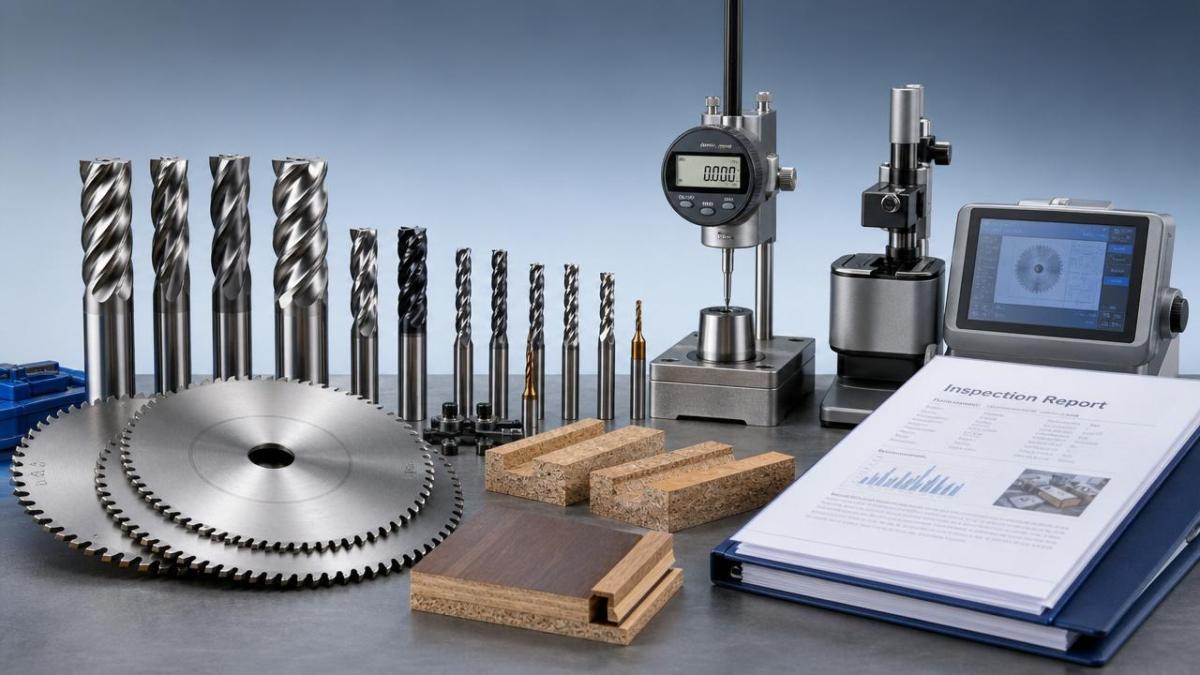
A low quote can look attractive at the inquiry stage.
In bulk purchasing, though, the real cost appears later.
If one batch shows unstable hardness, edge chipping, or uneven coating, output losses rise fast.
That is why a precision woodworking tools factory should be judged by process stability, not by unit price alone.
In practical terms, tooling quality affects cut accuracy, tool life, dust behavior, machine speed, and panel finish.
Those factors matter even more in flexible manufacturing.
PWFS often tracks this shift across CNC routers, edge banders, die-cutting systems, and other precision equipment fields.
The common lesson is simple.
When production becomes faster and more customized, small quality deviations create larger commercial risk.
So the first question is not whether a supplier is cheap.
It is whether the factory can keep every batch close to the same performance window.
What should you verify first when screening a precision woodworking tools factory?
Start with manufacturing fundamentals that are difficult to fake.
A capable precision woodworking tools factory should explain its steel grades, carbide sources, brazing methods, grinding tolerance, and coating process clearly.
If answers stay vague, the risk is already visible.
It also helps to check whether drawings, geometry revisions, and test records are controlled systematically.
Factories serving panel furniture and custom cabinet lines usually need stronger traceability.
Short lead times mean less room for manual correction.
The table below gives a practical screening framework.
A strong factory will answer these questions with data, not sales phrases.
How can you tell whether machining precision is truly stable?
Sample quality alone is not enough.
Many suppliers can make one good piece.
The harder test is repeatability across batches.
Ask for measurement consistency from different production dates.
Compare tooth geometry, concentricity, brazing integrity, and coating adhesion.
If possible, review destructive or endurance testing results.
A reliable precision woodworking tools factory should also understand application-specific cutting behavior.
For example, tools for laminated board face different heat and chip evacuation demands than tools for hardwood shaping.
This is where technical depth separates general metalworking shops from specialized suppliers.
PWFS frequently highlights this point in advanced equipment analysis.
In high-speed systems, precision is not only a dimensional issue.
It is a motion issue, a heat issue, and a yield issue.
- Request test cuts on your target material, not generic wood.
- Compare fresh tools with re-sharpened tools from the same factory.
- Check whether tool life data is based on real meters cut or only estimates.
- Confirm if balancing standards fit high-speed CNC spindle conditions.
These checks reveal whether the supplier understands production reality.
Is factory scale more important than specialization?
Not always.
A large workshop may have impressive output, yet weaker control over niche tool geometry.
A smaller precision woodworking tools factory may offer tighter engineering support and quicker design feedback.
The better question is whether the factory matches your production model.
If your orders involve standard cutters in long runs, scale and inventory depth matter more.
If your projects involve custom profiles, nesting optimization, or special coatings, specialization becomes more valuable.
This mirrors a broader pattern across print and woodworking machinery.
High-volume systems reward standardization, while customized production rewards engineering agility.
A quick comparison can make the choice clearer.
The right answer depends on order structure, not on factory size alone.
Which warning signs usually appear before bulk order problems?
Most sourcing failures show clues early.
One common sign is inconsistent technical language.
If the supplier cannot explain feed speed limits, chip load logic, or substrate differences, support may collapse after delivery.
Another sign is overconfidence on lead time without discussing raw material planning.
That often means delivery promises are based on hope, not scheduling discipline.
Watch for these issues during evaluation:
- No batch coding or weak lot traceability.
- No clear policy for defective replacements.
- Reluctance to share inspection standards.
- Tool life claims without test conditions.
- Frequent price changes tied to unclear reasons.
In actual sourcing, the biggest mistake is treating tooling like a simple commodity.
A precision woodworking tools factory supports process continuity.
That makes service response, engineering communication, and root-cause analysis just as important as the tools themselves.
How should delivery, service, and total cost be judged before signing?
A realistic evaluation should extend beyond ex-works pricing.
Total cost includes tool life, scrap reduction, machine uptime, re-sharpening quality, packaging protection, and response speed when issues occur.
A cheaper batch that fails early can become the expensive choice.
It is worth asking how the precision woodworking tools factory handles urgent replenishment, technical troubleshooting, and performance disputes.
Factories with structured after-sales processes usually provide faster resolution.
That matters in industries shaped by rapid order turnover and customized production windows.
PWFS follows similar patterns across corrugated, printing, and woodworking equipment.
The suppliers that create long-term value are usually the ones that connect precision with system thinking.
Before confirming a bulk order, build a simple approval checklist.
- Approve technical drawings and material specs in writing.
- Lock sample results against measurable acceptance criteria.
- Confirm normal lead time and peak-season lead time separately.
- Define replacement rules for coating failure, breakage, and dimensional deviation.
- Clarify whether re-sharpening support is available and repeatable.
That checklist often prevents disputes later.
What is the smartest next step after shortlisting a precision woodworking tools factory?
Move from general evaluation to controlled validation.
Instead of jumping straight into a full container or annual contract, run a pilot order tied to real production conditions.
Test the same tool across different machines, materials, and shifts.
Measure finish quality, cutting meters, downtime, and operator feedback.
This gives a more honest picture than a showroom demonstration.
If results stay stable, then expand order volume with clearer confidence.
In the end, selecting a precision woodworking tools factory is really about reducing uncertainty.
Look closely at precision control, material consistency, delivery discipline, and service logic.
When those pieces align, bulk purchasing becomes less of a gamble and more of a managed decision.
The practical next move is to turn your shortlist into a measurable scorecard, then validate it with a pilot run.
Related News
Get weekly intelligence in your inbox.
No noise. No sponsored content. Pure intelligence.
