
Precision Woodworking Tools Selection Guide: Key Specs for Accuracy and Surface Finish
Precision Woodworking Tools Selection Guide: Key Specs for Accuracy and Surface Finish
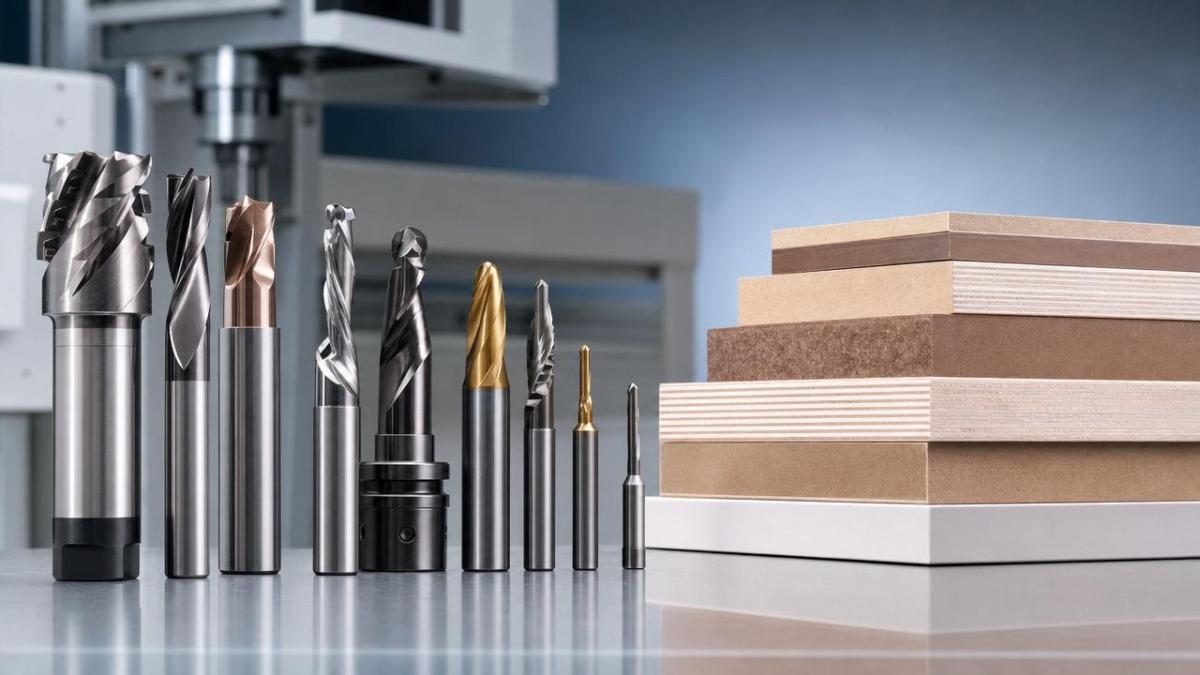
Selecting precision woodworking tools is not only about flute shape or cutter diameter.
For CNC production, the real decision sits in the relationship between geometry, balance, coating, spindle behavior, and chip flow.
That is why precision woodworking tools should be evaluated as part of a cutting system, not as isolated consumables.
A tool that looks similar on paper can create very different outcomes on laminated board, MDF, plywood, solid wood, or engineered panels.
In practice, small specification gaps often show up as edge chipping, burn marks, fuzzing, dimensional drift, or unstable cycle times.
More importantly, those issues rarely stay at the tool level.
They affect nesting yield, rework rates, edge banding quality, dust load, and machine uptime.
This guide breaks down the key specifications that matter most when comparing precision woodworking tools for high-accuracy CNC applications.
Start with the Performance Outcome
Before comparing catalogs, define the output target.
Different precision woodworking tools are optimized for different combinations of tolerance, edge quality, feed speed, and board type.
A furniture line cutting melamine panels needs different priorities than a solid wood door plant or a custom router cell.
From a technical review standpoint, five output questions usually clarify the selection path.
- What dimensional tolerance must the final part hold?
- What surface finish is acceptable before sanding or edging?
- What material stack is processed most often?
- What feed rates are required for target throughput?
- What failure mode creates the highest production cost?
Once those answers are clear, the specifications of precision woodworking tools become easier to compare in a meaningful way.
Runout and Concentricity Come First
If accuracy is the main objective, runout should be one of the first checkpoints.
Even excellent precision woodworking tools cannot deliver clean cuts if the spindle, holder, and tool axis are not concentric.
Excessive runout makes one cutting edge work harder than the others.
That shortens tool life, increases heat, and leaves inconsistent tool marks on the surface.
For many CNC woodworking applications, lower runout directly supports better edge integrity and more stable size control.
What to verify
- Tool shank tolerance and finish quality.
- Maximum indicated runout at cutting diameter.
- Compatibility with collet, holder, and spindle standard.
- Assembly repeatability after tool changes.
In real production, unstable concentricity is often misread as poor tool quality.
The better approach is to assess the whole toolholding chain together with the tool specification.
Tool Geometry Shapes Cut Quality
Geometry is where many differences between precision woodworking tools become visible on the panel edge.
Rake angle, relief angle, helix direction, flute count, and cutting length all affect chip formation and surface finish.
For example, compression tools are often preferred for laminated boards because they reduce breakout on both faces.
Upcut tools improve chip evacuation, but they may lift fibers on top surfaces.
Downcut tools can improve top-edge finish, but they may trap chips in deeper cuts.
Selection logic by application
- Use compression geometry for clean top and bottom edges on double-faced panels.
- Use upcut geometry when deep slotting needs stronger chip evacuation.
- Use downcut geometry when top-face cleanliness matters more than evacuation.
- Use higher flute stability carefully, because feed demand also rises.
This is also where long-tail evaluation terms matter.
When reviewing precision woodworking tools, compare them by actual cut behavior, not just by product label.
Balance, Vibration, and Dynamic Stability
At higher spindle speeds, balance quality becomes a serious selection factor.
Poorly balanced precision woodworking tools can introduce vibration that degrades finish long before visible chatter appears.
Vibration affects dimensional repeatability, edge straightness, bearing load, and even noise levels on the shop floor.
This becomes more critical with longer tools, aggregate heads, and demanding nested-based manufacturing cycles.
Warning signs during evaluation
- Fine ripples on otherwise smooth edges.
- Premature wear on one side of the tool.
- Inconsistent finish between identical machines.
- Spindle load spikes at stable feed settings.
A good review process should therefore include not only static dimensions, but also dynamic cutting behavior at real production speeds.
Coating, Substrate, and Wear Resistance
Not every wear problem is solved by using a harder tool.
The substrate grade, carbide quality, grain structure, and coating system should match the board composition and production rhythm.
Abrasive materials such as MDF, HDF, and particleboard with glue content can wear edges faster than expected.
In these cases, precision woodworking tools with well-matched carbide and low-friction coatings often provide more stable finish over longer runs.
From a cost perspective, the best tool is not always the one with the longest absolute life.
It is the one that maintains acceptable cut quality throughout the defined tool-change interval.
Useful comparison points
- Carbide grade for abrasive composite boards.
- Coating friction behavior under heat.
- Wear pattern consistency across batches.
- Regrind potential and total life-cycle value.
Feed Compatibility and Chip Load Matter More Than Catalog Speed
A common mistake is choosing precision woodworking tools by maximum spindle speed alone.
What matters more is whether the tool can run at the required chip load within the machine’s actual feed range.
If feed is too low, the tool may rub instead of cut.
That causes heat buildup, resin adhesion, and poor surface finish.
If feed is too high for the edge strength, chipping and dimensional instability follow quickly.
This is why precision woodworking tools should be reviewed together with spindle power, control accuracy, vacuum hold-down, and workpiece stability.
Chip Evacuation Is a Quality Issue, Not Just a Dust Issue
From recent production trends, chip evacuation is getting more attention for good reason.
Higher speeds, denser engineered boards, and longer unattended runs make chip flow a major stability factor.
When chips are not cleared efficiently, precision woodworking tools recut debris instead of removing fresh material.
That increases heat, weakens finish quality, and can distort groove dimensions.
The clearer signal is that evacuation performance should be reviewed with dust extraction capacity and groove depth together.
Practical checks
- Inspect slot bottoms for compacted chips.
- Check whether finish declines in deeper passes.
- Review extraction airflow near the cutting zone.
- Compare upcut and compression designs on identical parts.
In many cases, better evacuation improves both surface finish and predictable tool life.
Build a Short, Repeatable Evaluation Matrix
The most reliable selection process uses a controlled comparison matrix.
This keeps decisions from being driven only by unit price or supplier claims.
For precision woodworking tools, a practical matrix usually includes measurable criteria and weighted business impact.
- Dimensional accuracy over a fixed batch size.
- Edge cleanliness before secondary processing.
- Tool life to the defined rejection threshold.
- Spindle load stability during full-speed production.
- Compatibility with current holders and maintenance routines.
- Cost per accepted part, not cost per tool.
This also helps standardize communication across process, maintenance, purchasing, and production teams.
In actual business settings, that alignment often reduces trial cycles and speeds up decisions.
Final Decision: Choose for Stability, Not Just Sharpness
The best precision woodworking tools are not simply the sharpest tools on day one.
They are the tools that hold accuracy, maintain finish, and stay predictable across real production conditions.
That means looking closely at runout, geometry, balance, coating, chip load compatibility, and evacuation performance together.
It also means validating tool performance with the actual spindle, holder, board material, and shift pattern.
A disciplined evaluation process turns precision woodworking tools from a catalog item into a controllable lever for quality and throughput.
If the goal is cleaner edges, tighter tolerances, and more consistent CNC output, start with measurable specs and test for production stability.
That approach usually leads to better decisions, lower hidden cost, and a more dependable surface finish over time.
Related News
Get weekly intelligence in your inbox.
No noise. No sponsored content. Pure intelligence.
