Whole-House Customization Workflow: What Equipment Is Needed From Design to Installation?
Whole-house customization is no longer a simple cabinet-making task. It is a connected manufacturing workflow where design software, cutting equipment, drilling units, edge banding lines, sorting systems, and on-site installation must stay synchronized.
That shift matters because delivery promises are getting shorter while expectations for finish quality, fit accuracy, and environmental performance keep rising. In practice, the winning factor is not one machine, but how equipment and data move together from concept to installation.
For operations planning, capital allocation, and factory upgrade decisions, it helps to view the whole-house customization workflow as a digital production chain. Every break in that chain creates rework, delays, material waste, or installation problems later.
Why the workflow matters more than any single machine
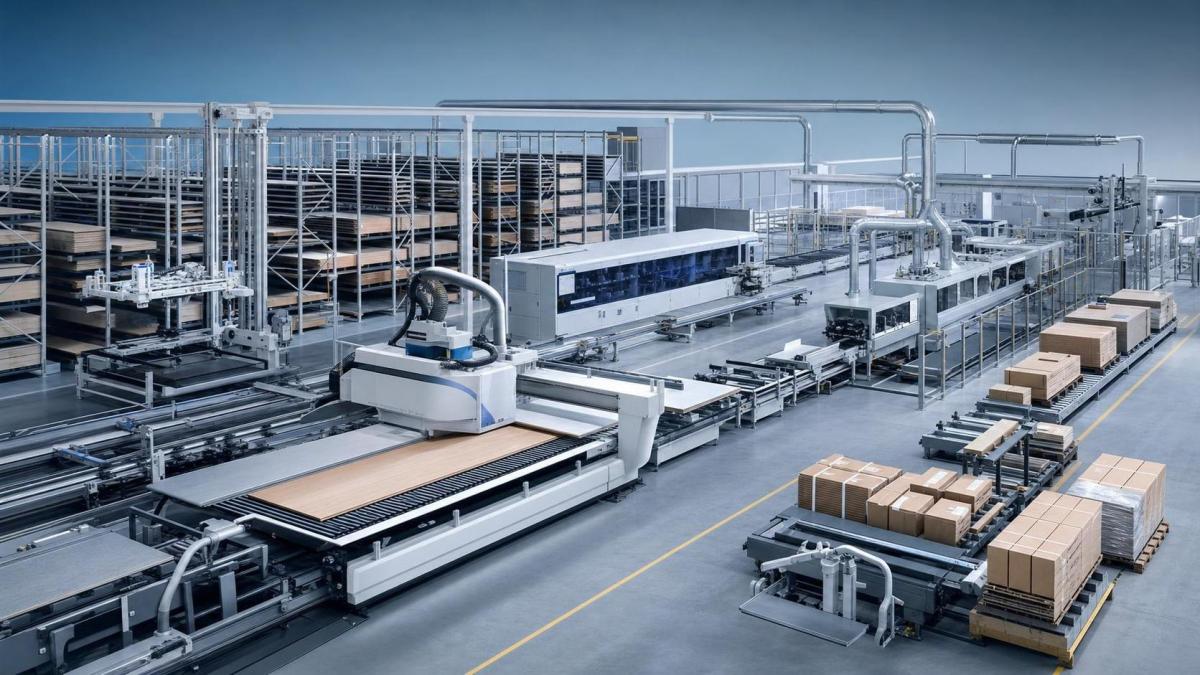
In many factories, equipment lists look impressive, yet output remains unstable. The reason is usually poor linkage between front-end order data and back-end execution.
Whole-house customization deals with variable room sizes, mixed panel specifications, hardware combinations, and installation sequencing. Unlike standard furniture production, almost every order can contain unique dimensions and process paths.
This is where PWFS offers useful context. Its focus on CNC woodworking routers, panel edge banders, and digital manufacturing intelligence highlights the same principle seen in advanced printing and packaging lines: precision only creates value when the entire process is integrated.
A corrugated board line or offset press succeeds through disciplined material flow, registration control, and automated consistency. Whole-house customization follows the same industrial logic, even though the finished product is a living space rather than a shipping box.
The core equipment chain from design to factory output
The workflow usually starts long before cutting. Design confirmation, bill of materials generation, nesting optimization, and production scheduling determine whether the shop floor runs smoothly or fights constant exceptions.
1. Design and order management systems
The first requirement is design software linked with pricing, configuration rules, and production output. This may include CAD, 3D room design, ERP, and MES modules.
The goal is not only visual presentation. The system must convert a confirmed scheme into machinable data, hardware lists, panel labels, and installation logic without repeated manual interpretation.
2. Panel storage and intelligent feeding
Before machining begins, automated or semi-automated panel storage improves material traceability and loading efficiency. This is especially important when panel colors, thicknesses, and surface finishes vary by order.
A well-designed feeding system reduces waiting time at the CNC station and lowers the risk of wrong-board use, which is a common hidden cost in whole-house customization.
3. CNC cutting and nesting equipment
CNC nesting routers are the production core. They read digital programs directly, cut irregular shapes, drill basic holes, and support fast switching between cabinet, wardrobe, vanity, and wall panel components.
For higher-output factories, automatic loading, labeling, unloading, and waste removal become just as important as spindle power or travel size. The machine must fit the order mix, not only the peak speed specification.
4. Drilling and connecting preparation
Dedicated six-sided drilling or CNC drilling centers improve precision for connector holes, hinges, dowels, and concealed fittings. They also simplify downstream assembly and installation.
In whole-house customization, drilling accuracy affects more than assembly speed. It influences door alignment, drawer performance, wall fit, and the installer’s ability to solve site deviations without damaging panels.
5. Edge banding systems
Edge banders are essential for both appearance and durability. They seal exposed edges, improve moisture resistance, and support indoor environmental standards when process control is stable.
PUR and laser edge banding are often discussed because seam quality now affects brand positioning. For premium whole-house customization, edge performance is a visible quality signal, not a secondary process.
What happens after machining is often underestimated
Many planning discussions focus on cutting speed and machine count. Yet a large share of delays appears after parts leave the main machining area.
Sorting, buffering, quality inspection, package identification, and installation sequencing determine whether customized parts arrive at the project site in usable order.
This is where manufacturing discipline from packaging industries offers a useful lesson. High-speed lines succeed because each item remains traceable. Whole-house customization needs the same rule for every panel, connector, and installation package.
Digital links are as important as physical equipment
A modern factory can own advanced machines and still struggle if data travels through spreadsheets, manual renaming, or disconnected software islands.
The most valuable equipment in whole-house customization may be invisible: MES, production dashboards, machine interface protocols, optimization engines, and traceability systems.
These tools support several practical outcomes:
- Stable conversion from design data to machine code.
- Live visibility into bottlenecks, downtime, and order progress.
- Accurate label generation for each component and package.
- Faster root-cause analysis when installation issues appear.
- Better planning for mixed-batch production and urgent inserts.
PWFS often frames this as a broader Industry 4.0 transition. That interpretation fits well. Whole-house customization becomes more profitable when flexible production is managed with the same rigor used in precision print and converting operations.
How to evaluate equipment for different operating models
Not every factory needs the same line architecture. Equipment decisions should reflect order complexity, labor structure, finish positioning, and installation radius.
Project-focused production
When orders are large but less frequent, flexibility and changeover control matter more than maximum throughput. Strong design integration and reliable drilling accuracy usually deliver better returns than adding duplicate machines too early.
Retail-scale order flow
When order volume is high and fragmented, automated storage, fast nesting, intelligent labeling, and sorting systems become critical. Without them, whole-house customization turns into a scheduling problem rather than a production advantage.
Premium finish positioning
For higher-end projects, edge quality, surface protection, dust control, and packaging standards deserve more attention. Installation complaints often come from finish damage, chip breakout, or inconsistent edge appearance, not from headline machine speed.
Practical checkpoints before expanding a line
A useful review starts with process mapping rather than equipment catalogs. The question is where orders lose time, accuracy, or traceability.
- Check whether design data reaches CNC, drilling, and labeling without re-entry.
- Measure how often parts wait between cutting, edge banding, and sorting.
- Track error sources by order, panel type, hardware set, and installation team feedback.
- Compare machine utilization with actual order completion rates.
- Review whether packaging supports transport and site handling conditions.
This approach prevents overinvestment in isolated capacity. In whole-house customization, a faster cutter does not solve a weak drilling process or a chaotic kitting stage.
From equipment selection to installation success
The most effective whole-house customization systems are built backwards from the final installation result. If on-site fitting, visual quality, and delivery reliability are the target, then machine selection must support those outcomes from the beginning.
That means treating software, CNC routers, drilling centers, edge banders, sorting tools, and packaging methods as one coordinated structure. It also means evaluating digital connectivity with the same seriousness as spindle configuration or adhesive technology.
The next useful step is to map the current workflow against actual order behavior: where design data breaks, where panels queue, where errors emerge, and where installation teams lose time. That review usually makes the right equipment priorities much clearer.
Related News
Get weekly intelligence in your inbox.
No noise. No sponsored content. Pure intelligence.
