
Which industrial packaging trends will cut waste in 2026?
As material costs rise and sustainability rules tighten, enterprise leaders are asking which industrial packaging trends will deliver measurable waste reduction in 2026.
From right-sized corrugated design and fiber-based barrier coatings to AI-driven production planning, automated die-cutting optimization, and traceable low-migration printing, the next wave of packaging efficiency will be built on precision.
For manufacturers, converters, and equipment investors, cutting waste is no longer just an environmental goal. It is a direct path to lower costs, higher throughput, stronger compliance, and resilient supply chains.
Why Industrial Packaging Trends Need a Checklist in 2026
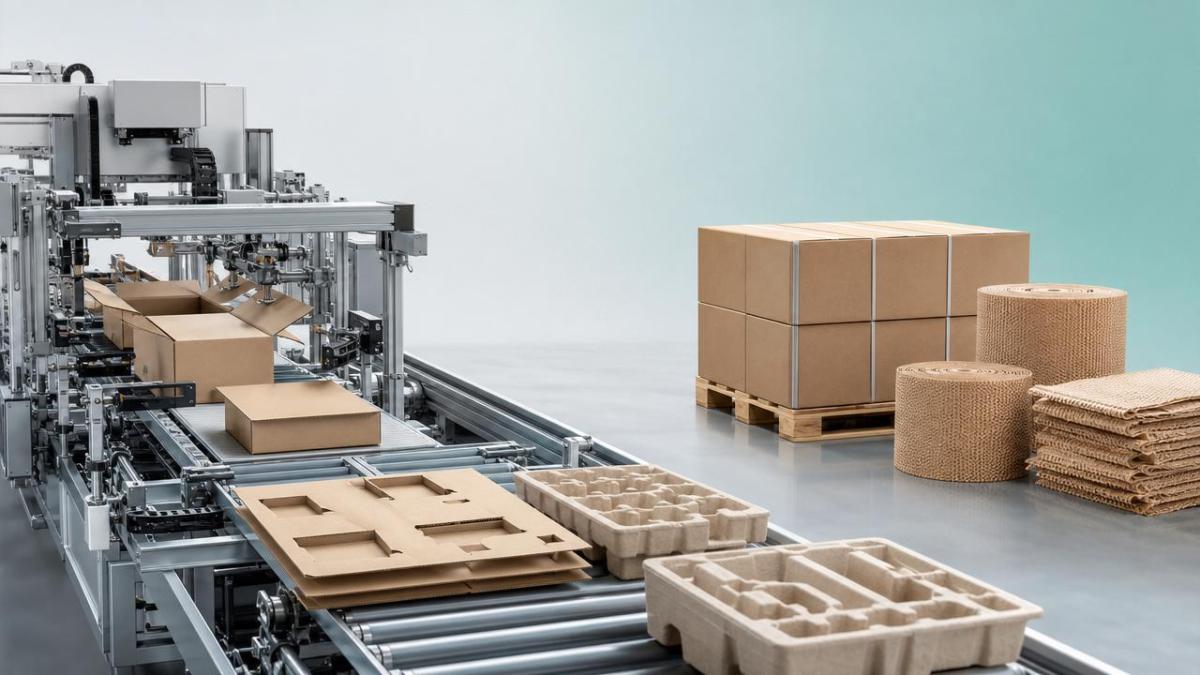
Industrial packaging trends are moving faster because waste now appears in every cost center. Fiber loss, ink migration risk, oversize cartons, and rejected pallets all carry financial weight.
A checklist turns broad sustainability goals into production decisions. It helps compare substrates, machines, workflows, and compliance controls without relying on slogans.
In corrugated, folding carton, furniture, and e-commerce packaging, the most effective industrial packaging trends share one trait: they reduce variation before material is consumed.
PWFS tracks this shift across corrugators, offset presses, die-cutters, folder-gluers, CNC routers, and edge banders. Waste reduction depends on connected precision, not isolated upgrades.
Core Checklist: Industrial Packaging Trends That Cut Waste
Use this checklist to assess which industrial packaging trends can reduce waste in daily production, capital planning, and supplier evaluation.
- Audit carton dimensions against real product data, then eliminate empty cube before negotiating material grades or freight contracts.
- Apply right-weighting to corrugated board, balancing burst strength, edge crush, moisture exposure, stacking time, and parcel network abuse.
- Adopt digital imposition tools that nest blanks tightly and reduce trim waste before die boards enter production.
- Use automated die-cutting registration to cut make-ready sheets, reduce rejects, and stabilize high-speed folding carton output.
- Specify low-migration inks and controlled curing profiles to prevent food-grade recalls, scrap, and rework.
- Replace plastic-heavy protection with molded fiber, paper cushioning, or recyclable corrugated inserts where compression data supports the switch.
- Track roll, sheet, ink, glue, and coating usage through MES data instead of relying on monthly inventory estimates.
- Install vision inspection after printing, die-cutting, gluing, and case forming to remove defects before downstream waste multiplies.
- Standardize reusable transport packaging for closed-loop flows, especially components, furniture panels, fixtures, and industrial spares.
- Connect packaging design with palletization software, because cube efficiency often saves more material than a lighter board grade.
These industrial packaging trends work best when measured together. A lighter material can increase damage, while an optimized structure can cut waste without reducing protection.
Trend 1: Right-Sized Corrugated Becomes the Waste Baseline
Right-sizing remains one of the most practical industrial packaging trends because it attacks fiber waste, filler waste, truck space, and dimensional freight charges simultaneously.
The key is not simply making boxes smaller. The process must connect product geometry, compression requirements, automated case forming, and return-rate data.
Modern corrugated board lines can support this trend with faster flute changes, tighter moisture control, and better web alignment. These improvements reduce warp and rejected sheets.
In 2026, industrial packaging trends will favor flexible corrugators that serve shorter runs without excessive setup loss. E-commerce variety makes long-run assumptions weaker.
Trend 2: Fiber-Based Barriers Replace Hard-to-Recycle Layers
Barrier innovation is among the industrial packaging trends most affected by regulation. Food, cosmetics, medical, and chilled logistics all need protection without complex laminates.
Water-based coatings, dispersion barriers, and recyclable fiber structures can reduce landfill exposure. They also simplify recycling claims when tested under recognized standards.
However, coating choice must match converting conditions. Cracking during scoring, glue interference, drying energy, and rub resistance can create hidden waste.
The strongest industrial packaging trends in barrier design combine lab testing with pressroom trials. A recyclable material that fails on line is not sustainable.
Trend 3: Precision Printing Reduces Rejects and Compliance Risk
Offset and flexographic printing are central to industrial packaging trends because color errors, registration drift, and ink defects quickly create high-value scrap.
High-precision offset presses running thousands of sheets per hour need closed-loop color measurement, stable ink-water balance, and reliable substrate conditioning.
For food and personal care packaging, low-migration systems matter as much as visual quality. Compliance failures often waste more than normal production defects.
Industrial packaging trends in 2026 will push print departments toward traceable recipes, digital job histories, and documented wash-up controls.
Trend 4: Smarter Die-Cutting and Folder-Gluing Prevent Geometric Waste
Die-cutters and folder-gluers turn flat material into sellable structure. Small errors in crease depth, stripping, or glue placement can scrap complete batches.
That is why industrial packaging trends increasingly focus on machine kinematics. Stable acceleration, clean stripping, and precise blank separation improve yield.
Automated glue inspection also reduces invisible waste. A weak seam can survive packing, then fail in transit and damage the product.
The practical target is first-time-right converting. Faster machines only cut waste when setup, registration, folding, and inspection remain synchronized.
Trend 5: AI Planning Cuts Overproduction and Changeover Loss
AI planning is one of the most discussed industrial packaging trends, but its value depends on data quality. Poor master data only automates confusion.
Useful systems predict demand, group similar jobs, sequence substrates, and reduce wash-ups. They also flag unstable specifications before production starts.
For corrugated and folding carton operations, AI can recommend run order by flute, board grade, ink family, die format, and delivery window.
These industrial packaging trends reduce waste by preventing unnecessary changeovers. Less idle time also lowers energy use and labor pressure.
Trend 6: Traceability Makes Sustainability Claims Defensible
Traceability is becoming mandatory in many industrial packaging trends. FSC chain-of-custody, recycled content evidence, and ink safety records must be verifiable.
A strong traceability system links purchase orders, roll IDs, batch data, press settings, inspection records, and finished goods labels.
This reduces waste during audits and disputes. Instead of quarantining broad inventory, teams can isolate affected lots quickly.
In 2026, industrial packaging trends will reward digital material passports and supplier data integration, especially for export-oriented packaging.
Application Notes by Packaging Scenario
E-Commerce and Parcel Logistics
E-commerce packaging faces unpredictable product mixes and rough parcel networks. Right-sized corrugated, tested inserts, and automated case selection deliver immediate waste reduction.
Industrial packaging trends for this scenario should be judged by damage rate, filler usage, average cube, line speed, and customer return data.
Food, Beverage, and Personal Care
These sectors require stronger compliance discipline. Low-migration printing, recyclable barriers, and controlled curing reduce scrap linked to safety uncertainty.
The best industrial packaging trends here combine shelf appeal with verifiable material safety. Color brilliance cannot compensate for failed migration control.
Furniture, Panels, and Custom Interiors
Whole-house customization creates irregular panel sizes, fragile edges, and mixed hardware kits. Packaging must protect surfaces without excessive foam or film.
CNC woodworking routers and edge banders influence packaging waste too. Accurate cutting and sealed edges reduce protective overpackaging and transit rejects.
Commonly Missed Risks in Industrial Packaging Trends
- Check whether lightweight board increases damage claims, because downstream product loss can erase upstream material savings.
- Validate glue compatibility with coatings, since recyclable barriers can disrupt bonding and cause carton failures.
- Measure setup waste separately from production waste, because short runs can hide expensive make-ready losses.
- Confirm recycling claims by region, as collection systems and paper mill acceptance rules vary widely.
- Protect data accuracy in MES and AI tools, because wrong specifications create faster, larger waste events.
Many industrial packaging trends fail when treated as purchasing decisions only. Material substitution must be tested through the entire converting and logistics chain.
Execution Guide for 2026 Waste Reduction
Start with a waste map. Separate losses from design, procurement, storage, printing, die-cutting, gluing, packing, warehousing, and transport.
Then rank industrial packaging trends by payback speed and risk. Right-sizing and inspection often deliver faster results than full material redesign.
- Build a baseline using kilograms of waste per thousand units, not only percentage scrap.
- Select three high-volume SKUs and redesign them using cube, compression, and pallet data.
- Run controlled trials across printing, die-cutting, gluing, packing, and distribution.
- Document defects by cause, including substrate, machine setting, operator action, and supplier variation.
- Scale only after damage rate, customer complaints, recycling claims, and throughput remain stable.
PWFS recommends aligning equipment investment with this sequence. A new press, corrugator, die-cutter, or folder-gluer should solve measured waste causes.
Measurement Table for Comparing Waste-Cutting Options
Conclusion: Which Industrial Packaging Trends Matter Most?
The industrial packaging trends most likely to cut waste in 2026 are practical, measurable, and connected to production reality.
Right-sized corrugated, recyclable barriers, precision printing, automated die-cutting, AI planning, and traceability form the strongest waste-reduction portfolio.
The next step is direct: measure current waste, choose pilot SKUs, validate through the line, and scale only when protection, compliance, and throughput improve together.
For any operation evaluating industrial packaging trends, the winning question is simple. Which change removes waste before material, energy, and labor are already spent?
Related News
Get weekly intelligence in your inbox.
No noise. No sponsored content. Pure intelligence.
