
Packaging Industry Trends in 2025: What Is Driving Demand for Short-Run Digital Packaging?
In 2025, packaging industry trends are no longer shaped by volume alone. They are being redefined by faster online fulfillment, shorter product cycles, rising SKU complexity, and tighter sustainability expectations.
That is why short-run digital packaging is moving from a useful alternative to a strategic production model. It helps brands respond to demand swings, launch faster, reduce waste, and keep packaging relevant without committing to long conventional runs.
For operations tied to corrugated lines, offset presses, die-cutting systems, and automated converting, this shift matters well beyond print technology. It changes planning logic, asset utilization, inventory risk, and the economics of customization.
Why short-run digital packaging is gaining momentum
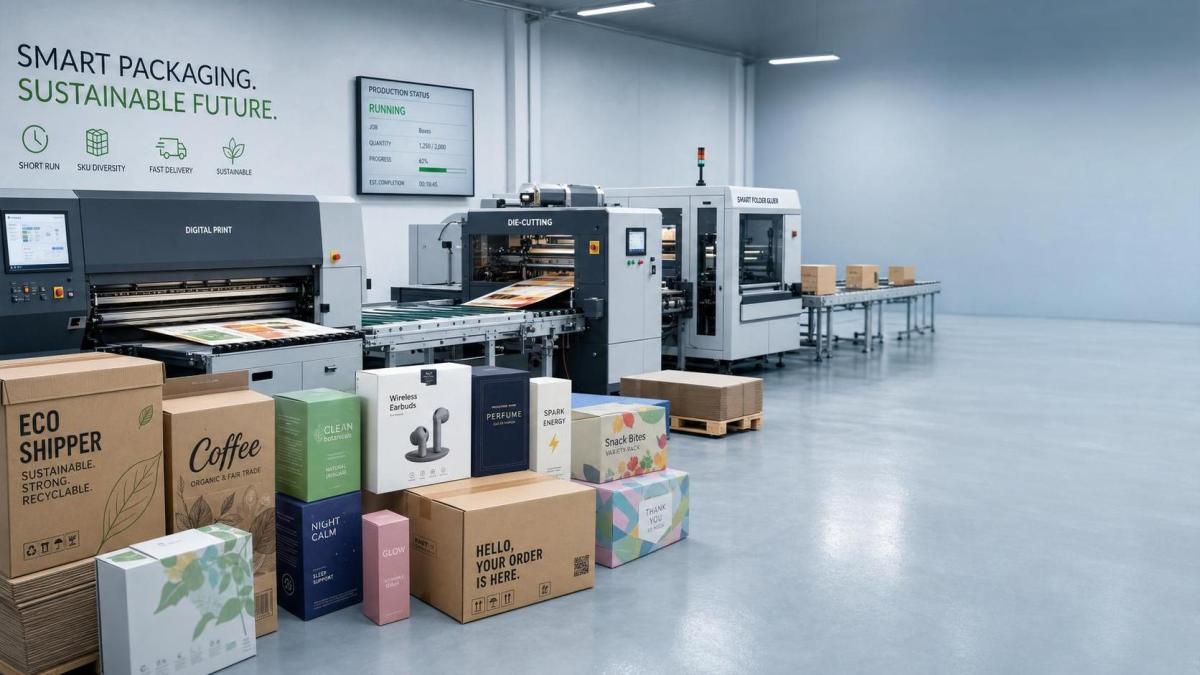
One of the clearest packaging industry trends is the move away from forecasting months ahead with confidence. Demand is more fragmented, promotions are more frequent, and product lifecycles are less predictable.
Short-run digital packaging fits this environment because it lowers the penalty of uncertainty. Instead of printing large inventories, businesses can produce closer to actual demand and revise graphics, formats, or compliance details with less disruption.
This matters in sectors where packaging is both a protective structure and a selling surface. Corrugated transit boxes, folding cartons, promotional sleeves, and seasonal gift formats all benefit from faster changeovers and version control.
In practical terms, digital short runs are not replacing every analog process. They are expanding the operating range of packaging plants that need to handle both volume efficiency and flexible response.
The real forces behind 2025 packaging industry trends
Several demand drivers are converging at once, and together they explain why short-run digital packaging is accelerating.
E-commerce has changed packaging economics
Online retail rewards speed, resilience, and frequent assortment updates. Shipping-ready packaging must protect products, carry clear branding, and adapt quickly to campaigns, channels, and regional offers.
That puts new pressure on corrugated board lines and converting systems. The priority is no longer only throughput. It is also the ability to support mixed order profiles without creating excess stock.
SKU proliferation is raising complexity costs
More product variants mean more artwork versions, more packaging dimensions, and more regulatory details. Conventional long runs remain efficient at scale, but they become less forgiving when volumes split across many SKUs.
Short-run digital packaging helps absorb that complexity. It supports versioned packaging without forcing large minimum orders or repeated plate changes.
Sustainability pressure is becoming operational
Sustainability is no longer only a reporting topic. It now affects material choices, make-ready waste, obsolete stock, and traceability requirements.
This is where packaging industry trends connect with production intelligence. Lower overruns, smarter job sequencing, and better alignment between print demand and converting capacity can reduce waste without weakening service levels.
Customization has become a margin tool
Packaging is increasingly expected to support niche launches, localized campaigns, limited editions, and personalized retail experiences. In those cases, speed and relevance often create more value than the lowest unit cost.
That is one reason digital capability is becoming part of broader packaging industry trends, not just a specialist print topic.
Where this shift touches the production chain
Short-run digital packaging affects more than the pressroom. It influences how the entire converting chain is balanced, from substrate preparation to finishing accuracy.
PWFS tracks this shift through the machinery that turns paper-based materials into high-value packaging. That perspective is useful because market change is easiest to understand when linked to process capability.
In other words, the growth of digital short runs depends on mechanical precision and workflow discipline just as much as on print technology. Registration stability, finishing repeatability, and data connectivity all shape profitability.
How to read the opportunity in business terms
A common mistake is to compare digital packaging only on click cost or unit cost. That misses the broader business case behind current packaging industry trends.
The stronger evaluation looks at total outcome: reduced inventory exposure, fewer obsolete cartons, faster campaign readiness, lower make-ready waste, and improved flexibility when demand changes unexpectedly.
For many packaging operations, short-run digital capability works best in a hybrid production model.
- Long, stable runs stay on optimized conventional lines.
- Variable, seasonal, or test-market jobs move to digital workflows.
- Finishing assets are configured to support both with minimal friction.
- Planning systems decide allocation based on margin, urgency, and complexity.
This approach protects investment in high-speed offset and converting while opening room for profitable small batches. It also aligns with the PWFS view that yield and flexibility must advance together.
Key signals worth monitoring in 2025
Not every packaging operation needs the same level of digital short-run capability. The right pace depends on product mix, channel volatility, compliance burden, and finishing requirements.
Still, several signals indicate that packaging industry trends are pushing in this direction.
- Frequent artwork changes driven by promotions or regionalization.
- Rising write-offs from obsolete printed inventory.
- More demand for pilot launches and small market tests.
- Tighter sustainability reporting around waste and material efficiency.
- Capacity loss caused by too many short jobs on conventional assets.
When several of these appear together, the issue is usually structural rather than temporary. That is the point where digital packaging becomes part of operating design, not a backup option.
Questions that help shape the next move
The most useful next step is not to ask whether digital packaging is good in general. It is to define where it creates measurable advantage inside a specific packaging workflow.
A grounded review usually starts with a few practical questions.
- Which SKUs create the most planning instability or inventory waste?
- Where do job changes reduce the productivity of offset or converting lines?
- How much value comes from faster launch timing or localized packaging?
- Can MES, prepress, print, and finishing data flow more seamlessly?
- Which quality standards must remain non-negotiable across short runs?
The answer often leads to a hybrid roadmap rather than a full replacement plan. That is especially true where corrugated performance, color control, die-cutting accuracy, and gluing consistency all affect final value.
In 2025, the most important packaging industry trends are not about choosing one technology over another. They are about building a system that can convert volatility into speed, precision, and profitable flexibility.
A careful review of run profiles, finishing constraints, workflow data, and waste patterns is usually the best place to begin. From there, short-run digital packaging becomes easier to judge as an operating strategy, not just a production feature.
Related News
Get weekly intelligence in your inbox.
No noise. No sponsored content. Pure intelligence.
