
Industrial packaging solutions that cut damage in transit
For procurement teams, industrial packaging solutions are no longer just a cost item—they are a direct lever for reducing transit damage, protecting brand reputation, and improving supply chain efficiency.
From corrugated board strength to precision die-cutting and high-speed box forming, the right systems decide whether goods arrive intact, compliant, and shelf-ready across demanding global routes.
This shift is pushing industrial packaging solutions from a back-end function into a strategic capability tied to automation, material science, and data-led quality control.
Transit damage is becoming a systems issue, not only a materials issue
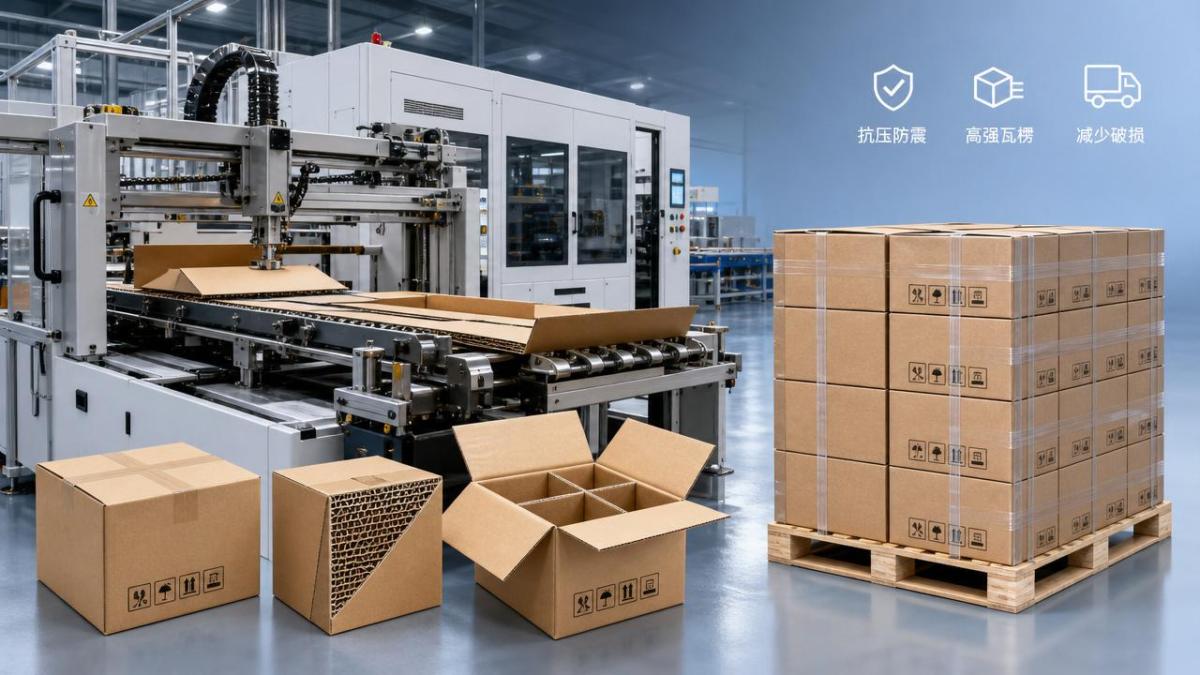
Damage in transit used to be blamed on weak cartons or rough handling.
Today, the pattern is broader. Failures often come from mismatched board grades, poor structural design, unstable printing, weak folds, and inconsistent gluing.
That is why industrial packaging solutions now combine material selection, converting precision, box geometry, and production consistency into one coordinated performance model.
In e-commerce, export logistics, and automated warehousing, packaging faces compression, vibration, moisture, repeated handling, and rapid sorting.
A box that performs well in static storage may fail inside a high-speed distribution network.
Several market signals show why industrial packaging solutions are being upgraded
The demand for better industrial packaging solutions is being accelerated by changes across logistics, retail, compliance, and manufacturing automation.
- Parcel volumes remain high, increasing stacking pressure and handling frequency.
- Cross-border shipping extends transit time and climate exposure.
- Retail-ready packaging must look premium while still resisting distribution stress.
- Automation requires precise dimensions for smooth conveying and palletizing.
- Sustainability targets demand lower material use without sacrificing protection.
- Traceability and compliance raise expectations for print quality and substrate control.
These signals explain why advanced industrial packaging solutions increasingly depend on integrated corrugated lines, offset presses, die-cutters, and folder-gluers.
Why the shift is happening now across packaging and broader industrial operations
The change is not driven by one factor. It reflects a convergence of operational pressure, customer expectations, and machine-level capability improvements.
The result is clear: industrial packaging solutions are increasingly judged by end-to-end performance, not only by unit price.
Where packaging failure starts in the production chain
Many transit losses begin upstream, long before goods enter a truck or container.
Corrugated board formation affects compression resistance
Board quality depends on flute formation, adhesive application, moisture balance, and liner bonding.
Modern corrugated lines help industrial packaging solutions deliver stable burst strength, edge crush performance, and dimensional consistency.
Printing accuracy influences downstream converting
High-precision offset presses do more than improve appearance.
Reliable registration supports clean die-cut alignment, accurate folding positions, and fewer weak points caused by conversion errors.
Die-cutting and folder-gluing determine final box integrity
Poor creasing can crack liners. Weak gluing can open seams. Inconsistent folding can distort stacking behavior.
That is why industrial packaging solutions need tight tolerance control at high speed, not only strong raw material inputs.
The impact reaches cost, brand trust, compliance, and factory efficiency
Transit damage has a visible direct cost, but the hidden cost is often larger.
- Returns, replacements, and customer service activity increase.
- Warehouse rework slows throughput and disrupts planning.
- Damaged presentation weakens brand credibility at delivery or on shelf.
- In regulated sectors, packaging failure can create compliance concerns.
- Excess packaging used as a safety buffer raises freight and material costs.
For broader industrial operations, better industrial packaging solutions also improve pallet stability, loading efficiency, and line-side packing speed.
This makes packaging performance a cross-functional issue linked to production, logistics, marketing, and sustainability goals.
The strongest industrial packaging solutions balance protection, speed, and sustainability
The market no longer rewards overbuilt packaging by default.
The winning approach is engineered optimization: enough protection for the route, enough precision for automation, and enough efficiency for commercial viability.
Key traits of high-performing systems
- Board grades matched to stacking load and humidity conditions
- Structural designs that reduce empty space and product movement
- Stable print registration for accurate downstream converting
- Consistent crease depth, cut quality, and adhesive application
- Data visibility for rejects, downtime, and process drift
- Compatibility with recyclable materials and lower-waste production
PWFS tracks these shifts closely because machine precision and process intelligence are now central to industrial packaging solutions that cut damage in transit.
What deserves close attention in the next evaluation cycle
A useful review goes beyond carton price and includes production capability, route conditions, and measurable failure points.
- Map damage by lane, product type, and packaging format.
- Compare board specification with actual compression and drop requirements.
- Check whether print and die-cut tolerances support automated packing lines.
- Review glue consistency, fold quality, and seam failure frequency.
- Measure material use against protection outcomes, not habit-based standards.
- Assess traceability, food-contact, or ink migration risks where relevant.
These checkpoints help identify whether industrial packaging solutions are underperforming because of design, equipment capability, material choice, or process variation.
A practical response should connect machine capability with packaging outcomes
This approach reflects how advanced industrial packaging solutions are evolving: less guesswork, more engineering evidence, and tighter integration across the packaging chain.
The next step is to treat packaging as performance infrastructure
Industrial packaging solutions now sit at the intersection of logistics resilience, visual quality, automation readiness, and sustainability performance.
Organizations that connect corrugated production, print precision, die-cut accuracy, and gluing consistency can reduce transit damage without defaulting to heavier materials.
PWFS continues to observe this transition through the lens of board physics, print registration, converting kinematics, and smart factory intelligence.
A practical starting point is simple: review recent damage data, identify the failure stage, and align future industrial packaging solutions with real shipping conditions and measurable production capability.
Related News
Get weekly intelligence in your inbox.
No noise. No sponsored content. Pure intelligence.
