
Industrial Packaging Systems for High-Mix Production: How to Reduce Changeover Delays
Industrial Packaging Systems for High-Mix Production: How to Reduce Changeover Delays
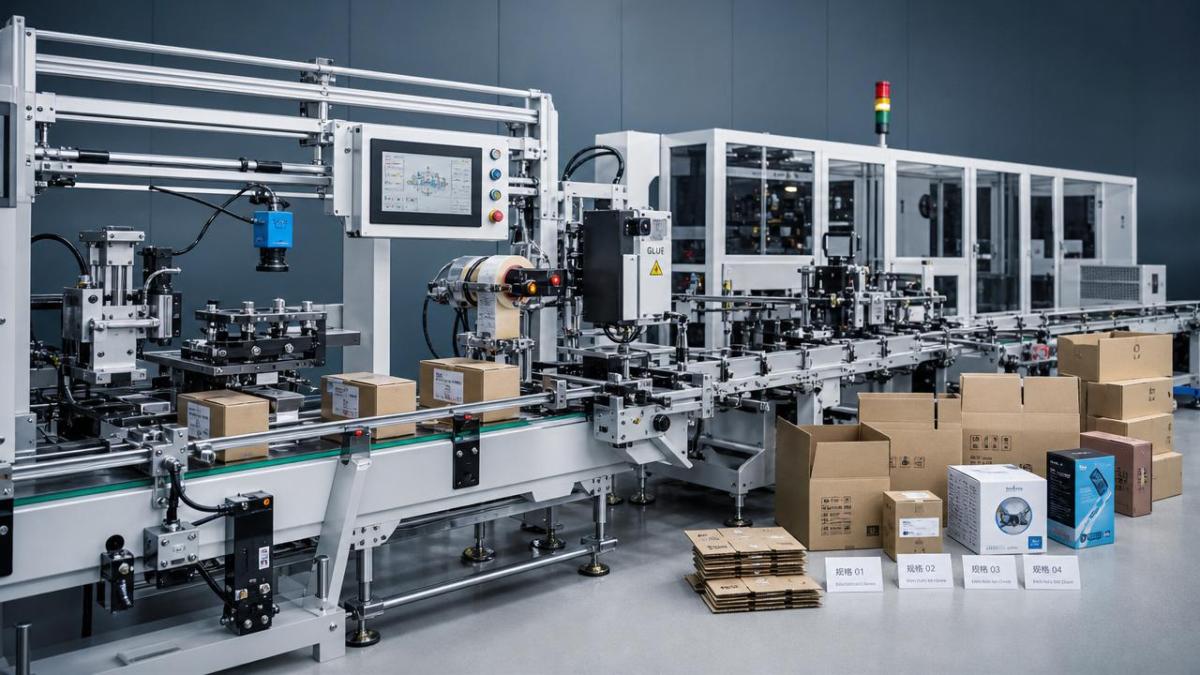
In high-mix production, changeovers rarely fail for one big reason.
They usually slow down because of many small interruptions.
A label guide needs resetting. A feeder needs tuning.
Glue paths change. Print registration drifts. Operators wait for approval.
That is why industrial packaging systems matter so much today.
They help production teams switch formats faster without losing quality.
They also reduce guesswork across corrugated, folding carton, and custom packaging runs.
From recent market shifts, one signal is clear.
Shorter orders are now normal, not exceptional.
E-commerce packaging, promotional runs, seasonal SKUs, and customized furniture-related packing all add variety.
This means industrial packaging systems must support flexibility as a core function.
Why Changeover Delays Hurt More in High-Mix Operations
In long-run production, setup time spreads across many finished units.
In high-mix environments, that buffer disappears quickly.
Ten extra minutes between jobs can remove an entire shift’s worth of planned capacity.
The damage is not only about time.
Frequent manual adjustments increase scrap, rework, and operator fatigue.
Schedule reliability also suffers when each new SKU behaves differently.
Modern industrial packaging systems reduce this risk by standardizing repeatable setup steps.
They turn setup knowledge into digital process control instead of tribal memory.
- Lost machine availability cuts daily output.
- Slow first-piece approval delays downstream packing.
- Repeated tuning raises board, ink, glue, and label waste.
- Unclear settings make quality unstable across shifts.
What High-Performance Industrial Packaging Systems Need to Do
Not every line is designed for fast product switching.
Some machines run fast only when product variation is low.
For high-mix work, industrial packaging systems should make changeovers simpler, shorter, and more predictable.
In practical terms, that starts with recipe-driven settings.
Saved job data lets operators recall feeder positions, print parameters, glue patterns, and carton dimensions quickly.
Servo-based positioning is another major advantage.
It replaces trial-and-error handwheels with automatic movement to target values.
Vision inspection also plays a bigger role than before.
When industrial packaging systems confirm print, fold, cut, or code quality early, restart time becomes much shorter.
- Store and recall job recipes accurately.
- Automate key positioning points with servo control.
- Support modular tooling for rapid swap-out.
- Use inline inspection for first-pass validation.
- Connect with MES or scheduling software.
Five Practical Ways to Reduce Changeover Time
1. Separate Internal and External Setup Tasks
Many delays happen while the line is stopped for preparation work.
That preparation should happen before the current job ends.
Pre-stage dies, plates, glue, tooling, pallets, and digital files near the line.
Industrial packaging systems work better when material flow is disciplined around them.
2. Build Standard Job Recipes
If each shift uses different naming, setup becomes slower immediately.
Create recipe rules for dimensions, board grades, print layers, and fold structures.
This allows industrial packaging systems to retrieve settings with fewer errors.
3. Use Quick-Change Tooling
Tooling design has a direct effect on downtime.
Magnetic cylinders, indexed guides, and cartridge-style units shorten mechanical change steps.
Even a small reduction per change compounds across a week.
4. Stabilize First-Pass Quality
Fast changeover means little if startup scrap remains high.
Use preset values, camera checks, and clear approval criteria.
The best industrial packaging systems reduce both setup time and startup instability.
5. Review Every Delay with Real Data
Do not label every loss as operator error.
Track delay categories such as tooling search, setting mismatch, cleaning time, and approval waiting.
This shows where industrial packaging systems need process support, not just machine upgrades.
Where Digital Integration Makes the Biggest Difference
Digital integration is often discussed in abstract terms.
In real plants, its value is much more concrete.
When industrial packaging systems connect with prepress, order management, and MES, setup becomes cleaner and faster.
Operators do not need to re-enter the same job data several times.
That removes avoidable mistakes before the job even starts.
This is especially useful in corrugated board lines, offset printing, die-cutting, and folder-gluer workflows.
A digital thread also improves repeat orders.
If a packaging SKU returns after three months, the line should not start from zero.
How to Evaluate Industrial Packaging Systems Before Upgrading
Buying faster equipment does not automatically solve high-mix inefficiency.
The better question is whether the system fits actual product variation.
Start with the current delay pattern.
If most losses come from adjustments, choose more automation and recipe control.
If most losses come from tooling logistics, redesign the staging process first.
In many cases, the strongest result comes from combining machine capability with workflow discipline.
- Check average changeover time by product family.
- Measure first-good-sheet or first-good-box timing.
- Review how many settings are still manual.
- Confirm recipe accuracy on repeat jobs.
- Test operator usability, not just top speed.
- Estimate scrap cost during startup and adjustment.
This evaluation method gives a more honest view of industrial packaging systems.
It also supports better capital decisions for flexible manufacturing.
Common Risks That Keep Changeovers Slow
Several issues continue to block improvement even after equipment upgrades.
One common problem is inconsistent master data.
If dimensions, materials, or artwork versions are wrong, industrial packaging systems cannot perform as intended.
Another problem is over-customized workflow.
When every urgent order bypasses standards, setup stability disappears.
Training gaps are also costly.
A smart interface helps, but it cannot replace structured operating practice.
In actual operations, the best lines combine automation with disciplined execution.
A Practical Path Forward
Reducing changeover delays does not require a perfect factory from day one.
It requires focus on the steps that repeat every shift.
Start by mapping one product family with frequent changeovers.
Then standardize setup, digitize recipes, and remove manual searching.
Next, validate first-pass quality with clear checkpoints.
Finally, use downtime data to decide where automation adds real value.
The strongest industrial packaging systems are not only fast.
They are predictable, easy to repeat, and flexible enough for changing demand.
In high-mix production, that is what protects output, quality, and margin at the same time.
Related News
Get weekly intelligence in your inbox.
No noise. No sponsored content. Pure intelligence.
