
Flexible Manufacturing Systems Price: Cost Drivers, ROI Factors, and Budget Benchmarks
Why does flexible manufacturing systems price vary so much?
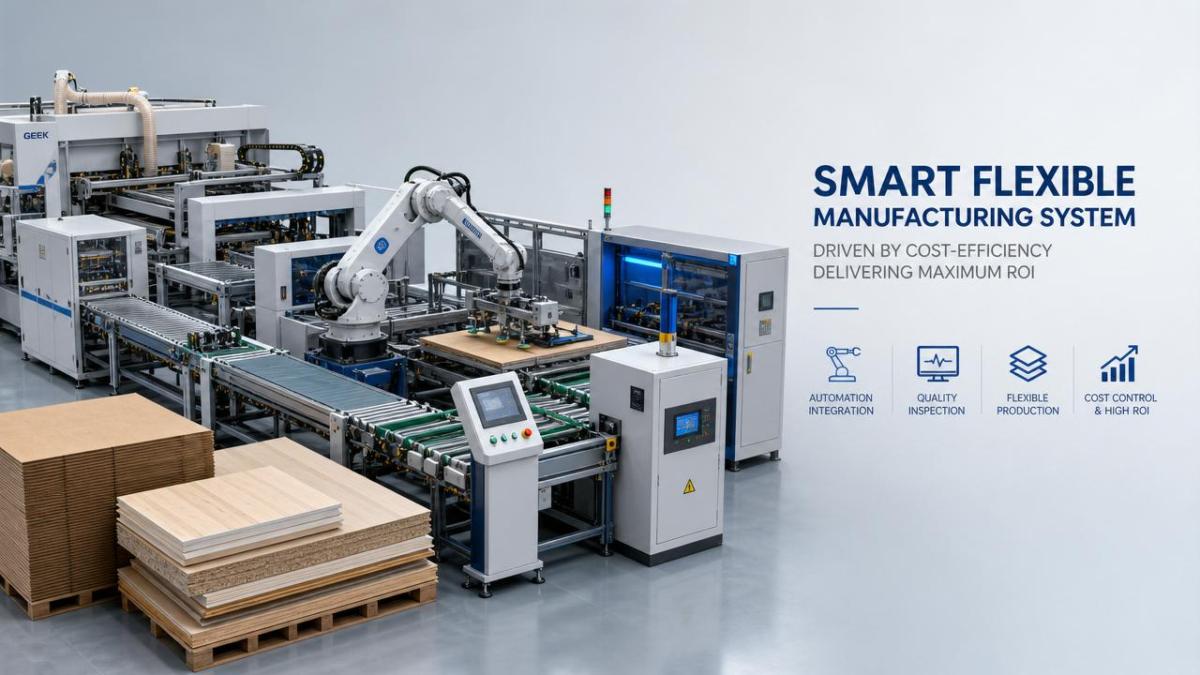
Flexible manufacturing systems price can look confusing at first glance. Two suppliers may both promise automation, yet the budget gap can be dramatic.
The reason is simple. You are rarely buying one machine. You are funding a connected production capability with software, material flow, controls, training, and future capacity built into it.
In packaging, printing, and woodworking, that difference becomes even sharper. A corrugated board line, offset press, folder gluer cell, or CNC routing line carries distinct throughput, tolerance, and integration demands.
PWFS tracks these sectors closely because they sit where packaging demand, customization pressure, and automation investment meet. In practice, the real question is not just price, but price relative to output quality and scheduling flexibility.
A low quote may exclude MES links, changeover automation, dust extraction upgrades, color inspection, or traceability modules. A higher quote may already include the infrastructure that protects margin later.
That is why evaluating flexible manufacturing systems price requires a broader lens. Upfront equipment cost is only one layer of the capital decision.
What usually drives the total cost beyond the base equipment?
The most important cost drivers usually appear after the first quotation sheet. They are not hidden exactly, but they are often underestimated during early approval discussions.
Automation depth matters first. A semi-automated cell costs far less than a line with robotic loading, inline inspection, auto sorting, and closed-loop adjustment.
Software scope comes next. ERP, MES, CAD/CAM, scheduling, barcode tracking, and recipe management can materially change flexible manufacturing systems price, especially when multiple brands must communicate reliably.
Production targets also shape cost. If a line must support short runs by day and sustained high-volume output by night, the control architecture and buffering requirements become more expensive.
For print and packaging, registration accuracy, waste reduction, and inspection speed influence hardware selection. For woodworking, spindle performance, nesting optimization, edge quality, and chip evacuation can move budgets significantly.
It helps to separate cost into practical buckets:
- Core machinery and automation modules
- Software licenses, interfaces, and data integration
- Factory utilities, foundations, dust or air systems
- Installation, commissioning, and operator training
- Spare parts, service agreements, and ramp-up losses
More often than not, flexible manufacturing systems price rises because the project is asked to solve labor, quality, traceability, and delivery problems at the same time.
What budget benchmarks make sense for packaging, print, and woodworking operations?
There is no universal benchmark, but practical ranges are still useful. The key is to treat them as planning references, not quotation substitutes.
A compact flexible cell with limited integration may start in the low six figures. A multi-machine line with software coordination and material handling can move into the mid six figures or well above.
In corrugated converting, highly automated feeding, die-cutting, folding, and gluing combinations often require substantial spending because uptime losses quickly become expensive.
In offset printing, the budget expands when color control, inspection, stack logistics, and rapid job changeover are essential. In CNC woodworking, five-axis flexibility and linked edge processing can raise the total sharply.
The table below gives a more useful way to frame flexible manufacturing systems price discussions.
A better benchmark question is this: what cost per saleable unit will the line support after stabilization? That usually leads to a more realistic budget conversation than sticker price alone.
How should ROI be judged when the savings are not only labor-related?
This is where many evaluations become too narrow. Flexible manufacturing systems price is often justified only through headcount reduction, but the stronger cases usually come from multiple smaller gains working together.
Labor savings matter, of course. Yet in high-mix production, setup reduction, lower spoilage, fewer reworks, and better schedule adherence may be worth just as much.
For a print line, improved registration control can reduce waste on premium jobs. For die-cutting and folding, stable tooling repeatability can lower downtime. For woodworking, better nesting and cut accuracy can improve board yield.
PWFS often highlights this operational link: precision and flexibility are not separate topics. When systems hold tolerances at speed, they protect both revenue and delivery credibility.
A practical ROI review usually includes:
- Direct labor reduction or redeployment
- Lower scrap, ink, paper, board, or panel loss
- Faster changeovers and more usable machine hours
- Higher first-pass yield on demanding jobs
- More stable lead times for short-run orders
- Additional sales capacity without proportional labor growth
If those factors are modeled together, flexible manufacturing systems price becomes easier to compare against legacy equipment, outsourcing, or staggered manual upgrades.
Where do cost overruns and budgeting mistakes usually come from?
Most overruns do not come from one dramatic surprise. They build through small assumptions that were never tested early enough.
A common mistake is approving flexible manufacturing systems price based on nominal speed rather than usable speed. If changeovers are frequent, theoretical output may never appear in actual production.
Another issue is underestimating site readiness. Power upgrades, compressed air, dust collection, floor reinforcement, humidity control, and data cabling can add meaningful cost.
Software complexity creates another trap. A line may run well as a standalone asset, yet struggle when linked to planning, traceability, or order management systems.
In regulated packaging or export-oriented furniture production, compliance also matters. FSC traceability, food-contact standards, emissions expectations, and audit trails may influence both equipment scope and validation effort.
Before approval, it helps to check this short decision table.
How can a smarter approval model reduce investment risk?
The most effective approach is to compare scenarios, not only suppliers. A staged comparison often produces better decisions than a simple lowest-price review.
One scenario may keep legacy machines and add labor. Another may install a semi-flexible cell. A third may fund a fully integrated line with stronger digital control.
When those options are measured against throughput, yield, lead time, energy use, maintenance exposure, and expansion potential, flexible manufacturing systems price becomes easier to defend or reject on solid grounds.
In sectors covered by PWFS, this matters because market pressure keeps moving in two directions at once. Volumes stay demanding, while customization, traceability, and delivery compression keep increasing.
That combination favors systems that can switch jobs quickly without losing precision. The budget should therefore reflect not only current demand, but the cost of being operationally rigid next year.
A useful next step is to build a decision sheet around five items: actual job mix, required automation scope, integration boundaries, stabilized unit economics, and acceptable payback range.
Once those are defined, flexible manufacturing systems price stops being a vague number. It becomes a measurable investment case tied to output quality, resilience, and long-term manufacturing flexibility.
Related News
Get weekly intelligence in your inbox.
No noise. No sponsored content. Pure intelligence.
