
Industrial Cutting Solutions for Composite Materials: How to Choose by Tolerance, Speed, and Waste
Composite materials are now common in packaging, furniture panels, transport parts, and display systems, but they rarely behave like a single material. Fibers pull, resins heat up, laminates chip, and layered boards deform under speed. That is why choosing industrial cutting solutions is less about headline machine power and more about how tolerance, throughput, and waste interact on the shop floor.
In environments tracked closely by PWFS, this decision carries real production weight. A die-cut blank with unstable edges affects folding accuracy. A routed decorative panel with heat marks weakens finishing quality. A fast line that produces too much scrap can erase any gain in cycle time. The most useful evaluation starts with process fit, not brochure claims.
Why composite cutting demands a different lens
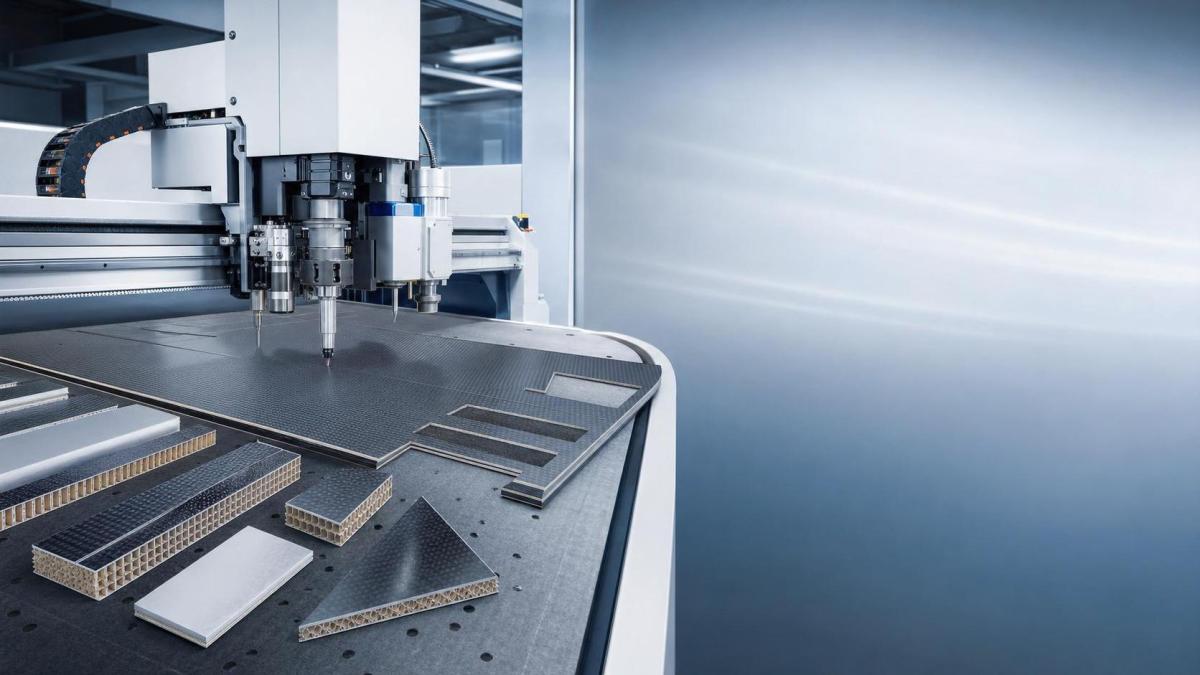
A composite is designed to combine properties, so cutting also means managing conflicting behaviors. One layer may be brittle, another elastic, and another sensitive to heat or pressure.
This matters across corrugated conversion, coated boards, engineered wood panels, honeycomb structures, laminated furniture parts, and fiber-reinforced industrial components. The cut edge often influences the next process more than the cut itself.
In packaging lines, poor edge stability can reduce print registration, folding consistency, or glue bonding. In woodworking systems, weak chip evacuation or tool vibration can degrade hole position, surface finish, and edge banding quality.
For that reason, industrial cutting solutions should be judged as part of a production chain. The real question is not only whether the machine cuts, but whether the output remains stable for printing, folding, drilling, sealing, laminating, or assembly.
Tolerance is a process requirement, not a standalone number
Tolerance looks simple in a specification sheet, yet it becomes meaningful only when tied to product function. A decorative panel may accept one edge condition, while a nested furniture part with hardware drilling may not.
The same applies to die-cut packaging. A blank may pass dimensional checks and still fail during high-speed folding because cut geometry varies under line tension.
Questions behind the tolerance target
- Is the critical need edge straightness, hole location, contour accuracy, or layer integrity?
- Does tolerance remain stable after tool wear, thermal drift, or material batch variation?
- Will the cut part move into printing, folding, gluing, edging, or hardware insertion?
- Is the accepted tolerance measured in the lab or under actual production speed?
This is where advanced industrial cutting solutions show their value. Servo stability, nesting software, vacuum hold-down, toolpath control, and compensation logic often matter as much as the cutting head itself.
PWFS frequently frames precision in this broader way. Micron-level registration in print and dynamic balance in die-cutting both show the same principle: precision is system behavior under motion.
Speed only matters when output stays usable
Fast cutting is attractive, but technical evaluation should separate nominal speed from effective throughput. Many systems reach impressive maximum rates while losing quality at the speeds needed for real shifts.
Composite materials amplify this gap. Heat buildup can soften resin-rich zones. Dust loading can alter vacuum performance. Tool deflection can change edge quality long before a machine reaches its advertised limit.
In both packaging and customized furniture production, usable speed is the speed that protects downstream quality. Industrial cutting solutions should therefore be compared using shift-level productivity, not isolated peak numbers.
Waste is shaped by physics, software, and line discipline
Scrap is often treated as a nesting problem, but composite cutting waste begins earlier. Material flatness, layer consistency, humidity, blade condition, fixture performance, and operator intervention all change yield.
For corrugated and printed structures, waste may come from crushed flute, inaccurate kiss-cut depth, or misaligned die-cut geometry. For engineered wood and laminated boards, waste often appears as breakout, burn marks, delamination, or edge defects that later fail inspection.
Where waste reduction usually starts
- Match cutting energy to the material stack, not just total thickness.
- Test tool geometry against real batch variation, not ideal samples.
- Measure first-pass yield after downstream operations, not immediately after cutting.
- Review software nesting, remnant handling, and job sequencing together.
This is one reason PWFS emphasizes digital connectivity and zero-waste manufacturing logic. Better industrial cutting solutions increasingly combine motion control, MES data, and quality feedback rather than relying on isolated machine settings.
Choosing among cutting methods in real production
No single method fits every composite. Knife cutting, die-cutting, routing, oscillating tools, waterjet, laser, and hybrid systems all solve different problems.
Knife and oscillating systems work well where low heat and flexible changeover matter. They are common for softer laminates, packaging structures, gasket-like materials, and sample runs.
Die-cutting suits high-volume repeatability when geometry is stable and tooling economics make sense. It remains central in folding carton and corrugated conversion because speed and repeat performance can be excellent.
CNC routing is strong for rigid composites, decorative boards, and customized furniture components. It supports complex contours, drilling, grooving, and nested manufacturing, especially where part variety is high.
Laser systems can offer clean detail and non-contact cutting, yet heat-affected zones must be evaluated carefully. Waterjet can protect heat-sensitive structures, though moisture management and operating cost may become limiting factors.
The better comparison is not method versus method in isolation. It is method versus required tolerance, acceptable edge condition, hourly target, and downstream process compatibility.
Signals that separate a suitable system from an attractive one
Technical evaluation becomes more reliable when the shortlist is built around a few hard signals. These signals show whether industrial cutting solutions can stay productive beyond demonstration runs.
- Stable cut quality across different material batches and ambient conditions.
- Clear data on tool wear, maintenance intervals, and spare part dependence.
- Proof that software, controls, and motion system are integrated, not loosely added.
- Evidence from similar applications involving laminated, fiber-based, or engineered boards.
- A realistic path to connect cutting data with inspection, MES, or planning workflows.
In sectors touched by PWFS, this integration is becoming decisive. The same factories that demand exact print registration or flexible furniture routing also need cutting decisions supported by traceable process data.
A practical next step for evaluation
A useful selection process starts with three documents: a tolerance map, a throughput profile, and a waste diagnosis. Together, they reveal what the cutting system must actually protect.
Then compare industrial cutting solutions using production-like samples, full-shift assumptions, and downstream quality checks. Include edge finish, dimensional drift, scrap causes, setup time, and digital integration in the scorecard.
That approach usually leads to a better decision than focusing on machine speed alone. For composite materials, the right choice is the one that keeps tolerance predictable, throughput credible, and waste under control when production pressure is real.
If the comparison still feels close, review the process through the same lens used in advanced packaging and woodworking systems: how the cut behaves in the next operation often tells more than the cut itself.
Related News
Get weekly intelligence in your inbox.
No noise. No sponsored content. Pure intelligence.
