
How to Compare Industrial Packaging Systems for Throughput, Footprint, and Changeover
Choosing between industrial packaging systems rarely comes down to headline speed alone. A line that looks impressive on paper can lose value when it consumes too much floor space, creates bottlenecks between modules, or requires long changeovers for new box, carton, or printed formats.
That is why comparison needs a broader lens. In corrugated converting, offset printing, die-cutting, folder-gluing, and even adjacent wood-based production environments, the strongest solution is usually the one that balances throughput, footprint, and changeover under real operating conditions.
For PWFS, this topic sits at the center of modern production intelligence. As packaging demand rises with e-commerce, customization, and shorter delivery cycles, industrial packaging systems must deliver stable output while remaining flexible enough for mixed orders, compliance needs, and future automation.
Why the comparison framework matters
A useful comparison framework helps separate theoretical capacity from practical capacity. Suppliers often present maximum machine speed, but technical evaluation depends more on sustained performance across shifts, product changes, operator variation, and maintenance windows.
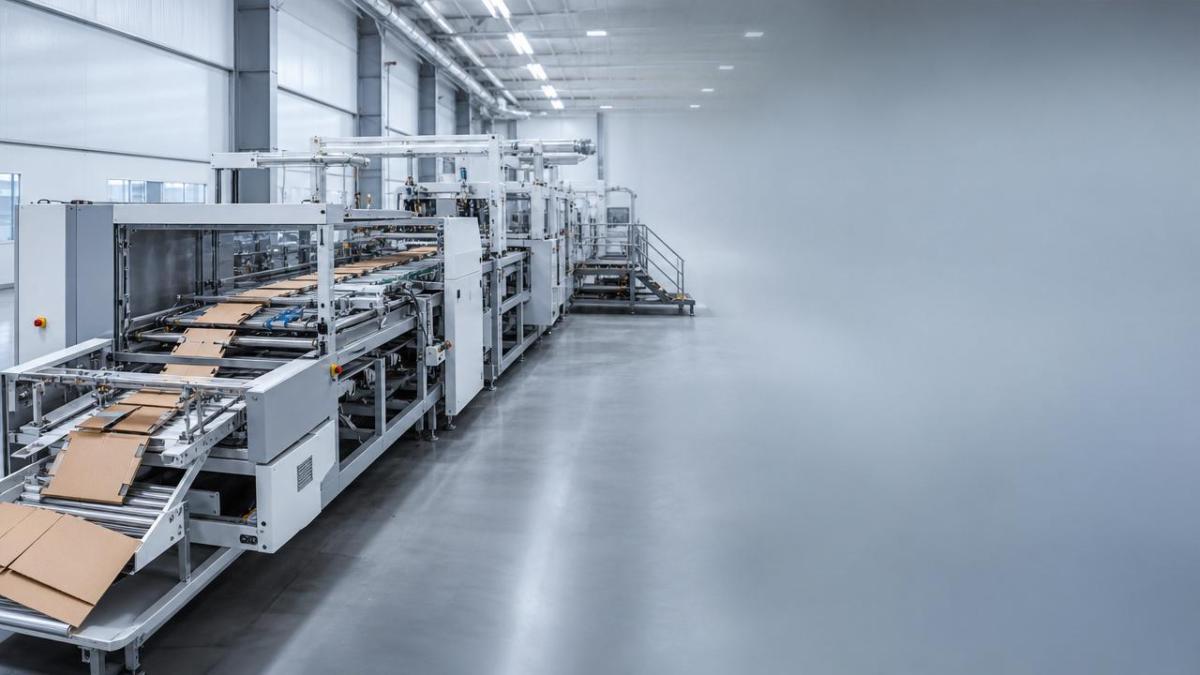
This is especially relevant in sectors covered by PWFS. A corrugated board line, a high-precision offset press, and a folder gluer may each perform well individually, yet the full system succeeds only when material flow, registration stability, and handoff timing work together.
In other words, industrial packaging systems should be assessed as production ecosystems. The right question is not only how fast one machine runs, but how consistently the entire line converts substrate into saleable output.
Throughput is more than rated speed
Throughput measures the volume of acceptable product delivered within a defined time. In practice, this includes startup waste, minor stops, speed losses, jam recovery, and quality holds. A line with lower nominal speed may outperform a faster line over a full week.
For industrial packaging systems, the most relevant throughput indicators usually include net output, OEE-related losses, reject rate, and performance under mixed SKU production. These factors matter more than a single maximum speed figure from a brochure.
What to examine in throughput data
- Average sellable output per shift, not only peak speed.
- Performance at common job sizes and substrate grades.
- Waste during setup, ramp-up, and order transitions.
- Sensitivity to registration drift, glue variation, or board warp.
- Dependency on operator skill for maintaining target speed.
For example, offset and die-cut operations often lose throughput through inspection pauses and registration correction. Corrugated converting may be limited by downstream stacking or palletizing. The line rate is only as strong as its weakest linked process.
Footprint should be read as space efficiency
Footprint is often misunderstood as machine length and width. That is only the starting point. In industrial packaging systems, true space demand includes operator access, roll or sheet staging, scrap evacuation, safety clearance, utilities, maintenance zones, and future expansion paths.
A compact machine can still create an inefficient layout if material has to cross aisles repeatedly or if finished goods accumulate between modules. By contrast, a longer integrated line may use floor area more intelligently by reducing handling, labor travel, and intermediate buffering.
Questions that clarify footprint value
- How much productive output is generated per square meter?
- Does the layout support straight-through material flow?
- How much buffer space is required between process steps?
- Can automation modules be added without major relocation?
- Are maintenance points reachable without stopping adjacent equipment?
This matters in facilities where print, converting, and finishing compete for room. It also matters in furniture-related environments where CNC routers, edge banders, and packaging cells must coexist within one digital production architecture.
Changeover often decides real flexibility
When SKU counts rise, changeover becomes a strategic metric. Many industrial packaging systems are no longer judged by long-run efficiency alone. They are judged by how quickly they shift between dimensions, print designs, flute profiles, glue patterns, tooling sets, or bundle formats.
Fast changeover supports smaller batch sizes, lower WIP, and more responsive planning. It also reduces the pressure to overproduce just to protect line efficiency. That is increasingly valuable where brand variation, seasonal packaging, and retailer-specific formats are common.
Elements behind changeover performance
In many cases, the smartest industrial packaging systems are not the fastest on a single product. They are the ones that recover quality quickly after every change and preserve output during a varied production schedule.
Different system types need different comparisons
A balanced method should reflect the equipment category. Corrugated board lines require attention to steam control, board stability, and downstream synchronization. Offset presses demand close review of color consistency, makeready time, and sheet handling reliability.
Die-cutters and folder gluers should be compared for tool change discipline, blank transfer stability, and glue application repeatability at speed. In wood-linked packaging or display manufacturing, CNC and edge processing systems add another dimension: digital file responsiveness and part-to-part customization.
This is where PWFS brings value as an intelligence source. Its focus on paper and wood production allows comparison logic to move beyond generic machinery metrics and toward the physics of registration, motion, pressure, thermal behavior, and line-level automation.
How to build a practical evaluation matrix
A good matrix makes trade-offs visible. Instead of searching for one perfect score, compare industrial packaging systems by weighting the criteria that matter most in the intended production model.
For high-volume e-commerce transit packaging, throughput and uptime may lead. For premium printed cartons, registration control and changeover quality may carry more weight. For mixed-mode plants, footprint and digital connectivity may become decisive.
A useful matrix usually includes
- Sellable output at typical product mix.
- Floor space per unit of output.
- Average and worst-case changeover time.
- Waste during startup and after changeovers.
- Integration with inspection, MES, and automation.
- Maintenance burden and spare part exposure.
Whenever possible, request production data from comparable applications, not abstract benchmarks. Site references, FAT records, and live demonstrations provide stronger signals than nominal specifications alone.
Signals that deserve closer attention
Several warning signs appear repeatedly when comparing industrial packaging systems. One is a strong speed claim without supporting data on waste, staffing, or sustained uptime. Another is a compact layout that hides difficult service access or poor material logistics.
It is also worth examining how the system behaves under stress. Performance during board variation, ink instability, adhesive changes, or mixed digital job queues often reveals more than a clean factory demonstration running a single format.
More broadly, the market is moving toward connected production. Industrial packaging systems that can share recipes, collect event data, and support predictive maintenance are better positioned for continuous improvement than isolated machines.
From comparison to decision
The best decision usually comes from matching system behavior to business reality. Throughput shows whether demand can be met. Footprint reveals how efficiently capacity fits the plant. Changeover indicates whether the line can support product variety without eroding margins.
Seen together, these three dimensions provide a more reliable way to compare industrial packaging systems across corrugated, print, converting, and hybrid production settings. They also create a stronger basis for automation planning, capital justification, and operational risk review.
The next step is to turn internal production history into a shortlist of measurable requirements. Once current waste, layout limits, and changeover losses are quantified, system comparisons become clearer, and supplier discussions become far more productive.
Related News
Get weekly intelligence in your inbox.
No noise. No sponsored content. Pure intelligence.
