
How CNC furniture manufacturing improves order margins
For furniture operations facing rising labor costs, material volatility, and shorter customization cycles, CNC furniture manufacturing is becoming a direct lever for better order margins.
By connecting CAD/CAM data, automated nesting, precision routing, drilling, and edge-banding workflows, factories reduce waste, stabilize quality, accelerate delivery, and price customized orders confidently.
The real question is no longer whether automation improves output, but how fast CNC furniture manufacturing turns every panel, cut, and order into measurable profit growth.
CNC furniture manufacturing as a margin control system
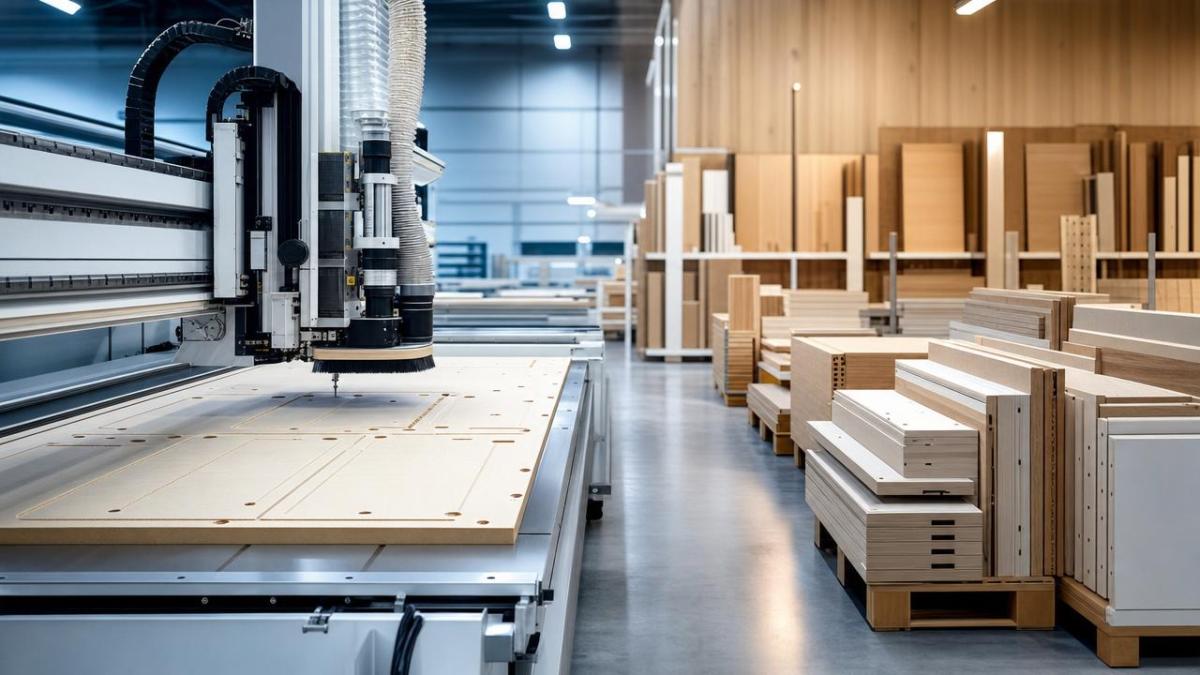
CNC furniture manufacturing refers to digitally controlled production of cabinets, wardrobes, doors, panels, office furniture, and customized interior components.
It usually combines design software, CAM programming, nesting optimization, CNC routers, drilling centers, labeling, sorting, and edge banding.
Unlike manual cutting, CNC furniture manufacturing converts order data into repeatable machine instructions, reducing interpretation errors and operator dependency.
Margins improve because fewer decisions are improvised on the shop floor, and more decisions are controlled before production starts.
A modern workflow begins with parametric design rules, then moves into automated bill of materials generation and panel nesting.
The CNC router executes cuts, grooves, holes, chamfers, pockets, and shaped edges according to verified digital files.
When integrated with MES or ERP, CNC furniture manufacturing also improves scheduling, material allocation, traceability, and cost feedback.
This makes profitability visible at order level, not only at monthly accounting level.
Industry pressures reshaping woodworking economics
Furniture production now operates in a market shaped by customization, e-commerce delivery expectations, material uncertainty, and strict quality requirements.
Whole-house customization has changed the economics of batch production. Smaller lots now require the efficiency once reserved for mass manufacturing.
CNC furniture manufacturing answers this tension by supporting flexible batches without abandoning standardization, repeatability, or throughput discipline.
These signals explain why CNC furniture manufacturing is increasingly evaluated as a financial system, not only as production equipment.
The strongest gains appear when design, quoting, machining, finishing, and dispatch share the same reliable data chain.
How CNC furniture manufacturing improves order margins
Order margin improves when revenue is protected and avoidable cost is removed before it becomes hidden loss.
CNC furniture manufacturing supports both sides by making each job easier to estimate, execute, inspect, and repeat.
Higher material yield
Panel material is often one of the largest variable costs in cabinet and furniture production.
Automated nesting places parts across boards to improve utilization, reduce offcuts, and control grain direction where required.
CNC furniture manufacturing also prevents wrong-side cutting, duplicated panels, missed holes, and mismatched component sets.
Even a small yield gain becomes significant when applied across daily sheets, monthly orders, and annual procurement budgets.
Reduced rework and warranty cost
Manual measurement errors often appear late, after finishing, packing, transport, or installation.
At that stage, the cost includes replacement material, labor, delayed delivery, and customer dissatisfaction.
CNC furniture manufacturing lowers this risk through precise machining paths, calibrated drilling patterns, and repeatable tolerance control.
When edge banders, drilling centers, and routers follow the same data, assembly fit becomes more predictable.
Faster throughput and better capacity use
Margins decline when machines wait for files, operators wait for boards, and finished parts wait for identification.
CNC furniture manufacturing reduces idle time through prepared programs, barcode labels, optimized tool changes, and clearer sequencing.
The result is not only higher speed, but steadier flow across cutting, drilling, edging, packing, and dispatch.
More accurate pricing for customization
Customized orders become profitable only when complexity is measured correctly before production begins.
CNC furniture manufacturing provides data on cutting length, machining time, tool requirements, board consumption, and labor touchpoints.
This helps quotations reflect real production burden instead of relying on broad assumptions.
Better costing protects contribution margin, especially when design variations look simple but require complex machining.
Typical application scenarios and margin logic
CNC furniture manufacturing is useful across many woodworking environments, but each scenario creates value differently.
The table below summarizes common use cases and the margin levers they activate.
In each scenario, CNC furniture manufacturing links design intent with machine execution and cost visibility.
That connection is especially valuable when product variety increases faster than available skilled labor.
Integration points that determine real financial impact
Buying a router alone does not guarantee higher order margins. Integration determines whether CNC furniture manufacturing delivers full value.
The most important connections are between front-end design, material planning, machine programming, shop-floor execution, and final accounting.
- Connect CAD libraries with standardized hardware, hole patterns, and cabinet rules.
- Use CAM systems that generate clean toolpaths with reliable machining priorities.
- Apply nesting software that balances yield, grain direction, and production sequencing.
- Adopt barcode labels to track panels from cutting to packing.
- Feed actual machine time and scrap data back into quotation models.
CNC furniture manufacturing becomes more profitable when the feedback loop is closed.
Without that loop, quoting may remain disconnected from actual production losses.
With it, each completed order improves the next estimate, schedule, and process plan.
Practical implementation guidance
A successful transition to CNC furniture manufacturing should begin with process mapping rather than machine comparison alone.
The goal is to identify where margin currently leaks through scrap, waiting, rework, slow programming, or uncertain costing.
Start with high-value bottlenecks
Prioritize product families that combine high volume, frequent customization, and measurable error cost.
These areas usually reveal the fastest return from CNC furniture manufacturing.
Standardize before automating
Digital production works best when cabinet structures, materials, hardware positions, and machining rules are clearly defined.
Standardization does not reduce customization. It creates controlled options that machines can execute reliably.
Measure margin with operational data
Track board yield, tool life, setup time, machine utilization, rework rate, and on-time completion.
These indicators show whether CNC furniture manufacturing is improving profit per order, not just output per hour.
Plan the surrounding workflow
Routing speed loses value if edge banding, sorting, packaging, or installation preparation cannot keep pace.
Balanced flow protects order margins better than isolated machine acceleration.
Technology considerations for sustainable gains
Several technical factors influence the long-term profitability of CNC furniture manufacturing systems.
Machine rigidity affects cutting accuracy, surface quality, tool vibration, and maintenance frequency.
Vacuum holding capacity determines whether small or narrow parts remain stable during high-speed machining.
Tool management influences edge quality, cycle time, and the consistency of repeated cuts.
Dust extraction affects operator safety, machine reliability, sensor stability, and finishing cleanliness.
Software compatibility is equally important because poor data transfer can recreate manual errors in digital form.
For CNC furniture manufacturing, the best equipment choice is the one that fits product mix, data maturity, and target margin model.
Data-driven order margin evaluation
A practical margin evaluation should compare pre-CNC and post-CNC performance using the same order categories.
Useful metrics include material consumption per finished square meter, rework cost per order, and average delivery variance.
Other indicators include quoting accuracy, machine utilization, labor hours per cabinet, and returned component rate.
CNC furniture manufacturing should also be judged by its ability to support higher-value customized orders.
When complex designs can be produced without uncontrolled labor expansion, margin potential increases significantly.
PWFS follows these connections across woodworking equipment, print systems, packaging lines, and intelligent factory infrastructure.
The same industrial logic applies across paper and wood: precision, automation, traceable data, and flexible throughput create defensible profit.
Next steps for margin-focused CNC deployment
The most effective next step is to audit three recent order groups: profitable, average, and margin-eroding jobs.
Compare their material yield, programming time, machine time, rework events, and delivery performance.
This reveals where CNC furniture manufacturing can deliver the strongest financial return.
After that, define a phased roadmap covering software rules, nesting strategy, machine selection, barcode tracking, and operator training.
The roadmap should include measurable targets, such as scrap reduction, fewer remake panels, shorter lead time, and better quotation accuracy.
CNC furniture manufacturing improves order margins when it is treated as a connected business system.
With disciplined data, balanced workflow, and precise machining, every panel becomes easier to price, produce, verify, and deliver profitably.
Related News
Get weekly intelligence in your inbox.
No noise. No sponsored content. Pure intelligence.
