
Custom Furniture Cost Drivers: Materials, Joinery, Lead Time, and Finish
Understanding what drives the price of custom furniture helps decisions move from guesswork to confident planning.
Materials, joinery, lead time, and finish all shape durability, appearance, and the final quote.
This guide explains how different scenarios change cost, where quality matters most, and how to compare custom furniture proposals clearly.
Custom Furniture Cost Drivers Start With the Use Scenario
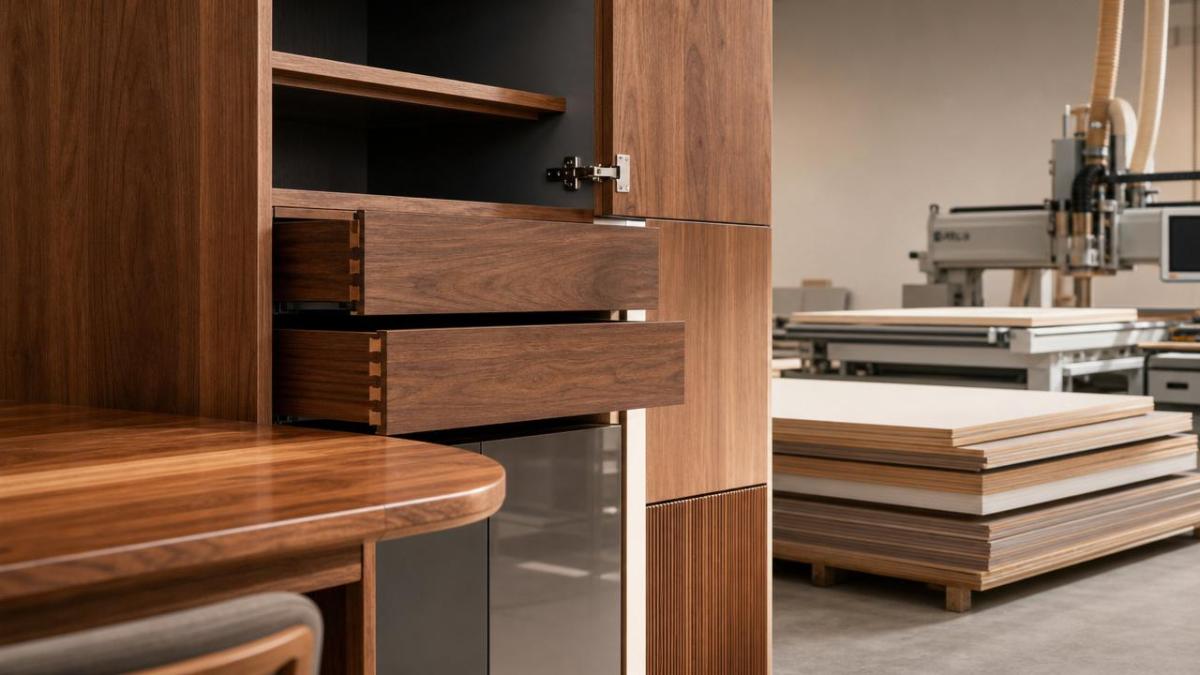
The same cabinet, table, or wall unit can carry very different costs across different spaces.
A display piece needs visual refinement. A kitchen cabinet needs moisture resistance, accurate hardware, and easy cleaning.
A hotel desk may need repeatable production. A home library may prioritize unique grain and hidden storage.
That is why custom furniture pricing should begin with the application, not only with size or species.
Modern CNC woodworking, edge banding, and digital nesting systems reduce waste, but choices still affect labor and machine time.
A clear scenario helps separate essential investment from decorative spending.
Material Choices Change Cost, Weight, and Lifespan
Materials are usually the first visible cost driver in custom furniture.
Solid wood, plywood, MDF, particleboard, veneer, laminate, and metal supports each behave differently.
Solid hardwood often costs more because it brings grain depth, repairability, and long service life.
Oak, walnut, ash, cherry, and maple vary by availability, grading, color consistency, and board yield.
Engineered panels can control budget while delivering stability for wardrobes, cabinets, and large flat surfaces.
High-quality plywood often performs well where screw holding, structure, and moisture tolerance matter.
MDF is useful for painted custom furniture because its surface finishes smoothly and resists grain telegraphing.
Particleboard can be economical, but edge sealing and hardware specification become more important.
When Premium Material Makes Sense
Premium material is justified when the piece faces heavy use, humidity, frequent movement, or long-term ownership expectations.
Dining tables, entry benches, bathroom vanities, and heirloom storage usually benefit from better substrates and finishes.
For custom furniture in rental or temporary interiors, smart engineered panels may provide better value.
Joinery Complexity Defines Labor and Structural Confidence
Joinery determines how parts connect, carry load, resist movement, and survive daily handling.
Simple butt joints, screws, dowels, biscuits, pocket screws, mortise-and-tenon, dovetails, and concealed connectors differ greatly.
More complex joinery usually increases cost because it requires precision, setup time, skilled inspection, and sometimes hand fitting.
CNC machining can improve repeatability, but tight assemblies still need careful engineering and quality control.
Custom furniture with drawers, sliding doors, lift mechanisms, or floating details often costs more than fixed shelving.
Movement adds tolerances. Tolerances add testing. Testing adds time.
Visible Joinery Versus Hidden Joinery
Visible joinery can become a design feature, especially in solid wood custom furniture.
Dovetails, through tenons, and exposed wedges require cleaner cuts and better material selection.
Hidden joinery may look minimal, but concealed strength still requires planning, drilling accuracy, and suitable hardware.
Lead Time Affects Price Through Scheduling Pressure
Lead time is not just a delivery date. It is a cost driver tied to workflow.
Custom furniture passes through design confirmation, material sourcing, cutting, machining, assembly, sanding, finishing, curing, and packaging.
When deadlines are compressed, work may require overtime, expedited materials, faster freight, or priority machine slots.
Short lead time also reduces the opportunity to optimize board yield or batch similar parts.
Digital production systems, MES coordination, and automated CNC cells help reduce uncertainty.
However, rushing approvals still increases risk, especially for complex custom furniture.
Fast Delivery Works Best With Stable Specifications
Fast timelines are more realistic when dimensions, drawings, finishes, hardware, and site conditions are already confirmed.
Late changes often create rework, waste, and rescheduling costs.
For custom furniture projects, early decisions usually save more money than last-minute negotiation.
Finish Selection Shapes Appearance, Protection, and Maintenance
Finish can be a surprisingly large part of a custom furniture quote.
Clear oil, wax, lacquer, polyurethane, water-based coating, stain, paint, veneer sealer, and UV coating vary widely.
A simple clear finish may be economical, especially when the wood grain already looks attractive.
A deep stained finish may require sampling, color adjustment, sealing, sanding between coats, and controlled drying.
Painted custom furniture can appear simple, but premium smooth finishes demand excellent substrate preparation.
High-gloss surfaces are especially demanding because they reveal dust, waviness, sanding marks, and edge imperfections.
Finish Should Match the Environment
A bedroom wardrobe does not need the same coating as a café counter.
Kitchens, bathrooms, retail displays, and office desks require stronger resistance to moisture, abrasion, and cleaning products.
Choosing the right finish protects custom furniture from avoidable repairs and early replacement.
Typical Custom Furniture Scenarios and Cost Signals
Different applications create different priorities. The table below shows where cost usually moves.
The cheapest quote may not be the lowest long-term cost.
A weak edge, poor hinge, or fragile coating can shorten service life dramatically.
How Needs Differ Between Residential and Commercial Spaces
Residential custom furniture often focuses on comfort, personal taste, storage habits, and visual harmony.
Commercial custom furniture usually emphasizes traffic, repeatability, cleaning cycles, installation speed, and compliance expectations.
A living room media unit may justify premium veneer and quiet hardware.
A restaurant service station may need impact-resistant laminate, sealed edges, and fast replacement parts.
The correct specification depends on how many hands, spills, impacts, and cleaning agents the piece will face.
- Choose solid wood where touch, aging, and repairability matter.
- Choose engineered panels where flatness, scale, and budget control matter.
- Choose durable coatings where moisture and cleaning are frequent.
- Choose stronger hardware where doors and drawers operate daily.
Scenario-Based Specification Advice for Custom Furniture
Good specifications reduce surprises. They also make quotes easier to compare.
Instead of asking only for a price, define use, environment, structure, finish, and installation conditions.
- Confirm dimensions, wall conditions, floor level, and access routes before production.
- Request material names, board thickness, edge treatment, and hardware brand details.
- Ask how joinery will support load, movement, and future repairs.
- Review finish samples under real lighting before final approval.
- Clarify lead time, change rules, delivery handling, and installation responsibilities.
For larger custom furniture programs, digital drawings and part lists are especially valuable.
They connect design intent with CNC machining, edge banding, finishing, and final assembly.
This reduces waste, improves accuracy, and supports consistent pricing across repeated units.
Common Misjudgments That Increase Custom Furniture Costs
Many cost problems begin with assumptions that sound small but affect production deeply.
One common mistake is judging material only by surface appearance.
A beautiful veneer over a weak core may fail faster than a simpler, stronger panel.
Another mistake is ignoring edge quality. Exposed or poorly sealed edges absorb moisture and look unfinished.
Panel edge banders, PUR glue, and laser edge systems can improve sealing and appearance.
Hardware is also underestimated. Hinges, slides, lifts, and connectors influence feel, noise, safety, and lifespan.
Finish samples are often approved too quickly. Color changes under daylight, warm lamps, and neighboring materials.
Site constraints are another hidden cost. Narrow elevators, uneven walls, and late trades can complicate installation.
Custom furniture should be measured, specified, and scheduled with the final environment in mind.
Reading a Quote Without Missing Key Cost Details
A useful quote explains more than the total amount.
It should describe materials, dimensions, joinery method, finish system, hardware, lead time, delivery, and installation scope.
If two quotes differ greatly, compare what is included before assuming one is overpriced.
One proposal may include premium slides, moisture-resistant panels, thicker veneer, and multiple finish coats.
Another may exclude installation, use thinner panels, or leave finishing details vague.
Clear comparison protects the value of custom furniture and prevents costly disappointment.
A Practical Next Step for Better Custom Furniture Decisions
Start with the space, not the catalog image.
List how the piece will be used, cleaned, loaded, moved, and viewed every day.
Then match materials, joinery, lead time, and finish to that scenario.
For precision production, accurate drawings and confirmed specifications help CNC woodworking systems deliver reliable results.
PWFS tracks the technologies behind modern paper, wood, packaging, and furniture production intelligence.
Use that manufacturing mindset when reviewing custom furniture: every cost should connect to function, durability, beauty, or delivery certainty.
When each driver is visible, the right investment becomes easier to defend and easier to enjoy.
Related News
Get weekly intelligence in your inbox.
No noise. No sponsored content. Pure intelligence.
