
High-Speed Printing Presses Explained: Key Performance Factors for Commercial Output
High-speed printing presses are often discussed in terms of sheets per hour, yet commercial output is decided by a broader equation. Print speed matters only when registration stays tight, substrates remain stable, drying keeps pace, and automation protects consistency across long runs. In packaging, publishing, and branded board applications, that balance determines whether output scales profitably or turns into waste, rework, and avoidable stoppages.
Why high-speed performance deserves closer evaluation
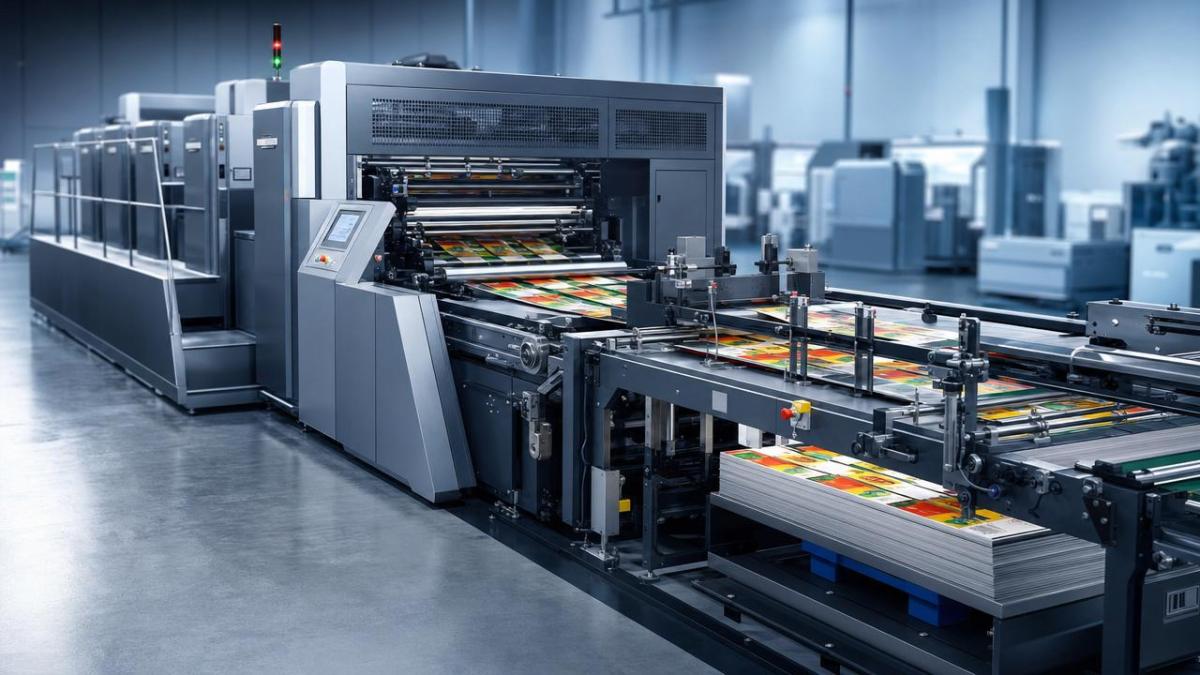
The market now asks presses to deliver more than volume. E-commerce packaging, short delivery windows, tighter brand standards, and compliance demands all raise the pressure on pressrooms.
Within the broader paper and wood processing landscape, printing sits at a critical transfer point. Corrugated lines create structural board, offset presses create visual value, and die-cutting plus folder-gluing convert printed sheets into final packaging.
That is why high-speed printing presses matter beyond the press hall itself. Their output quality directly affects downstream cutting accuracy, glue performance, finishing yield, and the visual credibility of consumer packaging.
PWFS follows this connection closely because print quality is not isolated machinery behavior. It links material science, motion control, color physics, automation logic, and commercial throughput into one measurable production result.
What “high-speed” really means in commercial printing
A press can be fast on paper and still underperform in production. True high-speed capability means maintaining repeatable quality at rated output, not merely reaching a peak mechanical number during ideal conditions.
In practice, high-speed printing presses combine synchronized feeder systems, stable impression control, accurate inking, predictable drying, and closed-loop monitoring. When one of these drifts, output speed becomes an unreliable statistic.
For commercial work, the most useful definition is simple: a high-speed press is productive when it can sustain target quality across real substrates, real job changes, and real operating shifts.
The difference between rated speed and effective speed
Rated speed is the manufacturer’s maximum operating figure under controlled conditions. Effective speed is what remains after makeready, wash-ups, inspection holds, substrate changes, and waste sheets are counted.
For evaluation work, effective speed is usually the better comparison metric. It reflects actual commercial output rather than headline machine capability.
Key performance factors that shape commercial output
Several variables decide whether high-speed printing presses perform as expected in demanding jobs. These factors interact continuously, so no single metric should be judged in isolation.
Registration accuracy under motion
Registration is the foundation of multicolor quality. At high speed, minor sheet travel variation can create visible haloing, blurred edges, or color shift, especially on fine graphics and small text.
The evaluation point is not only static registration tolerance. More revealing is how well the press holds registration during acceleration, long runs, and substrate variation.
Substrate handling and dimensional stability
Board, carton stock, coated paper, and lightweight sheets all react differently to tension, humidity, heat, and impression pressure. High-speed printing presses must transport each substrate without flutter, skew, or edge damage.
This becomes especially important for packaging lines. If the sheet stretches or curls during printing, die-cut registration and folding geometry may suffer later.
Ink transfer and drying balance
As speed rises, the press has less time for stable ink transfer and complete drying. Excess ink, poor fountain control, or uneven drying can trigger setoff, smearing, rub resistance issues, or color inconsistency.
Commercial output improves when the inking system, drying unit, and substrate specification are matched rather than optimized separately.
Automation and control logic
Modern high-speed printing presses rely heavily on automation. Preset ink keys, register cameras, auto plate change, feeder correction, defect detection, and press data integration reduce variation that operators cannot consistently manage by hand.
Automation is not only about convenience. It directly influences repeatability, labor dependence, and the ability to shorten makeready without compromising quality.
Mechanical rigidity and vibration control
At higher speeds, dynamic forces increase sharply. Frame rigidity, bearing quality, cylinder balance, and drive stability all affect dot placement and print smoothness.
A press that looks precise at moderate speed may show streaking or micro-misregister near its upper operating range. That difference often separates acceptable output from premium output.
Where these factors matter most
Not every print application stresses the machine in the same way. The commercial meaning of performance depends on the product, downstream process, and quality risk.
This application view is important because a press selected for premium cosmetic cartons may not be ideal for high-volume transit packaging, even if both are described as high-speed printing presses.
How to judge output beyond the brochure
Technical assessment becomes stronger when machine claims are translated into observable production indicators. The most useful questions tend to connect speed with stability, waste, and downstream fit.
- How much waste appears during startup, job change, and speed ramp-up?
- How stable is color density across the first hour and the eighth hour?
- Which substrates can run near target speed without added conditioning?
- How does the press integrate with inspection, MES, and post-press flow?
- What maintenance points most often reduce effective throughput?
These questions align with the way PWFS examines print systems inside larger converting environments. A press should be evaluated as part of a chain, not as an isolated asset.
Why downstream compatibility matters
Print output becomes commercial value only when die-cutters, folder-gluers, and packing lines can run cleanly after it. Sharp graphics lose value if cracking, curl, or dimensional drift reduce finishing yield.
That is why high-speed printing presses should be judged by line-level results, including converting efficiency and final pack appearance.
Current signals shaping press evaluation
Several market signals are changing what good performance looks like. Faster output alone is no longer enough.
Shorter runs with more SKU variation increase the value of fast makeready and data-driven presets. Compliance pressure makes traceability, ink suitability, and process logging more relevant. Labor variability increases dependence on automation and remote diagnostics.
Sustainability also changes the conversation. Waste sheets, energy-heavy drying, and unstable restarts now carry a measurable operating penalty. In other words, the best high-speed printing presses are becoming cleaner decision systems, not just faster mechanical systems.
A practical framework for next-step comparison
When comparing options, it helps to build a short evaluation grid around production reality rather than marketing language.
- Define the core substrate mix, run lengths, and target finishing process.
- Separate peak speed from sustainable speed under normal operating conditions.
- Measure quality drift, not only first-sheet acceptance.
- Check automation depth, data visibility, and fault recovery behavior.
- Review how the press supports compliance, waste control, and future line integration.
A structured comparison often reveals that the strongest commercial choice is not the fastest listed model. It is the machine that maintains visual precision, protects substrate integrity, and supports the full converting workflow with minimal interruption.
For anyone building a serious benchmark, the next useful step is to align press data with actual job samples, downstream tolerances, and long-run production records. That is where the real value of high-speed printing presses becomes visible.
Related News
Get weekly intelligence in your inbox.
No noise. No sponsored content. Pure intelligence.
