
How to Specify Precision Door Machining Equipment for Repeatable Joinery
How to Specify Precision Door Machining Equipment for Repeatable Joinery
Specifying precision woodworking equipment for doors requires more than comparing spindle power or published feed rates. A door is an assembly of interdependent parts: stiles, rails, panels, lock blocks, glazing details, hinges, seals, and hardware all have positional relationships that must survive machining, sanding, finishing, transport, and installation. A machine may produce an impressive first-off component while still creating cumulative errors across a shift, a batch, or a changing material mix.
For technical evaluators, the central question is not simply “How accurate is this machine?” It is: Can this equipment hold the required relationships between features repeatedly, under our material conditions, at our planned output, with realistic operator intervention? That question shifts the evaluation from headline specifications toward workholding, datum strategy, machine stiffness, tool management, software logic, dust extraction, and process verification.
This is especially relevant as interior, entry, cabinet, and architectural door manufacturers move toward shorter batches and broader model ranges. A line configured only for one stable door family may become inefficient when lock positions, hinge layouts, profiles, widths, cores, or decorative elements change frequently. The right specification should protect joinery quality without locking the plant into an unnecessarily rigid production method.
Define repeatability through functional relationships
Door machining tolerances should be defined from function, not from an isolated coordinate display. The relevant relationships often include the squareness of a door leaf, the alignment of mortises to the reference edge, the depth and position of hinge pockets, rail-to-stile joint fit, lock-case geometry, groove placement, and the consistency of machining on both faces. If those features are referenced differently from one operation to the next, even a highly capable CNC machine can produce an assembly that requires fitting, shimming, or manual correction.
Start by mapping each door family into critical-to-function features. Identify which dimensions affect assembly, hardware fit, visual reveal, sealing performance, and field installation. Then document the datum used for each feature. For example, hinge and lock operations may need to reference the same long edge and top or bottom end that defines the installation orientation. That is more useful than broadly demanding “high precision” from every axis.
The specification should distinguish between positioning accuracy, repeatability, and finished-part capability. Positioning accuracy describes how closely an axis reaches a commanded position under stated conditions. Repeatability concerns the ability to return to that position. Finished-part capability adds the effects of material movement, fixturing, cutter condition, program logic, vibration, and handling. For door plants, the last measure is usually the one that determines yield.
Choose the machine architecture around the door flow
There is no universal machine layout for door work. A compact machining center can suit a shop producing varied custom leaves at moderate volume. Through-feed door machining cells are better aligned with repeatable, higher-volume work where edge processing, lock preparation, and hardware drilling follow a defined sequence. Nested-based routing can be appropriate for certain engineered components, but it is not automatically the best route for long, solid-wood stiles or profiles that require consistent edge reference.
Evaluate the proposed architecture against the real production route, including loading, inspection, reorientation, buffering, and unloading. A machine that eliminates one machining setup but requires frequent manual flipping may not improve total repeatability. Likewise, a high-speed gantry does not resolve a weak upstream cutting process that supplies twisted, inconsistent, or poorly referenced blanks.
For doors with machining on multiple edges and faces, assess whether the machine can preserve one coherent datum throughout the process. That may require side referencing, end stops, automatic width adjustment, opposing clamps, or a transfer system designed to retain part orientation. The answer will vary between slab doors, framed doors, engineered veneer doors, and fire-rated constructions. It should be reviewed against representative drawings rather than a generic sample part.
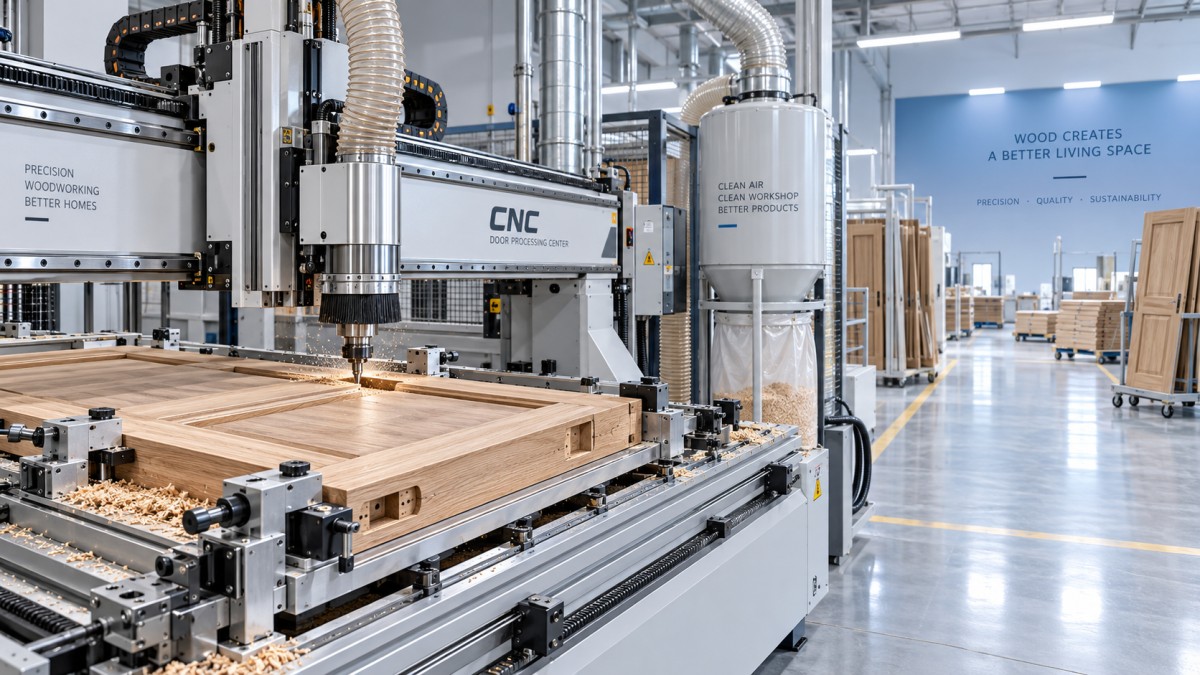
Workholding is where repeatable joinery is won or lost
Workholding deserves at least as much scrutiny as spindle configuration. Door components are long, sometimes heavy, and often sensitive to pressure marks or deflection. Solid timber may contain internal stress; veneered and composite products may have different friction characteristics; lightweight cores can react poorly to concentrated clamping. A fixture that appears secure in a demonstration can allow micro-movement once a large cutter enters a dense section or an aggressive mortise cycle begins.
Ask suppliers to explain how the machine locates, supports, and clamps each relevant workpiece. Important details include the number and placement of support points, clamp force control, protection against part lift, reference-face cleanliness, compensation for dimensional variation, and access for the required tool paths. For vacuum systems, ask how sealing is maintained around narrow members, grooves, apertures, and porous surfaces. For mechanical clamping, confirm whether fixtures can be changed quickly without undermining reference consistency.
The test should not stop at a nominally flat panel. Include the thinnest and widest planned parts, representative rail and stile lengths, samples with the expected surface finish, and any component likely to be prone to bowing. If the manufacturer plans to process both raw and finished or primed parts, the clamping strategy must account for surface protection and contamination risk.
Specify spindle, tooling, and chip control as one system
Spindle power alone is a poor proxy for door-machining capability. The useful specification includes spindle interface, speed range, torque characteristics, bearing condition monitoring where available, tool-change arrangement, and compatibility with the intended cutters, aggregates, drills, saws, and boring heads. A door program may combine profiling, grooving, hinge recessing, lock mortising, drilling, trimming, and decorative routing. Each operation creates different loading and chip-removal demands.
Tooling choices should be agreed before the equipment layout is frozen. Confirm maximum tool diameter and length, clearance around clamps, aggregate interference zones, tool holder standard, presetting workflow, and how tool data reaches the control. If long-reach tooling is required for deep lock pockets or special profiles, assess the impact on deflection and cycle strategy rather than assuming that a larger spindle resolves it.
Chip extraction is similarly linked to finish quality and repeatability. Chips accumulating in a mortise can affect depth control and create heat. Fine dust on a reference surface can shift a part by enough to matter at an assembly joint. The extraction specification should address hood geometry, airflow requirements supplied by the machine builder, duct routing, filter compatibility, and access for cleaning. It should also be coordinated with the selected material and tool geometry; MDF, particleboard, hardwood, softwood, and veneer-faced panels do not behave identically.
Automation should reduce variation, not merely labor
Automation is valuable when it stabilizes the process. Automatic loading, barcode identification, part measurement, tool checking, label printing, and transfer between operations can reduce manual decisions that cause orientation mistakes or wrong-program events. But automation also introduces its own constraints: part-size envelopes, stack quality, separator reliability, buffer logic, recovery procedures, and maintenance competence.
A sensible specification separates present throughput from future automation readiness. A manufacturer may not need a fully automatic cell today, yet it may be prudent to retain floor space, interfaces, safety provisions, and control capacity for later loading systems or downstream handling. Conversely, buying elaborate automation for a highly variable product mix can create difficult exceptions that operators bypass. The process becomes less controlled, not more.
Pay particular attention to error recovery. When a door blank is rejected, misread, or stopped mid-cycle, the system needs an unambiguous method to identify its status and prevent it from re-entering the line incorrectly. This is a practical detail that often matters more than the advertised number of parts handled per hour.
Digital integration must preserve the manufacturing intent
Precision woodworking equipment for doors increasingly sits between design software and factory execution. The important issue is not simply whether a machine has a network connection. It is whether door configuration data can move from design or order entry into validated machining programs without repeated manual transcription.
Review how the control manages parameterized door models, handedness, hardware libraries, machining rules, revision control, and operator permissions. A robust process should make it difficult to run a left-hand program on a right-hand leaf, or to select an outdated hinge pattern after an engineering revision. It should also allow traceability appropriate to the operation: part ID, program version, tool status, operator interventions, and inspection records may all be relevant depending on the customer’s quality system.
PWFS observes a similar principle across high-precision print and flexible woodworking: speed only becomes dependable when the data path and the physical reference system agree. In offset printing, registration depends on disciplined control of image, substrate, and machine motion. In door machining, the equivalent discipline is the link between approved geometry, correct part identification, stable fixturing, and verified tool paths. Digital connectivity should make that link more visible, not bury it inside a complex interface.
Demand an acceptance plan based on real parts
A technically sound purchase specification should include a factory and site acceptance approach before the order is placed. The tests need to use agreed door components, approved drawings, defined materials, named tools where possible, and measurable acceptance criteria. They should cover more than cycle time. Consider repeated machining of the same part, dimensional checks after tool changes, consistency across different operators or shifts, assembly fit, surface quality, and the effect of programmed product changes.
It is also worth defining what is excluded from the machine builder’s responsibility. Incoming blank quality, moisture condition in solid wood, material storage, tooling maintenance, and dust-collection performance can all affect results. Clear boundaries prevent a common dispute in which a machine is judged against a tolerance that the upstream material process cannot support.
Serviceability belongs in the same discussion. Request documentation for preventive maintenance, lubrication, calibration references, remote support conditions, spare-parts recommendations, electrical and pneumatic requirements, software backup, and training scope. A sophisticated machine that cannot be restored quickly after a control issue or fixture collision can become a bottleneck regardless of its nominal capability.
A better way to compare proposals
When comparing suppliers, use a weighted technical review tied to the actual door portfolio rather than a checklist dominated by machine options. Place the greatest attention on datum retention, fixture behavior, finished-part repeatability, tooling access, programming reliability, material range, and recovery from normal production exceptions. Cycle time should be assessed only after those fundamentals are credible.
The final choice may be a flexible CNC cell, a dedicated through-feed line, or a staged combination of cutting, profiling, and hardware preparation equipment. The correct answer depends on part mix, batch size, available skills, floor flow, and how quickly designs change. Before approval, ask each supplier to process the difficult parts—not only the standard door—and require the proposed operating method to be demonstrated as it would be used in production.
Repeatable joinery is not purchased through one specification line. It is designed into the relationship between the door, the material, the reference surfaces, the cutter, the machine, and the information that controls them. That is the level at which an equipment decision becomes durable rather than merely impressive in a demonstration.
Related News
Get weekly intelligence in your inbox.
No noise. No sponsored content. Pure intelligence.
