
Packaging Production Equipment for Folding Cartons: What a Complete Line Includes
Packaging Production Equipment for Folding Cartons: What a Complete Line Includes
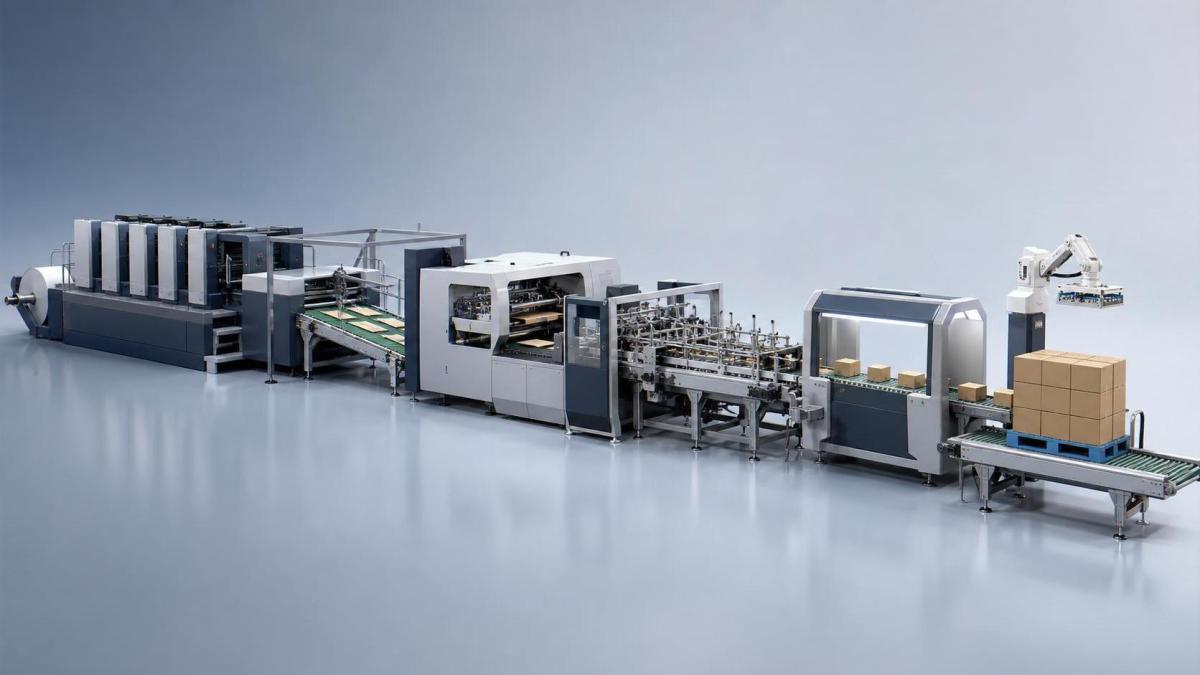
For new carton converting projects, line design decisions shape cost, uptime, and long-term flexibility.
That is why understanding packaging production equipment as a system matters more than comparing single machines.
A complete folding carton line usually combines printing, die-cutting, blanking, folder-gluing, inspection, packing, and internal logistics.
Each equipment block affects setup time, labor intensity, waste rates, delivery speed, and customer confidence.
In practical projects, the best packaging production equipment layout is not always the biggest one.
It is the line that matches carton structure, order mix, compliance demands, and expansion plans.
This guide explains what a complete line includes and how to configure it with fewer surprises.
Start with the production logic, not the machine list
Before selecting packaging production equipment, map the full converting flow from sheet input to bundled cartons.
That flow usually begins with printed board and ends with counted, inspected, packed, and palletized cartons.
The right sequence depends on substrate, carton geometry, decoration level, and output target per shift.
A cosmetics box line looks very different from a pharmaceutical leaflet-carton line or a food sleeve project.
This also means packaging production equipment must be chosen around application reality, not brochure speed alone.
- High-SKU jobs need fast changeover and recipe storage.
- Long-run jobs need stable mechanics and lower unit cost.
- Regulated sectors need traceability, inspection, and documented process control.
- Premium cartons need precise registration and surface protection.
Core packaging production equipment in a complete folding carton line
Most complete lines include six equipment groups, with automation levels adjusted to plant goals.
1. Sheet feeding and printing section
If printing is in-house, the first packaging production equipment block is usually the sheetfed offset press.
For brand-sensitive cartons, print quality sets the commercial value of the entire product.
Key options include coating units, UV systems, inline inspection, and preset automation for faster makeready.
2. Die-cutting and stripping section
The die-cutter converts printed sheets into precise carton blanks with creases, windows, and cut profiles.
Stripping removes waste automatically, reducing manual handling and improving downstream stability.
This packaging production equipment stage directly affects folding accuracy and glue-line consistency later.
3. Blanking or pre-feeder transfer section
For some formats, blanking separates finished carton shapes into neat piles before folder-gluing.
In high-volume plants, transfer automation helps balance speed between die-cutting and gluing lines.
4. Folder-gluer section
This is often the heart of folding carton packaging production equipment.
The folder-gluer handles straight-line cartons, crash-lock bottoms, multi-corner boxes, and specialty structures.
Look closely at belt stability, section length, glue control, and memory-based job setup.
5. Inspection and quality control section
Inspection systems are no longer optional in many applications.
Camera-based packaging production equipment can detect print defects, glue faults, barcode errors, and missing flaps.
For pharma and food work, documented rejection records support audits and customer claims management.
6. Packing, counting, and palletizing section
End-of-line packaging production equipment protects the productivity gained upstream.
Automatic counters, stackers, strappers, case packers, and palletizers reduce manual touchpoints and shipping damage.
Supporting systems that are often underestimated
A line can have strong core machines and still underperform because support systems were undersized.
In real projects, these hidden items often decide whether packaging production equipment runs smoothly or stalls.
- Pre-feeders and pile turners for stable sheet presentation.
- Conveyors and buffer stations for line balancing.
- Glue systems with temperature and viscosity control.
- Compressed air, dust extraction, and climate management.
- MES connectivity, job tracking, and production dashboards.
- Tooling storage for dies, plates, and make-ready parts.
PWFS has observed that intelligent support design usually improves line availability faster than adding headline speed.
How to configure packaging production equipment by application
Application needs should drive line depth, automation level, and inspection intensity.
This application-first approach keeps packaging production equipment investments aligned with real order economics.
Selection factors that affect ROI more than rated speed
Many projects overvalue nameplate speed and undervalue line behavior across a full month of production.
When comparing packaging production equipment, focus on the metrics that drive usable output.
- Makeready time between repeat and new jobs.
- Waste levels during startup and job change.
- Operator dependence for stable quality.
- Maintenance access and spare parts lead time.
- Software openness for MES, ERP, and inspection data.
- Upgrade path for future automation modules.
A slower but better-integrated packaging production equipment line can outperform a faster fragmented setup.
Common project risks and how to avoid them
Recent projects show a clear pattern: most delays come from planning gaps, not from machine defects alone.
- Underdefined product mix leads to overspecified or underspecified packaging production equipment.
- Ignoring utility loads creates startup delays during installation.
- Weak workflow design causes bottlenecks between die-cutting and folder-gluing.
- No spare tooling strategy increases downtime during urgent changeovers.
- Limited training leaves advanced functions unused after handover.
The practical fix is simple: define cartons, shifts, quality thresholds, labor model, and data flow before tendering.
A practical roadmap for building a complete line
A disciplined roadmap reduces budget drift and shortens the path to stable output.
- Define carton families, annual volume, substrate range, and compliance needs.
- Map the required packaging production equipment flow and buffer points.
- Compare suppliers on uptime logic, not just machine speed.
- Validate utilities, floor load, layout clearance, and future expansion space.
- Plan FAT, SAT, training, spare parts, and digital integration early.
- Track ramp-up with OEE, waste, and changeover benchmarks.
For teams managing carton investments, the strongest result comes from building a line that is balanced, inspectable, and expandable.
In the end, complete packaging production equipment is not just a list of machines.
It is an operating system for quality cartons, reliable delivery, and scalable manufacturing growth.
Related News
Get weekly intelligence in your inbox.
No noise. No sponsored content. Pure intelligence.
