
What to check in woodworking CNC routers for sale
What to Check in Woodworking CNC Routers for Sale
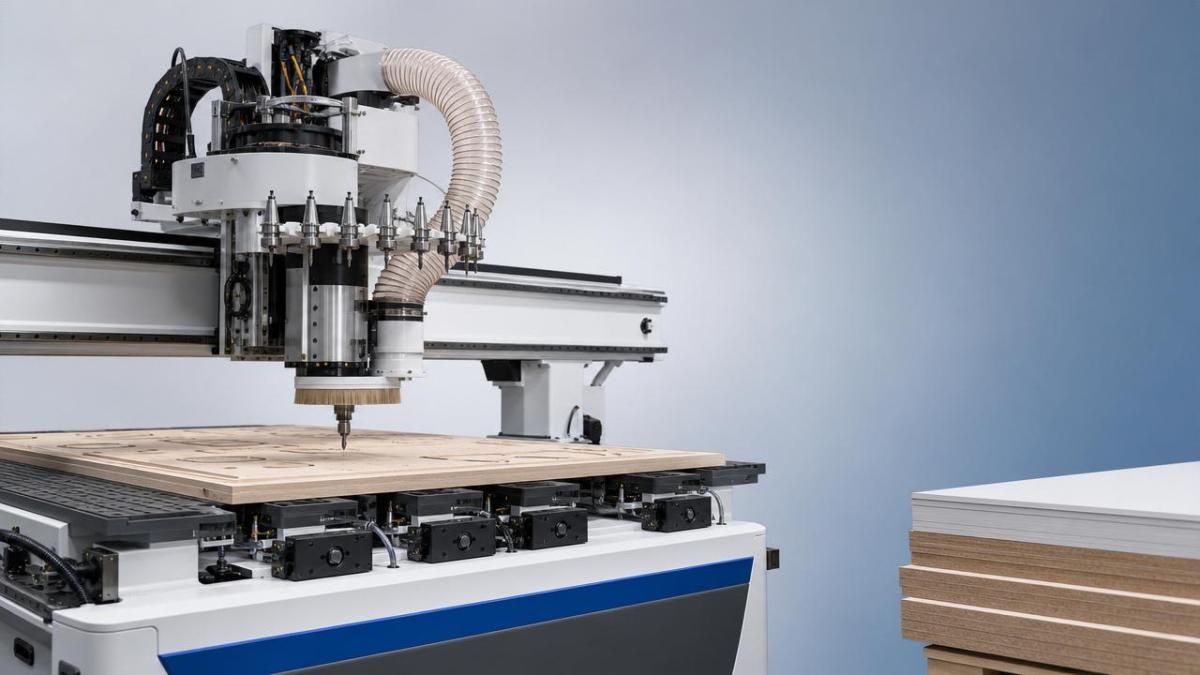
When evaluating woodworking CNC routers for sale, price is only one visible layer of the decision.
Stable precision, flexible customization, uptime, software fit, and long-term return determine whether the machine truly supports production growth.
As panel furniture and whole-house customization expand, CNC routers have become smart carving centers inside digital woodworking factories.
The right choice connects CAD design, nesting optimization, cutting, drilling, labeling, dust extraction, and downstream edge banding.
Start from the Production Scenario, Not the Brochure
Different factories need different woodworking CNC routers for sale, even when catalogs show similar travel sizes and spindle power.
A cabinet workshop values fast nesting, reliable drilling, and barcode flow more than decorative 3D carving performance.
A solid wood door producer needs torque stability, vibration control, and smooth surface quality across thicker materials.
A sign-making or mixed-material shop may prioritize software openness, vacuum zoning, tool variety, and quick job changeovers.
Before comparing woodworking CNC routers for sale, define the main products, material mix, daily output target, and tolerance requirement.
Scenario One: Panel Furniture and Whole-House Customization
This scenario depends on speed, repeatability, and digital integration from order splitting to final panel assembly.
When checking woodworking CNC routers for sale, confirm nesting efficiency, automatic labeling, drilling accuracy, and compatibility with cabinet design software.
A strong machine should maintain edge quality on MDF, particleboard, plywood, and laminated panels during long shifts.
Vacuum hold-down performance is critical because small cabinet parts can shift during high-speed cutting.
Automatic tool changers also matter, especially when cutting, drilling, grooving, and chamfering must happen without manual interruption.
Key checks for customization lines
- Verify integration with CAD/CAM, nesting, MES, and barcode systems.
- Check drilling precision for hinges, connectors, shelf pins, and dowels.
- Confirm automatic loading, unloading, and labeling options.
- Test vacuum zoning with small and narrow parts.
Scenario Two: Solid Wood Doors, Frames, and Decorative Components
Solid wood creates different demands because grain direction, density variation, and internal stress affect cutting stability.
For these jobs, woodworking CNC routers for sale should be judged by rigidity, spindle torque, thermal control, and vibration suppression.
A heavy frame and quality linear guide system reduce chatter during deep profiling or long contour machining.
Surface finish should be inspected after machining, not only measured through positioning accuracy claims.
If 3D relief carving is common, look closely at toolpath smoothness and controller interpolation performance.
Judgment points for solid wood work
- Ask for test cuts using the real wood species.
- Review spindle cooling, bearing quality, and duty cycle.
- Check gantry rigidity under deeper cutting loads.
- Assess dust extraction around profiling and pocketing tools.
Scenario Three: Mixed Materials and Flexible Job Shops
Some operations process plywood, MDF, acrylic, composites, aluminum sheets, foam boards, and occasional hardwood parts.
In this case, woodworking CNC routers for sale must offer broad parameter control and safe material-specific machining settings.
A flexible controller helps adjust feed rate, spindle speed, acceleration, vacuum zones, and tool selection quickly.
Tool-change speed is valuable, but tool library management is equally important for mixed-batch production.
Software openness matters because job shops often receive files from different design platforms and customer sources.
Compare Requirements by Scenario
This comparison helps narrow woodworking CNC routers for sale before technical negotiation begins.
It also prevents paying for impressive features that do not solve the actual production bottleneck.
Check the Spindle Like a Production Risk
The spindle is not just a power number printed in a specification sheet.
It determines cutting stability, edge finish, heat generation, tool life, and achievable feed speed.
When reviewing woodworking CNC routers for sale, ask about spindle brand, bearing grade, cooling method, and continuous operating capacity.
A higher kilowatt rating does not always mean better productivity if torque drops during demanding cuts.
Run sample programs using real board thicknesses, common cutters, and expected feed rates.
Evaluate Control Systems and Software Compatibility
Modern woodworking CNC routers for sale should connect smoothly with design, optimization, production planning, and reporting systems.
Check whether the controller supports common file formats, toolpath simulation, error alarms, and easy parameter backup.
The interface should help operators reduce mistakes during batch switching, tool changes, and panel remakes.
For Industry 4.0 upgrades, confirm available communication protocols and data export options.
A router that cannot exchange production data may become isolated inside an automated furniture line.
Match Tool Changing to Batch Rhythm
Tool-changing configuration should match the number of operations per part and the frequency of product variation.
Woodworking CNC routers for sale may offer linear, carousel, or combined automatic tool-changing systems.
A simple nesting line may need fewer tools than a door-carving or multi-process furniture cell.
Check tool capacity, change time, tool measurement, tool breakage detection, and magazine protection from dust.
Fast tool changing is useful only when accuracy is repeatable after thousands of cycles.
Do Not Treat Dust Extraction as an Accessory
Dust control affects safety, surface quality, tool life, machine wear, and downstream finishing.
When comparing woodworking CNC routers for sale, inspect dust hood design, airflow demand, hose layout, and chip evacuation efficiency.
Poor extraction leaves chips inside grooves, increases heat, and can reduce vacuum holding performance.
For laminated boards, clean cutting zones reduce scratches and improve later edge banding consistency.
Use Total Ownership Cost, Not Only Purchase Price
The cheapest offer can become expensive when downtime, spare parts, rejected panels, and service delays are included.
A serious review of woodworking CNC routers for sale should include energy use, tooling cost, maintenance labor, and software fees.
Service capability is especially important for production lines that depend on promised delivery dates.
Ask for spare parts lists, response time commitments, remote diagnostic options, and local technician availability.
Practical ownership checks
- Calculate cost per finished panel, not only machine price.
- Confirm consumables, filters, lubrication points, and wear parts.
- Review warranty exclusions and preventive maintenance schedules.
- Compare real downtime risk across shortlisted suppliers.
Common Misjudgments When Shortlisting Machines
Many failed purchases begin with evaluating woodworking CNC routers for sale through isolated technical numbers.
Travel size, spindle power, and price are important, but they do not describe the full production outcome.
Another mistake is accepting demo cuts on easy materials instead of testing actual products and tolerances.
Some overlook floor layout, dust pipeline capacity, compressed air stability, and power supply quality.
Others underestimate training time, software setup, tool database creation, and operator adaptation.
- Do not choose by spindle power alone.
- Do not ignore after-sales support and spare parts logistics.
- Do not assume every controller fits existing software.
- Do not skip real production sample testing.
A Scenario-Based Checklist Before Purchase
A structured checklist makes comparison of woodworking CNC routers for sale more objective and easier to defend.
- Define products, materials, thicknesses, tolerances, and daily output.
- Prepare real CAD files and expected toolpaths for testing.
- Verify spindle performance under continuous cutting conditions.
- Test vacuum holding with small, narrow, and nested parts.
- Confirm software, barcode, MES, and reporting compatibility.
- Review maintenance access, diagnostics, spare parts, and service coverage.
This process reduces emotional buying and shifts attention toward measurable production value.
Final Action: Turn Machine Comparison into Production Verification
The best way to evaluate woodworking CNC routers for sale is to connect every feature with a real scenario.
Request sample machining, cycle-time data, accuracy reports, software workflow proof, and maintenance documentation before final negotiation.
For growing furniture and woodworking operations, the right router becomes more than a cutting machine.
It becomes the digital bridge between custom design, automated production, stable quality, and profitable delivery.
PWFS tracks woodworking CNC routers for sale through the lens of precision, flexibility, automation, and long-term industrial value.
Use that same lens to select equipment that fits the scene, protects uptime, and supports smarter wood manufacturing.
Related News
Get weekly intelligence in your inbox.
No noise. No sponsored content. Pure intelligence.
