
Flexible Wood-Cutting Methods: Which Materials and Part Shapes Are Best Suited?
Flexible wood-cutting starts with the real production setting
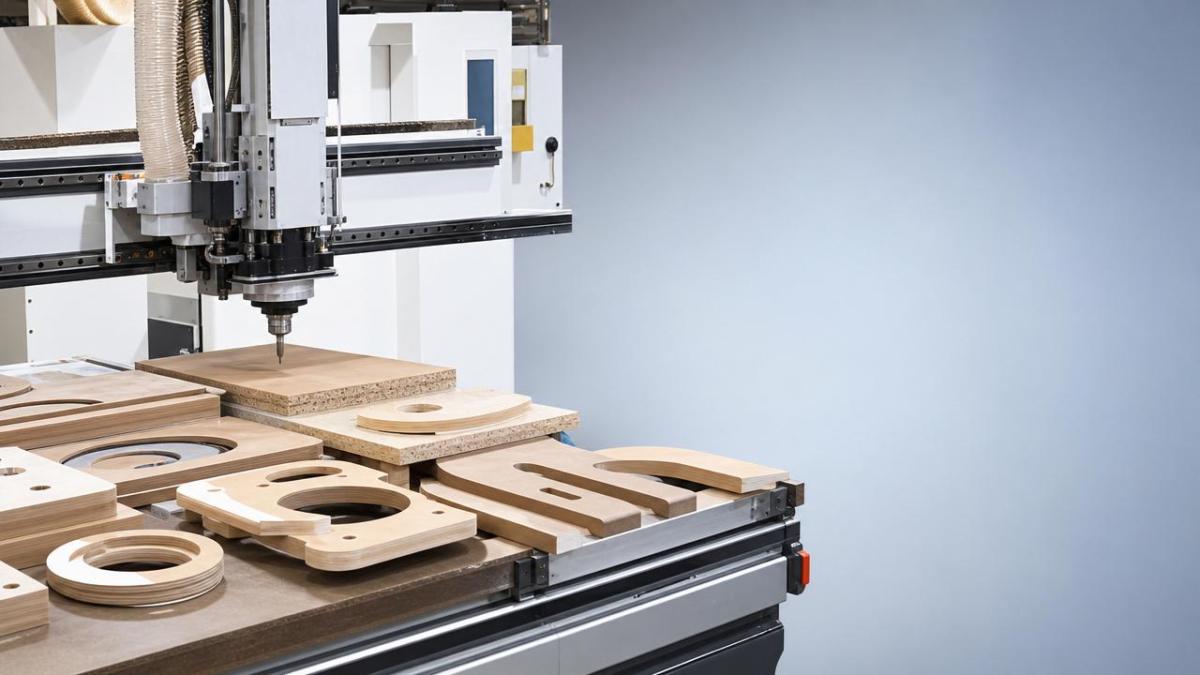
Flexible wood-cutting matters most when product mix changes faster than tooling habits.
A cabinet door, a curved display panel, and a grooved packaging insert may share a CNC table, but not the same cutting logic.
That is why the best method cannot be chosen by spindle power alone.
Material density, fiber direction, chip evacuation, edge finish, and nesting pressure all shift the answer.
In practical evaluation, flexible wood-cutting is a matching exercise between board behavior and part geometry.
PWFS often frames this issue within a wider production chain.
A clean cut influences edge banding quality, drilling accuracy, assembly fit, packaging stability, and even digital scheduling efficiency.
This is especially visible where whole-house customization and high-mix industrial output now meet.
Why different materials push flexible wood-cutting in different directions
The same contour can behave very differently in MDF, plywood, particleboard, or solid wood.
MDF is stable and predictable, so flexible wood-cutting usually focuses on edge smoothness and dust control.
Plywood adds alternating grain layers, which improve strength but increase tear-out risk on exits and corners.
Particleboard is cost-efficient, yet brittle edges can weaken later edge-banding if tool wear is ignored.
Solid wood brings the biggest variation.
Moisture content, knots, resin, and grain direction all affect feed stability and surface quality.
Composite panels with laminates add another layer of judgment.
Here, flexible wood-cutting must protect the decorative face while still keeping speed acceptable.
In other words, the material is not only what gets cut.
It also determines which errors are expensive later, from chipping to glue-line failure.
Flat cabinet parts usually reward stability over aggressive speed
For wardrobes, shelves, side panels, and drawer fronts, the dominant shapes are rectangular or lightly notched.
These parts look simple, yet flexible wood-cutting still has clear priorities.
Dimensional repeatability matters more than maximum feed rate because downstream drilling and edge banding depend on it.
MDF and particleboard commonly suit nested-based CNC routing with compression tools or high-quality panel saw preparation.
The better choice depends on mix.
If dimensions repeat all day, saw-first processing may be more economical.
If sizes change order by order, flexible wood-cutting through automated nesting becomes more valuable.
A common mistake is assuming straight parts are low-risk.
In reality, small edge chips on melamine boards can become visible defects after sealing.
What to confirm in panel-based production
- Tool type should match face material, not only core material.
- Vacuum hold-down must stay stable on narrow leftover strips.
- Cut sequencing should reduce part movement near final tabs.
- Dust extraction capacity affects edge temperature and finish.
Curved furniture components need flexible wood-cutting that respects geometry
Once shapes become radiused, tapered, or asymmetrical, the evaluation changes quickly.
Chairs, decorative wall panels, rounded vanity parts, and store fixtures often fall into this zone.
Here, flexible wood-cutting must balance path accuracy with edge integrity on changing curves.
Plywood often performs well for structural curves, but it needs careful entry and exit strategy.
MDF supports smooth profiling for painted surfaces, though heat buildup can dull tools faster.
Solid wood shaped parts demand extra caution around grain reversals.
That is where climb versus conventional cutting decisions become practical, not theoretical.
In these jobs, a slower but cleaner pass often saves more than a fast rough edge ever can.
It reduces sanding, filler use, and visual mismatch on exposed surfaces.
Drilled, grooved, and interlocking parts create a different priority map
Some parts are not difficult because of outer shape.
They are difficult because many operations must align inside one cycle.
Flat-pack connectors, back-panel grooves, hinge pockets, and assembly slots are typical examples.
Flexible wood-cutting in this setting is inseparable from drilling strategy and datum consistency.
A perfectly cut outline still fails if groove depth varies or boring positions drift.
That is why integrated CNC processing usually outperforms separated manual routing when customization volume rises.
The benefit is not only fewer handling steps.
It is better positional coherence between every feature on the part.
PWFS often connects this point to wider factory intelligence.
When CAD, nesting, routing, drilling, and labeling share one data flow, flexible wood-cutting becomes far more predictable.
A quick comparison helps when material and shape compete
In mixed production, the most useful question is usually not which method is best overall.
It is which method best protects the most critical requirement in each case.
Where flexible wood-cutting is often misjudged
One frequent misread is treating all sheet materials as interchangeable because their thickness matches.
Core structure and surface layer often matter more than nominal dimensions.
Another mistake is optimizing only for cycle time.
A fast program that creates sanding, rework, or weak edge adhesion is rarely the efficient option.
There is also a digital blind spot.
Flexible wood-cutting depends on software quality as much as mechanical capacity in high-mix workflows.
Poor nesting rules, wrong tool libraries, or unverified post-process settings can erase machine advantages.
Finally, many evaluations ignore what happens after cutting.
If the edge will be painted, wrapped, banded, or structurally loaded, the cutting decision should reflect that end use.
A more practical way to choose the right method
The most reliable path is to group parts by behavior, not by product name alone.
Start with three filters: material composition, geometry complexity, and downstream tolerance sensitivity.
Then compare cutting methods against the real bottleneck.
Sometimes that bottleneck is edge appearance.
Sometimes it is nesting yield, drilling alignment, or tool-change frequency.
In the PWFS view, flexible wood-cutting performs best when it is treated as part of an intelligent chain.
That chain links CAD data, routing physics, labeling, edge finishing, and final assembly expectations.
For the next evaluation step, it helps to build a short matrix for recurring jobs.
- List each material with face layer, density, and finish requirement.
- Tag parts by straight, curved, nested, or feature-heavy geometry.
- Note which defects are unacceptable in downstream operations.
- Test tooling and feed combinations on the highest-risk group first.
- Review maintenance intervals, dust load, and software consistency together.
That approach keeps flexible wood-cutting grounded in actual production logic rather than machine brochure claims.
It also makes later automation decisions more defensible across furniture, interiors, and related industrial wood applications.
Related News
Get weekly intelligence in your inbox.
No noise. No sponsored content. Pure intelligence.
