
Digital Print Packaging vs Conventional Print: What Matters for Short Runs?
Digital Print Packaging vs Conventional Print: What Matters for Short Runs?
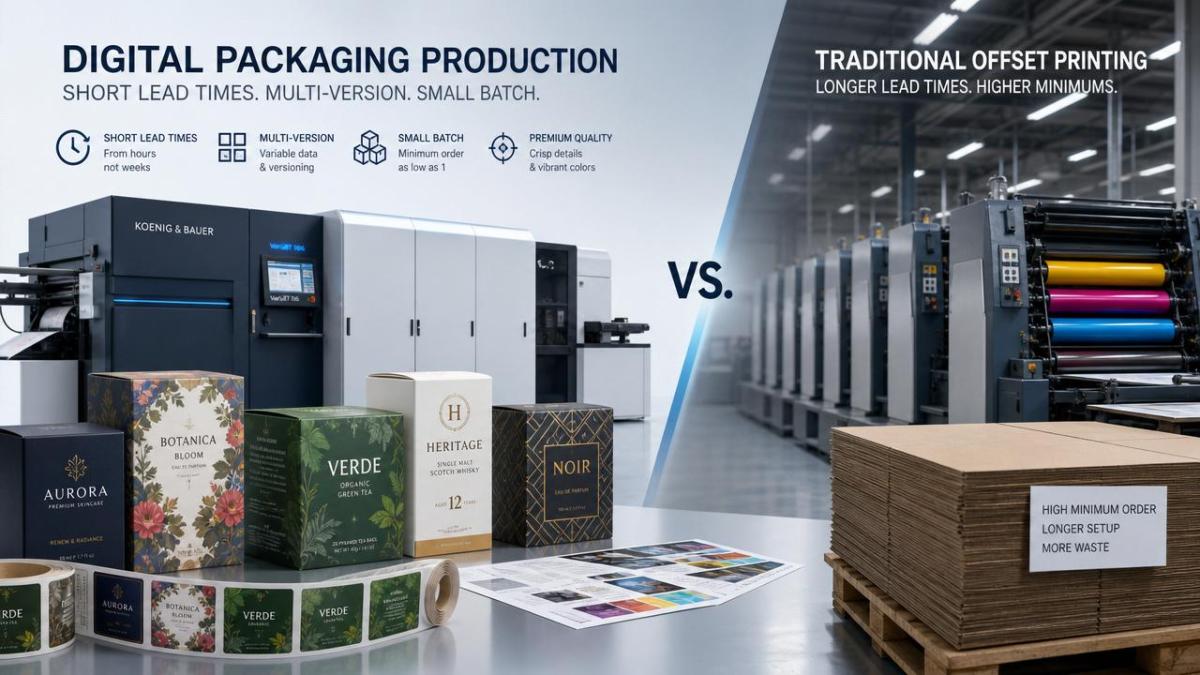
For short-run packaging, the real question is not simply which method looks cheaper on paper.
It is which process protects margin, supports speed, and reduces avoidable operational risk.
That is why digital print packaging has become a serious buying option, not just a niche alternative.
Conventional print still has strong advantages, especially at scale, but short runs change the economics fast.
In practical sourcing work, setup cost, lead time, and version control often matter more than the headline unit price.
This matters even more in markets driven by SKU expansion, promotional packaging, and regional customization.
From recent market behavior, buyers increasingly compare digital print packaging with offset or flexographic methods through a wider lens.
They look at total landed cost, waste exposure, approval cycles, and the commercial value of flexibility.
Why Short Runs Change the Print Decision
Short runs behave differently from long-volume packaging programs.
When order quantities are limited, fixed setup costs weigh more heavily on each carton or label.
Conventional print usually requires plates, longer makeready, and more startup waste.
Digital print packaging avoids many of those upfront steps, which changes the break-even point.
That does not mean digital is always cheaper.
It means the cost model is different and often better aligned with short production cycles.
- Less setup cost improves viability for small batch orders.
- Faster job changeovers support frequent SKU shifts.
- Lower minimum order quantities reduce excess stock.
- Versioning becomes easier for regions, campaigns, or compliance updates.
In other words, short-run procurement is not only about printing. It is about business responsiveness.
Cost Per Unit vs Total Cost of Ownership
A common mistake is comparing only unit price quotes.
For digital print packaging, buyers should evaluate total cost across the full packaging cycle.
Conventional print may show a lower per-piece cost at higher volume.
However, short runs often carry hidden costs outside the quote.
These include plates, approvals, storage, obsolete inventory, and disposal of unused packaging.
Digital print packaging frequently wins when demand is uncertain or product changes are frequent.
For many buyers, the smarter question is this: what is the cheapest correct decision, not the cheapest printed piece?
Lead Time, Agility, and Demand Volatility
Speed to market has become a major cost variable.
When product launches shift, promotions change, or compliance text must be updated, delay becomes expensive.
Digital print packaging helps compress prepress and production timelines.
That can reduce approval bottlenecks and make replenishment more predictable.
Conventional print is still highly effective, but it works best when artwork is stable and demand is well forecasted.
In actual business operations, unstable demand favors a more flexible print workflow.
- Use digital print packaging for pilot launches and market tests.
- Use it for seasonal or regional packaging changes.
- Use conventional print when volume is validated and artwork is locked.
This hybrid sourcing approach is becoming more common because it matches technology to business stage.
Color Quality and Brand Expectations
Quality concerns still shape many print buying decisions.
Some teams assume digital print packaging means lower brand impact. That is no longer always true.
Modern digital systems can deliver strong image quality, sharp text, and reliable short-run consistency.
Still, conventional print often remains the benchmark for exact spot color reproduction at scale.
This is especially relevant for premium consumer packaging with strict global color standards.
The right evaluation is not digital versus traditional in abstract terms.
It is whether the required brand outcome can be achieved within the run size and timeline.
- Check delta tolerance and repeatability, not just sample appearance.
- Confirm substrate compatibility before awarding short-run work.
- Review food-contact, ink migration, and compliance needs early.
- Request production-condition samples, not idealized showroom prints.
That last point is often where weak sourcing decisions become visible.
Versioning, Personalization, and SKU Complexity
A clearer signal in the market is the rise of packaging complexity.
Brands now manage more formats, more regulatory variants, and more targeted campaigns than before.
Digital print packaging is especially attractive when each version would otherwise need separate plates.
That lowers the friction of running multiple designs in one procurement cycle.
It also supports serialized, localized, or personalized packaging without the same setup burden.
Conventional print remains efficient for stable, repeated SKUs with high annual volume.
But once artwork variety grows, digital print packaging often becomes easier to justify commercially.
Operational Risks Buyers Should Not Ignore
The short-run print decision includes several risks that are often missed during quoting.
One is obsolete inventory after a design update or demand miss.
Another is the cost of delaying a launch because conventional setup is not yet ready.
A third is quality inconsistency when switching suppliers across print technologies.
Digital print packaging reduces some risks, but it introduces its own evaluation points.
For example, not every digital platform handles every board grade or finishing requirement equally well.
- Audit print provider capability by substrate and finishing process.
- Map approval lead time, not just production time.
- Estimate write-off risk for old inventory.
- Check whether converting, die-cutting, and gluing stay efficient at low volumes.
In corrugated and folding carton programs, the print method cannot be judged in isolation from the converting line.
A Practical Buying Framework for Short Runs
When evaluating digital print packaging against conventional print, a simple decision framework helps.
Start with volume, but do not stop there.
Look at the full commercial context around the packaging program.
- Define expected run length and reorder frequency.
- Measure artwork stability over the next six to twelve months.
- Calculate setup, waste, storage, and obsolescence cost.
- Check brand color tolerance and compliance requirements.
- Review how quickly the packaging must reach market.
- Decide whether versioning or personalization creates measurable value.
If volume is low, change is frequent, and inventory risk is high, digital print packaging usually deserves serious consideration.
If demand is stable, scale is large, and color targets are extremely rigid, conventional print may still lead.
In many cases, the best answer is not either-or. It is a staged sourcing strategy.
Final Takeaway
For short runs, digital print packaging matters because it changes the risk profile of packaging procurement.
It can cut setup burden, improve speed, support versioning, and reduce dead stock.
Conventional print still matters where scale, repeatability, and strict color economics dominate.
The best procurement decisions come from matching technology to demand reality, not defending old assumptions.
If you are comparing suppliers, ask for a side-by-side short-run model that includes print, converting, waste, inventory, and change costs.
That approach turns digital print packaging from a trend topic into a practical sourcing decision.
Related News
Get weekly intelligence in your inbox.
No noise. No sponsored content. Pure intelligence.
