
How industrial woodworking machinery affects output and VOC compliance
For enterprise decision-makers, industrial woodworking machinery is no longer just a production asset—it is a direct lever for output, consistency, and environmental compliance.
As customization expands and delivery windows shrink, equipment choices now shape throughput, rework rates, labor dependence, and VOC risk.
This matters across the broader manufacturing landscape, where wood processing, packaging, finishing, and digital production increasingly intersect.
For PWFS, the issue is practical: better industrial woodworking machinery helps factories connect flexible cutting, clean edge sealing, and compliance-ready finishing into one stable system.
When output pressure and VOC compliance rise together
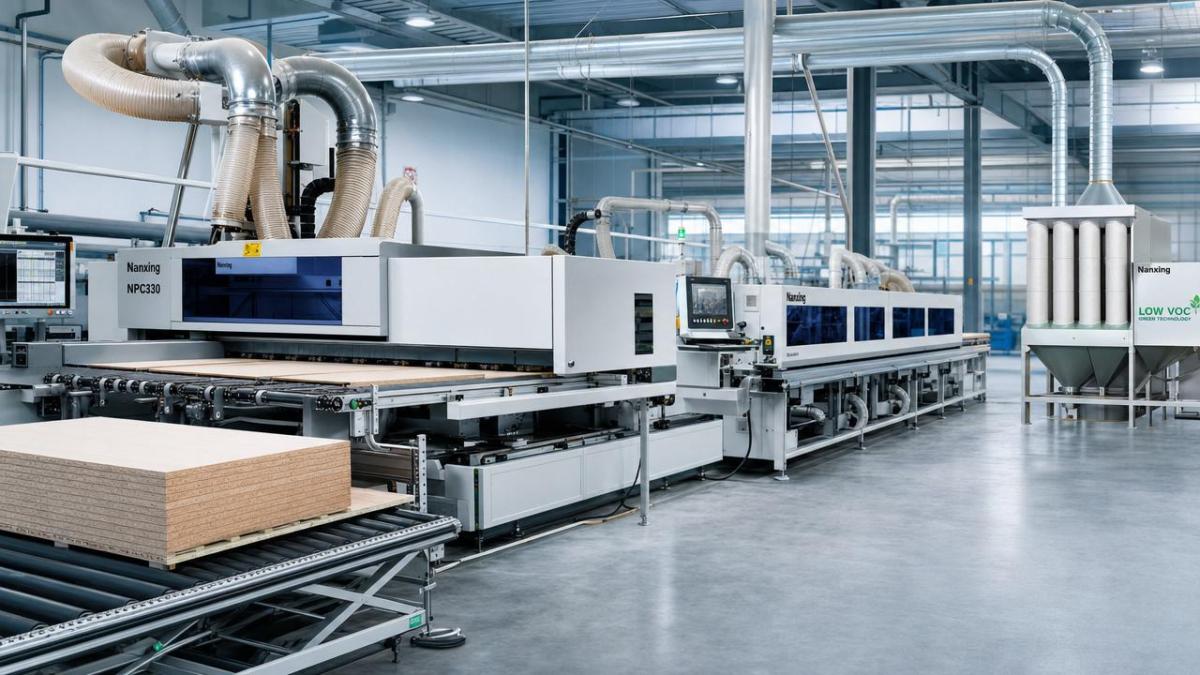
Many plants face two pressures at once: more order variety and stricter environmental rules.
In this setting, industrial woodworking machinery affects far more than cutting speed.
It changes dust generation, adhesive use, panel damage, idle time, and the consistency of downstream finishing.
VOC compliance is especially sensitive where lamination, coating, edge banding, and hot-melt bonding follow machining.
If machining quality is unstable, finishing teams often compensate with extra glue, more touch-up, or repeated passes.
That directly increases emissions exposure, material use, and defect risk.
Well-matched industrial woodworking machinery reduces these hidden losses by controlling accuracy at the source.
Scenario one: mass panel furniture lines need stable, repeatable flow
High-volume panel furniture operations depend on rhythm, not isolated machine speed.
Here, industrial woodworking machinery must support continuous nesting, drilling, routing, labeling, and edge preparation.
The key judgment point is line balance.
If the CNC router cuts faster than sorting or edge banding can absorb, output gains disappear into queues.
Another decision point is dimensional consistency across shifts.
Even small tool wear variation creates poor fit, edge gaps, and rework that disrupts the entire line.
For VOC control, this scenario benefits from precise panel preparation before sealing or bonding.
Cleaner cuts often allow lower adhesive usage and fewer correction steps later.
Core indicators in this scenario
- Tool change frequency and downtime impact
- Panel yield from nesting optimization
- Dust extraction efficiency near cutting heads
- Edge quality before gluing or laser edging
- Repeatability between day and night shifts
Scenario two: custom furniture production values flexibility over peak speed
Whole-house customization creates a very different operating environment.
Orders are fragmented, dimensions vary, and design files change constantly.
In this case, industrial woodworking machinery affects output through setup reduction and data accuracy.
A machine that reads CAD and MES instructions reliably can cut handoff errors dramatically.
The main judgment point is not maximum spindle speed.
It is whether the equipment can switch jobs quickly while preserving hole position, orientation, and part traceability.
VOC compliance also shifts here.
Frequent manual correction often introduces uncontrolled adhesive use, local touch-up, and inconsistent curing conditions.
Reliable industrial woodworking machinery lowers that variability by making first-pass accuracy more achievable.
What usually matters most
- Barcode or label integration for each part
- Software compatibility with design platforms
- Fast recovery after small-batch interruptions
- Minimal scrap during one-off orders
- Stable machining for low-emission finishing steps
Scenario three: export-oriented production faces stricter compliance exposure
Factories serving export channels often operate under tighter documentation and audit expectations.
Here, industrial woodworking machinery affects both measurable output and evidentiary compliance.
The first judgment point is process traceability.
If machine parameters, tool paths, and maintenance records are not organized, proving control becomes harder.
The second point is compatibility with low-VOC adhesives, cleaner edge technologies, and controlled dust capture systems.
When machining causes chipping or roughness, finishing teams often compensate using more chemicals.
That weakens both cost performance and environmental credibility.
For this scenario, industrial woodworking machinery should be viewed as part of a compliance architecture, not only a production center.
How different scenarios change equipment priorities
Practical recommendations for matching industrial woodworking machinery
A useful equipment decision starts with process mapping, not catalog comparison.
Output and VOC performance improve when machinery is selected around the real bottleneck.
- Measure where rework starts: cutting, drilling, edge prep, or finishing.
- Compare scrap reasons against machine accuracy and tool management records.
- Check whether dust extraction and chip removal match spindle performance.
- Validate compatibility with low-VOC adhesives, PUR systems, or laser edging.
- Review software connectivity with CAD, MES, and part identification workflows.
- Estimate total compliance cost, not only purchase cost.
In many cases, one upgrade in industrial woodworking machinery can reduce defects across several downstream stations.
That multiplier effect often produces faster returns than headline speed improvements alone.
Common misjudgments that weaken both output and compliance
A frequent mistake is judging industrial woodworking machinery only by advertised throughput.
If unstable cuts force extra sanding, gluing, or refinishing, true output falls.
Another oversight is treating VOC compliance as only a finishing department issue.
In reality, poor machining quality often triggers more emission-related materials later.
Some operations also underinvest in maintenance discipline.
Worn tools, drifting calibration, and weak extraction can quietly erode performance for months.
A final misjudgment is separating woodworking equipment from broader digital manufacturing strategy.
Without data flow, even advanced industrial woodworking machinery may deliver only partial value.
Next-step actions for a stronger production and compliance baseline
The most effective next step is a scenario-based equipment review.
List current order mix, finishing methods, adhesive systems, and recurring defect patterns.
Then assess whether existing industrial woodworking machinery supports those realities or fights them.
PWFS follows this exact logic across woodworking, printing, packaging, and intelligent production systems.
The goal is not isolated machine ownership.
It is a connected operating model where precision machining improves output, lowers waste, and supports credible VOC compliance.
When industrial woodworking machinery is chosen by application scenario, factories gain more than capacity.
They gain a durable path toward flexible growth, cleaner production, and stronger international competitiveness.
Related News
Get weekly intelligence in your inbox.
No noise. No sponsored content. Pure intelligence.
