
Die-Cutting Machines for Packaging: Flatbed vs Rotary and When to Use Each
For packaging buyers, choosing between flatbed and rotary die-cutting machines is not just a technical decision—it directly affects throughput, tooling cost, order flexibility, and long-term ROI. As carton formats diversify and delivery cycles tighten, procurement teams must understand how each die-cutting platform performs across corrugated boxes, folding cartons, labels, and high-volume packaging runs. This guide compares flatbed and rotary systems from a practical purchasing perspective, helping you identify when precision, speed, setup efficiency, or total cost of ownership should drive your investment decision.
In modern print and packaging plants, die-cutting sits between visual value creation and structural conversion. A press may deliver beautiful color, but the die-cutter determines whether the sheet becomes a reliable carton, display tray, mailer, sleeve, or label.
For procurement teams, the challenge is rarely “which machine is faster” in isolation. The better question is which die-cutting platform supports your mix of substrates, order quantities, changeover frequency, downstream folder-gluer speed, and 3-year ownership plan.
How Flatbed and Rotary Die-Cutting Machines Work
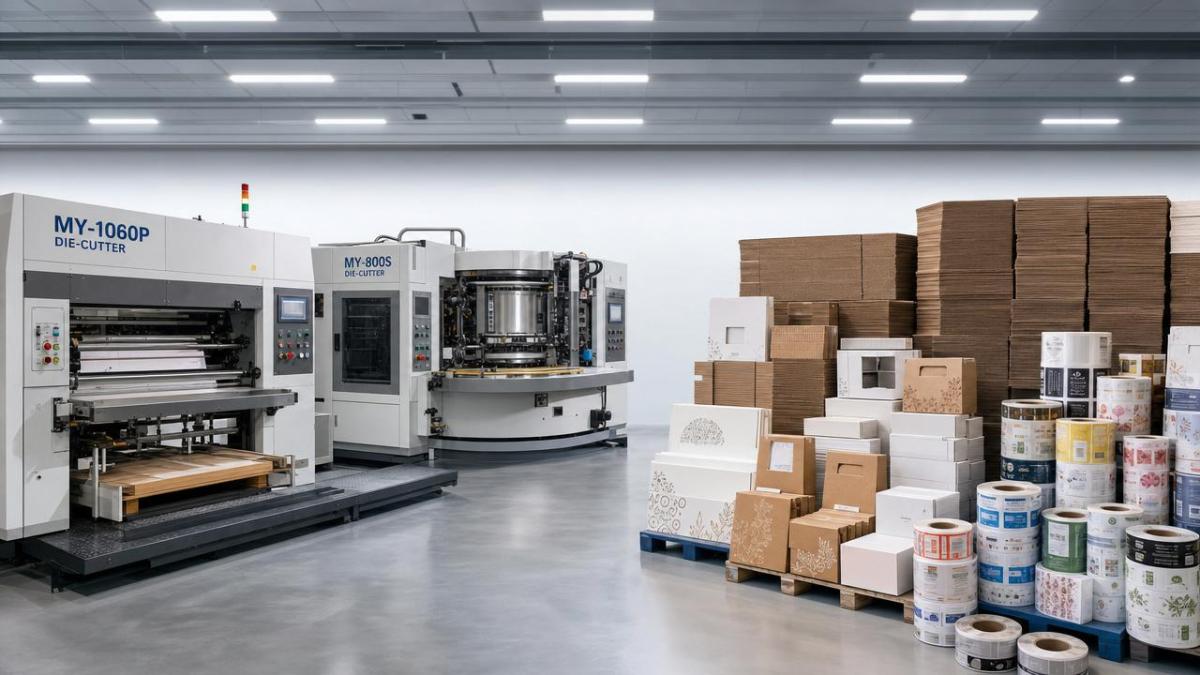
Flatbed and rotary die-cutting machines both cut, crease, perforate, and strip packaging materials. Their mechanical principles, however, create very different operating profiles in accuracy, tooling investment, machine footprint, and production rhythm.
Flatbed die-cutting: pressure, precision, and versatility
A flatbed die-cutter uses a flat cutting die and a moving or fixed platen to press the sheet under high force. In packaging, this force can reach hundreds of tons depending on sheet size, board grade, and machine design.
Because contact occurs across a flat plane, flatbed systems are well suited to folding cartons, corrugated sheets, luxury packaging, pharmaceutical cartons, cosmetic boxes, and products needing tight crease control within approximately ±0.1–0.3 mm in typical production conditions.
Rotary die-cutting: speed, continuity, and volume economics
A rotary die-cutter cuts material as it passes between rotating cylinders. The die is mounted around a cylinder, allowing continuous operation with fewer stop-start motions than a flatbed system.
Rotary die-cutting machines are commonly used for high-volume corrugated packaging, labels, flexible packaging, beverage carriers, and repetitive formats where line speed may matter more than frequent design change.
The following comparison gives buyers a first-level view of where each platform usually performs best. Actual results depend on substrate, tool quality, feeder stability, operator skill, and maintenance discipline.
The core conclusion is simple: flatbed equipment buys flexibility and structural accuracy, while rotary equipment buys continuous speed. A balanced purchasing decision should translate that difference into order economics, not just machine specifications.
When to Choose Flatbed Die-Cutting Machines
Flatbed die-cutting machines are often the safer choice when packaging demand is fragmented. If your plant handles 20–80 active SKUs per month, with many carton formats and board grades, flexibility becomes a real financial advantage.
Best-fit packaging applications
Flatbed systems perform well where creasing quality affects assembly, shelf appearance, or regulatory usability. Folding cartons for medicine, cosmetics, tobacco, electronics, and specialty retail packaging often depend on consistent crease depth and clean stripping.
- Folding cartons requiring accurate creasing and stable folding on downstream folder-gluers.
- Corrugated e-commerce mailers with frequent format changes and moderate volumes.
- Premium packaging with windows, hang holes, micro-perforation, or complex lock structures.
- Printed sheets where registration between graphics and cutting must stay tightly controlled.
Flatbed machines also fit converters serving brand owners that refresh artwork every 4–12 weeks. In these cases, the lower cost and faster availability of flat dies can protect margins during frequent product launches.
Procurement signals that favor flatbed
Buyers should prioritize flatbed platforms when the value of each job is tied to precision, variety, and make-ready control rather than raw meters per minute. This is especially true for sheet-fed offset packaging workflows.
- Average order quantities are below 50,000–100,000 sheets per design.
- The plant changes jobs multiple times per shift or runs mixed carton sizes daily.
- Carton structures include detailed crease lines, small flaps, windows, or locking tabs.
- Tooling budget must remain manageable across many SKUs and seasonal programs.
Key machine specifications to verify
For a flatbed investment, procurement should examine sheet size, cutting pressure, feeder stability, stripping automation, blanking capability, and integration with plant MES. A speed figure alone is insufficient.
Typical sheet-fed packaging plants may evaluate formats from 740 mm to over 1,600 mm, depending on whether the focus is folding carton, micro-flute, or larger corrugated display work.
A flatbed machine with automatic stripping and blanking may reduce manual handling by 2–4 steps. That directly affects labor planning, waste control, and the speed of downstream folder-gluer feeding.
When Rotary Die-Cutting Becomes the Better Investment
Rotary die-cutting machines become attractive when volume, repeatability, and inline efficiency dominate the business case. Their strength is not universal flexibility, but the ability to convert repeated structures at high speed.
High-volume runs and inline production
In corrugated packaging, rotary systems are often paired with flexo printing, slotting, creasing, stripping, and stacking modules. This enables a continuous workflow from printed board to finished blank.
For labels and flexible packaging, rotary systems can also support kiss-cutting, matrix removal, slitting, and rewinding. In these workflows, web tension control and die wear monitoring become critical purchasing factors.
Where rotary economics are strongest
Rotary tooling costs more because the die must match a cylinder circumference and maintain accuracy at speed. However, if the same structure runs weekly or monthly, that tooling cost can be diluted over millions of impressions.
For buyers, the turning point often appears when annual volume per format is high, changeovers are predictable, and the plant can schedule long campaigns of 4–8 hours without frequent interruption.
The table below translates common production scenarios into purchasing guidance. It is intended as a practical starting point before supplier trials and line simulations.
Rotary is most compelling when the buyer can guarantee production discipline. Without stable demand, cylinder inventory, scheduled maintenance, and accurate forecasting, a fast machine may create idle capital.
Risks to control before signing
Rotary systems require careful review of die lead time, cylinder storage, operator training, and spare parts availability. Buyers should ask whether tool delivery takes 2–6 weeks and how emergency replacements are handled.
Substrate variation is another risk. Corrugated board caliper, moisture, flute stability, and liner cracking can affect cut quality at speed, especially when the line operates across multiple board suppliers.
Cost, ROI, and Total Ownership Factors for Buyers
The purchase price of die-cutting machines is only one line in the investment model. Tooling, energy, operators, waste, maintenance, floor space, and downtime can change the real payback period significantly.
Tooling and make-ready economics
Flatbed dies are usually more economical and easier to store, which matters when a converter manages hundreds of carton designs. Rotary dies require more capital per format but can outperform over long, stable production cycles.
A useful procurement calculation is tooling cost per 1,000 finished blanks. For short runs, flatbed usually wins. For repeated runs across 12–24 months, rotary can become more competitive.
Operational efficiency and labor impact
Modern flatbed die-cutting machines with automatic stripping, non-stop feeder options, and preset functions can improve shift consistency. Still, job setup remains a core performance variable.
Rotary systems reduce repeated stop-start cycles, but they demand tighter upstream and downstream synchronization. A bottleneck at stacking, waste evacuation, or quality inspection can erase the speed advantage.
- Calculate expected annual machine utilization, not only rated hourly output.
- Include 5–10% start-up waste assumptions for difficult new materials during trials.
- Confirm preventive maintenance frequency, commonly weekly checks and quarterly service reviews.
- Assess whether operators can be trained within 2–4 weeks for stable job execution.
Integration with printing and folder-gluing
A die-cutter should not be purchased as an isolated island. It must match offset press sheet size, corrugator output, folder-gluer speed, pallet logistics, and inspection requirements.
For carton plants targeting Industry 4.0 operation, procurement should ask suppliers about production data capture, recipe storage, barcode job recall, remote diagnostics, and compatibility with MES platforms.
A Practical Selection Framework for Procurement Teams
Before requesting quotations, buyers should build a clear decision matrix. This prevents suppliers from comparing unlike configurations and helps management understand the commercial logic behind the equipment choice.
Step 1: Map your real order mix
Collect at least 6–12 months of job data. Review average run length, sheet size, substrate type, repeat rate, changeovers per shift, waste percentage, and peak-season workload.
If your top 20% of SKUs generate most of the volume, rotary may deserve serious evaluation. If the order mix is wide and seasonal, flatbed may provide stronger commercial resilience.
Step 2: Run material and structure trials
Trial cutting should include the hardest materials, not only standard board. Test laminated sheets, recycled corrugated, micro-flute, thick paperboard, varnished surfaces, and difficult grain directions.
Acceptance criteria should include cut cleanliness, crease cracking, registration, stripping stability, blank separation, and folder-gluer performance. A 30-minute demonstration is rarely enough for capital approval.
Step 3: Compare supplier support, not just equipment
For die-cutting machines, after-sales capability directly affects uptime. Buyers should verify spare parts lists, technician response time, training materials, remote support, and local service coverage.
- Request a 3-year consumables and spare parts estimate.
- Ask for installation milestones, typically foundation check, delivery, assembly, commissioning, and acceptance.
- Define performance tests using your own substrates and at least 3 representative structures.
- Clarify warranty exclusions related to tooling, operator misuse, and non-standard materials.
Common purchasing mistakes
One common mistake is buying the fastest rated machine while ignoring job changeover. Another is underestimating tooling management, especially when customer designs change every quarter.
A third mistake is failing to involve production, maintenance, quality, and finance early. A good capital decision should satisfy at least 4 stakeholders, not only the purchasing department.
Final Buying Guidance: Match the Platform to the Business Model
Flatbed and rotary die-cutting machines are not competitors in every situation. They are different answers to different production models, and the right choice depends on how your packaging business earns margin.
Choose flatbed when your plant values precision, frequent SKU changes, premium carton structures, and manageable tooling investment. It is especially strong for converters serving diversified brands and short-cycle packaging programs.
Choose rotary when your operation has repeatable high-volume demand, stable specifications, and enough production discipline to keep the line running for long campaigns. In those conditions, speed can translate into real unit-cost advantage.
PWFS helps packaging equipment buyers connect machine mechanics, production data, and capital logic across corrugated lines, offset presses, die-cutters, folder-gluers, and automated converting systems.
If you are evaluating new die-cutting machines for corrugated boxes, folding cartons, labels, or integrated packaging lines, consult PWFS for a structured comparison, supplier discussion checklist, and tailored purchasing guidance.
To refine your investment plan, review your order mix, identify your top constraints, and request a customized equipment selection consultation. Contact us to explore more practical packaging machinery solutions.
Related News
Get weekly intelligence in your inbox.
No noise. No sponsored content. Pure intelligence.
