
Industrial Printing Equipment Types for Packaging and Commercial Print
Understanding the major types of industrial printing equipment is essential for comparing packaging and commercial print capabilities, from high-speed offset presses and flexographic lines to digital inkjet systems, die-cutting, folding, and finishing solutions.
For researchers evaluating modern print production, each machine category reflects a different balance of speed, substrate compatibility, color accuracy, automation, and cost efficiency.
This guide introduces the core equipment used to turn paper, board, film, and corrugated materials into market-ready packaging and printed products.
Why Industrial Printing Equipment Needs a Checklist Approach
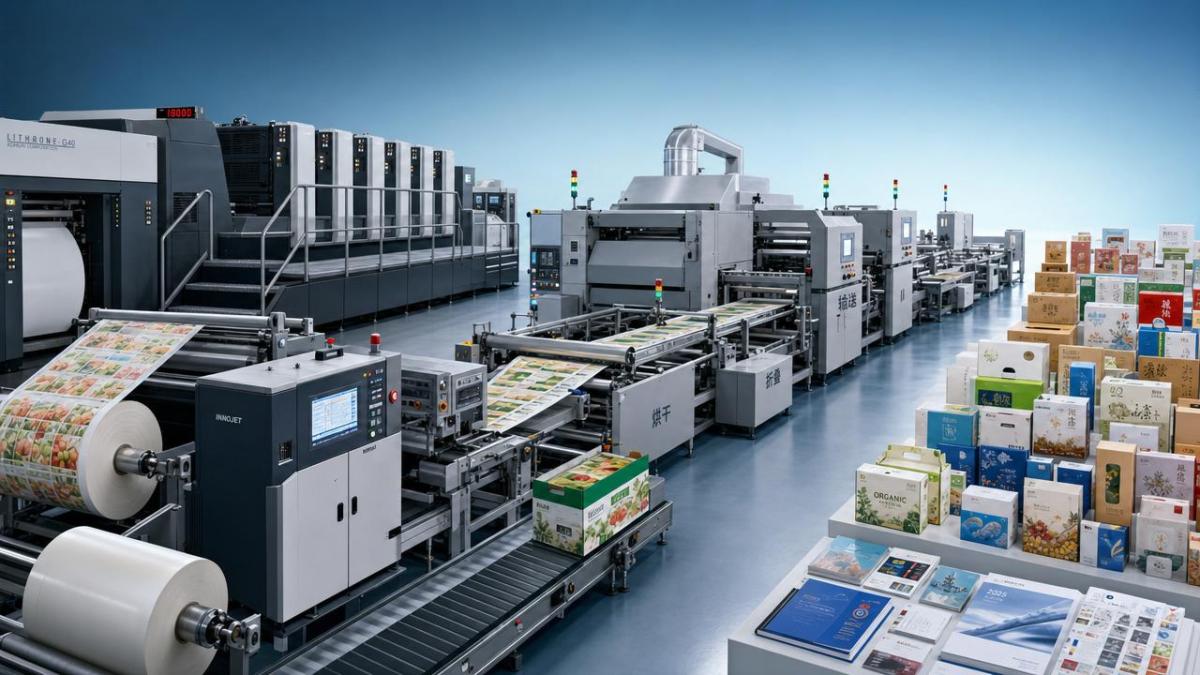
Industrial printing equipment is rarely selected by machine name alone. Output format, ink behavior, substrate tension, drying energy, and finishing flow all affect production value.
A checklist helps compare offset, flexographic, gravure, screen, and digital systems without overlooking workflow constraints that appear after installation.
In packaging and commercial print, the press is only one part. Prepress, inspection, die-cutting, folding, gluing, and logistics determine usable throughput.
Core Checklist for Evaluating Industrial Printing Equipment
- Define the primary substrate first, because paperboard, corrugated board, plastic film, labels, and metalized materials require different feeding, curing, and tension systems.
- Match print technology to run length, since offset suits consistent high-volume sheets, while digital industrial printing equipment supports short runs and variable data.
- Check color control capability through closed-loop inspection, spectrophotometers, plate quality, ink stability, and registration correction during high-speed production.
- Verify drying or curing requirements, including hot air, infrared, UV, LED-UV, electron beam, or oxidation, depending on ink chemistry and substrate sensitivity.
- Review makeready time, because plate changes, web threading, wash-up cycles, job presets, and automation strongly affect real operating cost.
- Evaluate finishing compatibility, ensuring die-cutters, folder-gluers, slitters, laminators, coaters, and stackers can keep pace with press output.
- Assess waste rate at startup and production speed, especially when industrial printing equipment handles expensive cartons, films, security stocks, or specialty coatings.
- Confirm data integration with MIS, MES, prepress workflows, barcode tracking, quality reporting, and automated job scheduling for repeatable production control.
- Compare service access, spare parts, operator training, software updates, and remote diagnostics before judging a machine by headline speed.
- Calculate total energy demand, including compressed air, drying load, vacuum systems, chillers, corona treatment, and post-press equipment.
Main Types of Industrial Printing Equipment
1. Offset Printing Presses
Offset presses remain vital for commercial print, folding cartons, catalogs, labels, and premium packaging where sharp detail and stable color matter.
Sheetfed offset industrial printing equipment uses plates, blankets, dampening, and ink trains to reproduce fine halftones at high sheet speeds.
It suits medium and long runs, especially when spot colors, varnishes, inline coating, and strict visual consistency are required.
2. Flexographic Printing Lines
Flexographic presses dominate corrugated packaging, labels, flexible packaging, sacks, tissue, and many roll-fed packaging applications.
This industrial printing equipment uses flexible relief plates, anilox rollers, and fast-drying inks to print on absorbent and non-absorbent materials.
Central impression flexo supports film stability, while inline flexo can combine printing, coating, laminating, die-cutting, and rewinding.
3. Digital Inkjet Systems
Digital inkjet industrial printing equipment is expanding in cartons, labels, corrugated displays, books, mail, décor, and personalized packaging.
It removes plates, shortens setup, and enables variable data, regional campaigns, versioned packaging, QR codes, and late-stage design changes.
Key checks include printhead life, nozzle compensation, ink cost, pretreatment, adhesion, curing speed, and color matching against analog standards.
4. Gravure Printing Presses
Gravure presses are used for very long runs in flexible packaging, decorative papers, tobacco packaging, magazines, and high-volume specialty products.
This industrial printing equipment transfers ink from engraved cylinders, producing rich density, smooth gradients, and consistent repeat quality.
Cylinder cost and preparation time are significant, so gravure works best when volume, repeatability, and image depth justify the investment.
5. Screen Printing Equipment
Screen printing remains useful for thick ink deposits, tactile effects, electronics, glass, textiles, signage, decals, and specialty packaging decoration.
Compared with other industrial printing equipment, it offers strong opacity and texture but usually has lower speed and higher manual control needs.
6. Corrugated Printing and Converting Lines
Corrugated board printing can involve flexo folder-gluers, preprint systems, digital single-pass presses, rotary die-cutters, and large-format display printers.
Industrial printing equipment for corrugated work must handle board crush, flute direction, ink absorption, warp, stacking, and rapid order changes.
Finishing Equipment That Completes the Print Value Chain
Printed sheets or webs rarely become sellable products without converting. Finishing equipment converts printed surfaces into cartons, labels, inserts, books, or displays.
- Add die-cutters when packaging needs accurate creases, windows, locks, hang tabs, display shapes, or carton blanks with repeatable geometry.
- Use folder-gluers to transform flat carton blanks into straight-line, crash-lock, four-corner, six-corner, or complex specialty boxes.
- Install laminators and coaters when abrasion resistance, gloss control, barrier performance, or premium tactile effects influence shelf appeal.
- Select slitters, rewinders, sheeters, and stackers according to roll width, core size, sheet squareness, bundle stability, and downstream automation.
- Integrate inspection systems that detect streaks, missing print, registration drift, barcode errors, color deviation, and coating defects at speed.
When industrial printing equipment is evaluated with finishing in mind, bottlenecks become visible earlier and project risk falls sharply.
Application Scenarios for Packaging and Commercial Print
Folding Carton Packaging
Folding cartons demand color precision, clean creasing, stable board feeding, and reliable gluing. Offset, flexo, and digital systems may all apply.
The best industrial printing equipment depends on volume, brand color tolerance, board grade, varnish needs, food-contact rules, and die-cut complexity.
Corrugated Boxes and E-Commerce Shipping
Corrugated production values uptime, fast changeover, board strength, and logistics efficiency. Print quality varies from shipping marks to retail-ready graphics.
Single-pass digital industrial printing equipment is increasingly used for versioned e-commerce boxes, promotional packs, and regional fulfillment campaigns.
Labels and Flexible Packaging
Labels and flexible packaging require tight web control, ink adhesion, curing stability, die-cut precision, and variable finishing combinations.
Flexo remains common, while digital industrial printing equipment supports SKU expansion, short campaigns, prototypes, and compliance-driven versioning.
Commercial Print and Publishing
Commercial print covers brochures, books, catalogs, transactional mail, calendars, and promotional materials. Speed and finishing diversity are central.
Offset industrial printing equipment handles high-volume quality work, while inkjet production lines support personalization and print-on-demand models.
Common Risks Often Missed During Equipment Comparison
Ignoring Substrate Variability
Paper moisture, board caliper, film stretch, coating quality, and recycled fiber content can affect registration, drying, feeding, and final appearance.
Test industrial printing equipment with real production substrates, not only ideal demonstration materials prepared for showroom conditions.
Underestimating Operator Skill
Automation reduces manual adjustment, but operators still need process knowledge in ink balance, maintenance, troubleshooting, and quality interpretation.
Training plans should be compared alongside machine specifications, especially for hybrid lines and advanced digital industrial printing equipment.
Separating Printing from Compliance
Packaging may require FSC traceability, low-migration inks, food-contact controls, pharmaceutical validation, barcode grading, or regional recycling marks.
Industrial printing equipment should support traceable job records, approved materials, controlled curing, and inspection evidence for regulated markets.
Focusing Only on Rated Speed
Rated speed does not equal profitable speed. Makeready, cleaning, web breaks, plate wear, curing limits, and finishing queues reduce output.
A realistic comparison of industrial printing equipment should use saleable pieces per shift, not maximum mechanical speed alone.
Practical Execution Steps Before Investment
- Map current and forecasted jobs by substrate, size, color count, run length, finishing route, compliance need, and delivery deadline.
- Run production trials using normal inks, boards, films, plates, coatings, files, and inspection standards instead of simplified demonstration jobs.
- Calculate total cost per usable unit, including waste, tooling, labor, energy, ink, maintenance, financing, floor space, and downtime.
- Confirm workflow integration from prepress to shipping, including job tickets, color data, inspection logs, pallet labels, and ERP feedback.
- Build a phased ramp-up plan with acceptance tests, training milestones, preventive maintenance routines, and measurable quality targets.
This practical sequence keeps industrial printing equipment selection tied to measurable production facts, not isolated machine claims.
Final Guidance for Selecting Industrial Printing Equipment
The strongest choice is not always the fastest press. It is the system that converts target substrates into saleable print with predictable quality.
Compare industrial printing equipment by technology fit, finishing balance, workflow visibility, compliance support, and long-term operating stability.
For packaging, prioritize registration, board handling, die-cut accuracy, gluing reliability, and inspection. For commercial print, prioritize makeready, color repeatability, and finishing flexibility.
A clear checklist turns equipment comparison into a controlled decision. Start with real products, verify complete workflows, and measure saleable output before final commitment.
Related News
Get weekly intelligence in your inbox.
No noise. No sponsored content. Pure intelligence.
