
Woodworking CNC Routers: 3-Axis, Nesting, or 5-Axis for Cabinet Parts?
Woodworking CNC Routers: 3-Axis, Nesting, or 5-Axis for Cabinet Parts? Choosing between them now shapes accuracy, yield, throughput, and assembly stability.
For cabinet parts, woodworking CNC routers are no longer judged only by spindle power or table size.
The real question is whether the machine architecture matches part geometry, batch variation, drilling logic, and software connectivity.
Demand Is Moving From Simple Cutting To Flexible Cabinet Part Intelligence
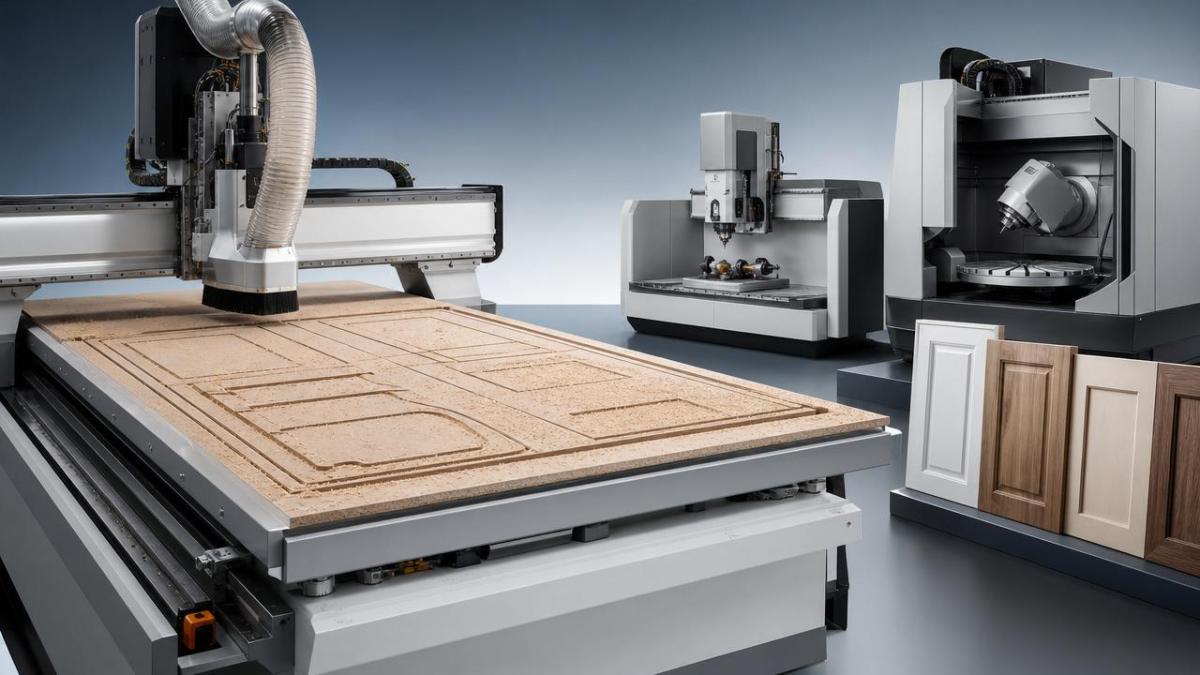
Whole-house customization has changed the role of woodworking CNC routers inside panel furniture production.
Factories now process mixed cabinet doors, side panels, shelves, backs, curved parts, and hardware-ready components in shorter cycles.
This shift rewards machines that reduce manual interpretation between design, nesting, drilling, labeling, edge banding, and assembly.
Traditional capacity metrics still matter, but they no longer explain total performance.
The stronger trend is digital continuity from CAD order data to finished cabinet part geometry.
In this environment, woodworking CNC routers must protect dimensional consistency while supporting fast changeovers and material-saving strategies.
Why 3-Axis Machines Still Remain Relevant
A 3-axis router remains a practical base for straight cutting, profiling, pocketing, and simple drilling.
For regular rectangular cabinet parts, it can deliver stable results with controlled investment and simpler maintenance.
The trend does not eliminate 3-axis woodworking CNC routers; it clarifies where they perform best.
- Best for repeated panels with limited angled machining.
- Suitable for standard carcass parts and simple decorative profiles.
- Easier to operate when programming depth is limited.
- Lower mechanical complexity supports easier troubleshooting.
However, 3-axis woodworking CNC routers may need extra drilling stations, manual flipping, or secondary processing for complex cabinet hardware.
That hidden handling can reduce the initial cost advantage when production variety increases.
Nesting Routers Are Becoming The Workhorse For Panel Yield
Nesting machines represent a major direction for cabinet part production because they combine cutting efficiency with material optimization.
Instead of processing one component at a time, nesting software arranges many parts across full sheets.
This makes nesting woodworking CNC routers highly relevant for customized cabinet orders with many panel sizes.
Vacuum table stability, labeling, automatic loading, and automatic unloading increasingly define their real productivity.
The cutting path is only one part of the value equation.
A strong nesting workflow also improves tracking from sheet inventory to edge banding sequence.
Key Drivers Behind Nesting Adoption
Nesting woodworking CNC routers are especially valuable when cabinet production depends on design-to-machine automation.
They reduce interpretation gaps that often cause wrong holes, wrong labels, or wrong edge banding instructions.
5-Axis Capability Signals A Move Toward Complex Geometry
5-axis machining is not automatically better for every cabinet part.
Its value appears when surfaces, bevels, sculpted doors, curved fronts, or compound-angle joinery become common.
For advanced cabinet designs, 5-axis woodworking CNC routers can reduce fixtures and secondary setups.
The tool can approach from multiple orientations, which supports undercuts, angled drilling, and complex edge shaping.
Yet the trend requires caution because programming, collision control, tooling, and operator competence become more demanding.
In many panel furniture lines, 5-axis equipment works best as a specialized cell, not the only cutting platform.
- Use 5-axis for shaped doors, premium fronts, and complex visible components.
- Use nesting for most rectangular cabinet carcass parts.
- Use 3-axis machines where geometry and volume are predictable.
This mixed-machine strategy often produces better economics than forcing one machine to handle every part type.
The Main Decision Has Shifted From Axis Count To Process Fit
The most important choice is not simply 3-axis, nesting, or 5-axis.
The stronger question is how woodworking CNC routers support the entire cabinet production chain.
Part accuracy affects edge banding gaps, drilling alignment, connector fit, door reveal consistency, and final installation quality.
A machine with impressive motion specifications can still fail if software flow and handling logic are weak.
Process Questions That Expose The Right Architecture
- Are most cabinet parts rectangular, shaped, or mixed?
- How many drilling faces are required per part?
- Does order data flow directly from CAD to CAM?
- Is labeling synchronized with nesting and edge banding?
- Can vacuum holding support small parts safely?
- Will automation reduce labor dependency or create bottlenecks?
These questions reveal whether woodworking CNC routers will improve throughput or simply add another isolated machine.
Impact On Downstream Assembly Is Becoming More Visible
Cabinet manufacturing errors often appear downstream, not at the cutting table.
A slight hole deviation may become loose connectors, misaligned shelves, or visible panel gaps.
This is why woodworking CNC routers must be evaluated through assembly outcomes.
Nesting routers can improve part grouping and identification, reducing sorting errors before edge banding.
3-axis routers can keep stable dimensions on repeated programs, supporting reliable carcass assembly.
5-axis routers can produce premium shapes that would otherwise require manual craftsmanship and more variable finishing.
The best result comes when machine data, barcode systems, and assembly instructions share the same digital source.
What To Watch Before Committing Capital
The market trend favors automation, but automation only pays back when bottlenecks are mapped accurately.
Before selecting woodworking CNC routers, compare cycle time against loading, unloading, labeling, tool changing, and scrap removal.
- Check real part mix, not sample demonstrations only.
- Confirm drilling requirements across cabinet sides, shelves, and doors.
- Evaluate nesting yield using actual board sizes and materials.
- Review dust extraction, chip evacuation, and tool heat management.
- Test barcode links to edge banders and assembly stations.
- Verify service access, spare parts, and controller openness.
Tooling strategy also deserves attention because cutters define edge quality, feed stability, and panel surface protection.
For particleboard, MDF, plywood, and laminated panels, tool geometry should match coating hardness and chip evacuation needs.
A Practical Selection Matrix For Cabinet Part Production
This matrix should be tested with actual cabinet orders, not generic machine catalog assumptions.
The strongest decision uses production data, material cost, reject rates, and assembly feedback together.
Where The Trend Points Next
The next stage for woodworking CNC routers is deeper integration with MES, optimization engines, and automated material handling.
Machines will increasingly receive work orders, tool paths, labels, and quality checkpoints from unified digital platforms.
This trend will reward open controllers, reliable data exchange, and predictable mechanical repeatability.
It will also expose weak links in dust control, tool life management, and panel handling discipline.
PWFS observes this shift as part of a wider movement toward flexible paper and wood manufacturing intelligence.
The same logic connects packaging lines, printing presses, edge banders, and cabinet machining cells.
Precision no longer lives inside one machine; it depends on connected processes and verified data.
Action Steps For A Better CNC Decision
Start by classifying cabinet parts by geometry, drilling complexity, annual volume, and material type.
Then run actual order files through candidate woodworking CNC routers and compare total flow time.
- Measure sheet yield, not only cutting speed.
- Record edge quality before edge banding.
- Check hole accuracy after repeated cycles.
- Validate label readability after dust exposure.
- Estimate labor changes across the complete line.
If most parts are rectangular and mixed, nesting woodworking CNC routers usually deserve first evaluation.
If premium curves and angled features dominate, 5-axis capability may justify its complexity.
If stable, repeated panels dominate, a disciplined 3-axis cell can remain highly competitive.
The winning choice is the machine architecture that turns design data into accurate, traceable, assembly-ready cabinet parts.
For deeper equipment intelligence, follow PWFS insights on woodworking CNC routers, edge banding, and flexible factory integration.
Related News
Get weekly intelligence in your inbox.
No noise. No sponsored content. Pure intelligence.
