
How Corrugated Box Manufacturing Works: Key Steps, Machines, and Quality Checks
Corrugated box manufacturing sits at the center of modern distribution, where speed, protection, print quality, and cost control must work together. A shipping box may look simple, yet it comes from a tightly linked process that turns paper reels into engineered packaging through heat, pressure, converting, and inspection. For anyone comparing production methods or equipment, the real value lies in seeing how each stage affects strength, appearance, uptime, and waste.
Why corrugated box production matters now
The rise of e-commerce changed the role of the box. It is no longer only a transport container. It is also a protection system, a branding surface, and a cost variable repeated millions of times.
That is why corrugated box manufacturing attracts attention across the broader print and converting landscape. Board lines, flexo units, die-cutters, folder-gluers, and digital control systems now influence logistics reliability as much as warehouse planning does.
At the same time, sustainability rules, FSC traceability, food-contact concerns, and pressure for lower waste are changing evaluation standards. Output volume still matters, but consistency matters more.
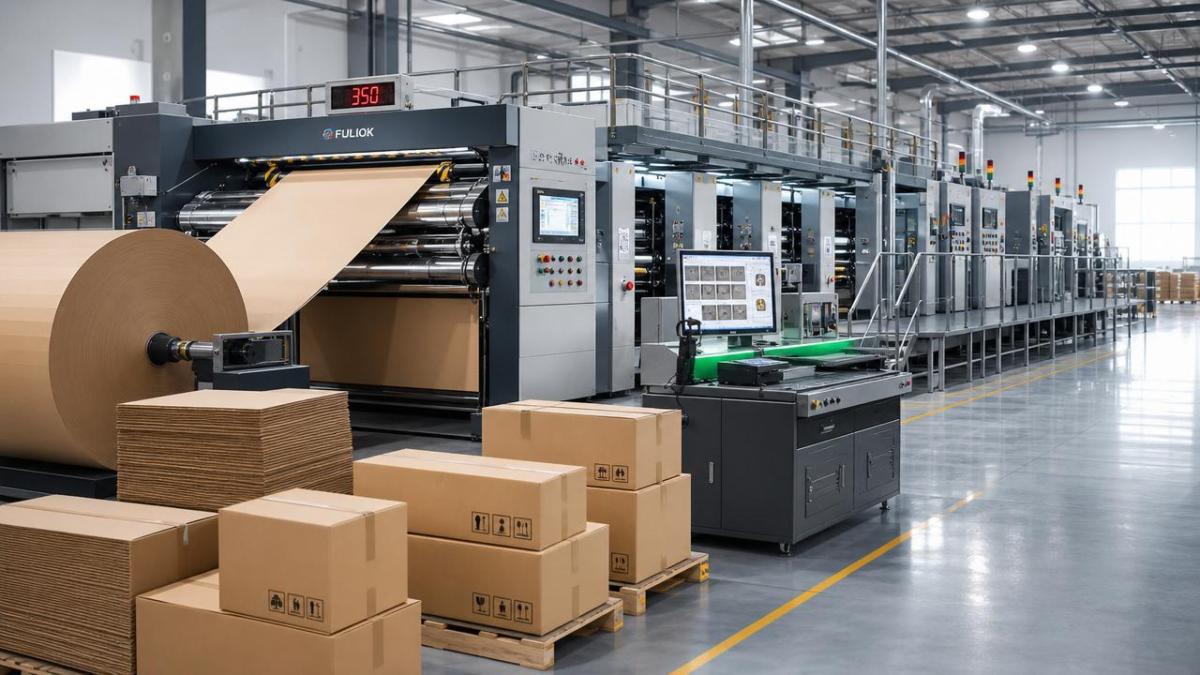
This is where a platform such as PWFS becomes useful. Its focus on corrugated lines, printing precision, die-cutting kinematics, and factory automation reflects how box plants are increasingly judged as connected production systems, not isolated machines.
What corrugated box manufacturing really includes
In practical terms, corrugated box manufacturing covers two linked operations. First comes corrugated board production. Then comes box converting, where board is printed, cut, creased, folded, and glued into a finished pack.
The board itself combines liner papers with a fluted medium. The flute profile creates stiffness, compression resistance, and cushioning while keeping weight relatively low.
Different formats serve different uses. Single-wall board is common in standard transit packaging. Double-wall or triple-wall structures appear when stacking loads, export handling, or rough distribution conditions demand more protection.
Because of this, the process cannot be judged only by speed. The real question is whether the line can produce the required board structure and box geometry without unstable bonding, warp, weak creases, or print defects.
From paper roll to corrugated board
The first major stage begins with reel handling and paper conditioning. Moisture balance matters early, because paper that is too dry or too damp will behave poorly under heat and tension.
In the corrugator, the medium passes through heated corrugating rolls that form the flute. Starch adhesive is applied, and a liner is bonded to create single-face board.
That structure then receives the outer liner at the double-backer. Heat, pressure, adhesive application, and line speed must remain balanced. If one variable drifts, bond strength and flatness can quickly suffer.
After bonding, the board moves through drying, slitting, scoring, and cut-off sections. By this point, the board already carries many of the quality signals that will later affect printing and converting.
Key machines in the board line
- Reel stands and splicers keep paper feeding stable during long production runs.
- Preheaters help control paper temperature and moisture response.
- Single facers create flute shape and establish the first adhesive bond.
- Double-backers complete board assembly under controlled heat and pressure.
- Slitter-scorers and cut-off units define the board format for downstream conversion.
How the board becomes a finished box
Once the sheet or web is ready, corrugated box manufacturing shifts into converting. This is where packaging requirements become visible: graphics, dimensions, opening features, stacking performance, and final pack shape.
For transport cases, flexographic printing is still common because it matches corrugated substrates and high-throughput lines well. Where stronger visual impact is required, pre-print or laminated litho solutions may enter the process.
Die-cutting or slotting defines flaps, handles, vents, and complex outer profiles. Creasing must be accurate, because poor score quality creates cracking, leaning boxes, and folding instability later on.
Folder-gluers or box makers then complete the structure with adhesive application and folding. In high-volume plants, this stage often decides real throughput because even strong board can fail if glue joints are inconsistent.
Where printing and converting accuracy meet
PWFS often frames advanced equipment as a chain of precision rather than separate departments. That view fits corrugated box manufacturing well.
If color registration shifts, brand graphics suffer. If die-cutting pressure is uneven, geometry changes. If folding alignment drifts, downstream case erection becomes slower. Small mechanical errors rarely stay small for long.
The quality checks that actually matter
Quality control in corrugated box manufacturing is most effective when it starts in-process, not only at the end. Final inspection can catch defects, but it cannot recover lost board stability or wasted paper.
Common checks cover both material performance and converting accuracy. The exact mix depends on end use, shipping risk, print needs, and regulatory exposure.
Where food packaging or export compliance is involved, traceability also matters. Paper sourcing, ink selection, adhesive suitability, and batch-level process records can become as important as physical test values.
Common production risks behind weak box performance
Many packaging failures are rooted upstream. A box may collapse in transit, but the cause may be poor flute formation, unstable starch solids, or moisture imbalance introduced much earlier.
Several warning signs deserve close attention:
- Frequent warp suggests uneven temperature control or paper mismatch.
- Crushed flute tips often point to pressure issues or rough handling.
- Dirty slotting and inaccurate creases reduce folding quality.
- Glue line variation can weaken joint integrity at the final stage.
- Repeat print deviation may signal machine wear or unstable feeding.
In practical evaluation, the strongest plants are not only fast. They are predictable. They hold registration, maintain board flatness, and keep defect rates low across long runs and quick changeovers.
How to assess a line beyond nameplate speed
When reviewing corrugated box manufacturing capabilities, it helps to separate headline speed from usable productivity. A high-speed line that generates too much waste may deliver lower real output than a slightly slower but more stable system.
A balanced assessment usually includes mechanical design, automation depth, maintenance access, recipe control, operator dependency, and data visibility through MES or related systems.
This is also where PWFS’s broader coverage becomes relevant. Board lines, printing platforms, die-cutters, and folder-gluers should be reviewed as one production chain, especially when a plant aims for high yield and flexible order mixes.
Useful questions during comparison
- How stable is board quality at maximum commercial speed?
- How much waste appears during order changes?
- Can the line handle both plain transit boxes and print-sensitive work?
- How are traceability, inspection data, and maintenance records managed?
- Which defects are monitored automatically, and which still rely on manual checks?
Where the next decisions usually lead
A clear view of corrugated box manufacturing makes later decisions easier. It becomes possible to connect board grade choice with logistics performance, printing method with branding needs, and machine configuration with order structure.
The most useful next step is usually not a broad market scan. It is a narrower review of board specifications, converting complexity, quality checkpoints, and automation priorities against actual packaging scenarios.
That approach creates a more reliable basis for comparing corrugators, printing systems, die-cutting platforms, and folder-gluing lines. In a market defined by volume, variation, and cost pressure, good judgment starts with understanding how the box is really made.
Related News
Get weekly intelligence in your inbox.
No noise. No sponsored content. Pure intelligence.
