
Zero-Waste Emissions in Packaging Plants: What Counts and How to Assess Feasibility
Zero-waste emissions in packaging plants has moved far beyond a sustainability slogan. In corrugated, offset printing, die-cutting, and folder-gluing operations, it now serves as a practical measure of process discipline, utility efficiency, recovery capability, and compliance resilience.
The difficulty is not only reducing visible scrap. It is deciding what should be counted as waste, what can be recirculated, and where zero-waste emissions is realistic, partial, or commercially unjustified.
That distinction matters in a market shaped by e-commerce packaging demand, tighter material controls, food-contact scrutiny, and rising pressure for digitalized manufacturing. Plants that assess feasibility clearly tend to make better capital choices than those that chase slogans.
What zero-waste emissions really means on a plant floor
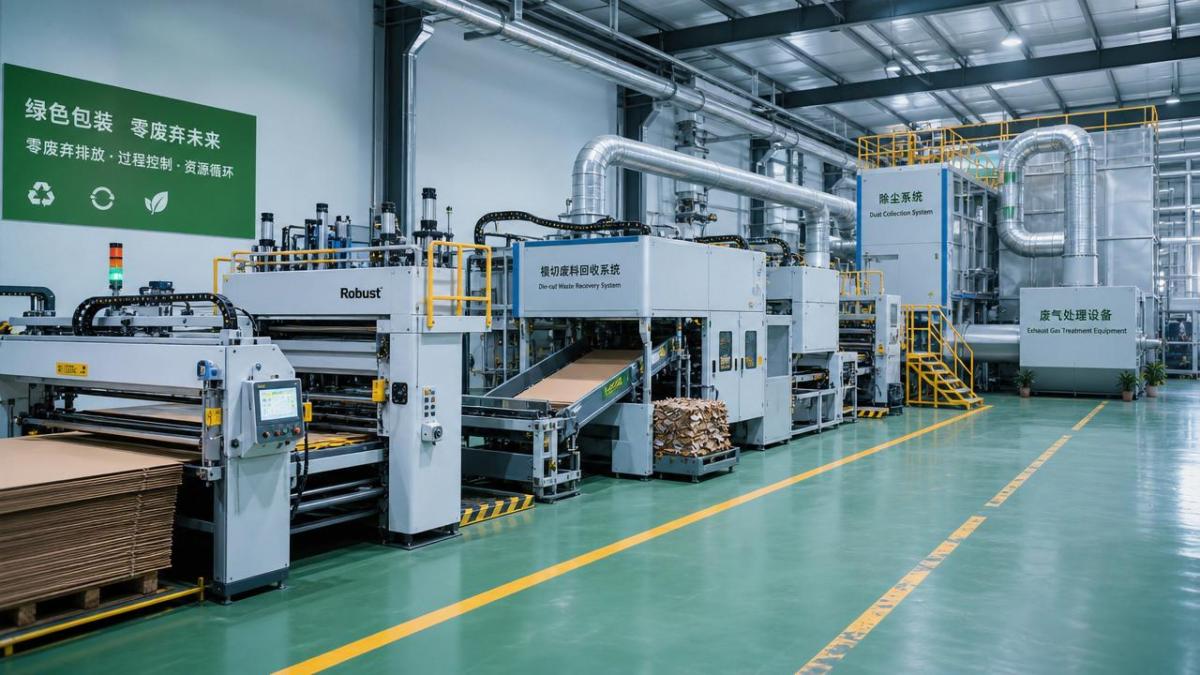
In packaging manufacturing, zero-waste emissions rarely means a literal absence of every output. It usually means that avoidable waste is designed out, unavoidable residues are captured, and disposal is pushed close to zero.
A serious definition should include three layers. The first is solid waste, such as board trim, die-cut skeletons, rejected printed sheets, adhesive containers, and maintenance consumables.
The second is liquid and airborne discharge. This includes wash water, coating residues, solvent-bearing emissions, dust, steam losses, and glue-related fumes.
The third is hidden waste. That includes energy loss, overproduction, excessive setup waste, unstable color registration, poor nesting, and avoidable rework.
For plants working with high-speed corrugators or precision offset presses, hidden waste often matters more than landfill tonnage. A stable process can eliminate more emissions than a recycling contract alone.
Why the issue is gaining urgency
Zero-waste emissions has become a boardroom issue because cost, regulation, and customer requirements are now interacting. Material prices remain volatile, while environmental claims face stricter verification.
For packaging converters, the pressure is especially visible in four areas:
- Recycled fiber and virgin board both demand tighter yield management.
- Food-grade, cosmetic, and pharmaceutical packaging requires cleaner chemistry control.
- Retail and export buyers increasingly ask for traceable waste and carbon data.
- Automation investments must prove both productivity and environmental return.
This is where PWFS brings useful context. Across corrugated lines, high-precision presses, folder-gluers, die-cutters, and CNC systems, the same pattern appears: waste reduction succeeds when equipment physics, data visibility, and workflow logic are aligned.
In other words, zero-waste emissions is not a single technology purchase. It is an operating architecture.
What should be counted before feasibility is judged
Many assessments fail because counting starts too late or too narrowly. Plants may track scrap bales, yet ignore startup sheets, adhesive purge, wash-up loss, or compressed air leakage.
A more useful accounting view is shown below.
Once those streams are visible, zero-waste emissions becomes easier to discuss without vague claims. It also prevents one common mistake: shifting waste from disposal to storage, without solving the source.
Feasibility depends on process design, not ambition alone
Not every plant can achieve the same endpoint. A high-volume corrugated box site has different limits from a short-run folding carton plant with frequent artwork changes.
That is why feasibility should be tested through operating conditions, not slogans.
Stable, repetitive production usually has the clearest path
Plants with long runs, standardized grades, and repeatable tooling can cut setup waste aggressively. Corrugated board lines are a good example, especially when moisture control, splice quality, and starch application are tightly managed.
High-mix production needs digital control first
Offset and converting operations with many SKUs often lose material during color adjustment, die change, and order sequencing. Here, zero-waste emissions depends on prepress accuracy, job batching, automatic wash systems, and MES visibility.
Chemistry-heavy steps need compliance-aware evaluation
Adhesives, coatings, inks, and cleaning agents cannot be judged only by recyclability. Food-contact rules, migration limits, worker exposure, and local discharge permits affect what “zero” can honestly mean.
In practice, a feasible roadmap often combines source reduction, internal reuse, external recovery, and only then final treatment.
Where the strongest business value usually appears
The value of zero-waste emissions is rarely limited to environmental reporting. It often shows up earlier in yield, uptime, and claim prevention.
- Better board utilization lowers exposure to raw material inflation.
- Cleaner process control reduces rejects from color drift and bonding defects.
- Lower chemical loss helps with audit readiness and safer plant operations.
- Energy recovery improves total equipment economics, not only sustainability metrics.
- Traceable waste data strengthens customer communication and tender credibility.
For PWFS-focused sectors, this is especially relevant. Whether the asset is a micron-sensitive offset press or a high-speed folder-gluer, ultra-high yield rates and zero-waste emissions usually reinforce each other.
The same logic is visible in woodworking equipment. Better nesting, edge treatment control, and dust capture do not only improve environmental performance. They also protect finish quality and delivery reliability.
A practical way to assess zero-waste emissions readiness
Assessment works best when it moves from physical flows to financial impact.
1. Map every loss stream
Track solids, liquids, air emissions, and energy loss by machine family, shift, product type, and order stage. Startup and changeover losses should be separated from steady-state performance.
2. Distinguish avoidable from structural waste
Some waste comes from poor settings or unstable maintenance. Some comes from substrate limitations, customer design choices, or legal chemistry requirements. Those categories should never be mixed.
3. Test technical recovery routes
Ask whether each stream can be reduced, reused internally, recycled externally, or replaced by a cleaner input. The answer may differ by country, buyer specification, and contamination level.
4. Compare economics at line level
A recovery system that looks attractive centrally may underperform on a low-volume line. Focus on payback, downtime effect, labor demand, and quality risk, not disposal cost alone.
5. Set a threshold for credible claims
If a plant says it supports zero-waste emissions, it should define boundaries clearly. Site scope, outsourced treatment, recycled content, and hazardous residues all need transparent treatment.
Signals that a plant is ready to move faster
Some conditions make implementation easier and safer.
- Job data already links prepress, press, converting, and warehouse records.
- Waste is measured by source, not estimated monthly.
- Maintenance discipline supports stable registration, pressure, temperature, and glue performance.
- Suppliers can document chemistry, recyclability, and handling conditions.
- Commercial teams can align customer promises with operational reality.
Where these signals are weak, the next step is not a grand declaration. It is usually better measurement, cleaner data, and targeted pilot work on one major waste stream.
From concept to next decision
Zero-waste emissions becomes useful when it is treated as an operational design question. The strongest results usually come from linking equipment behavior, material science, compliance logic, and digital production control.
For packaging plants, a sensible next move is to define counting boundaries, rank waste streams by value and risk, and test feasibility on one line before scaling across the site.
That approach creates a more reliable basis for capital planning, supplier selection, and environmental claims. It also turns zero-waste emissions from a broad ambition into a measurable manufacturing capability.
Related News
Get weekly intelligence in your inbox.
No noise. No sponsored content. Pure intelligence.
